The transition from automated trajectory execution to manual pilot intervention during the Artemis II mission represents a critical redundancy protocol, not a shift in primary operational philosophy. While the Orion spacecraft is designed for high-level autonomy, the "manual piloting" phase—specifically the Proximity Operations Demonstration (POD)—functions as a validation of the human-in-the-loop interface required for high-stakes maneuvers such as lunar orbit rendezvous and emergency docking scenarios. The success of the Artemis program hinges on the crew’s ability to override flight software during non-nominal events, effectively serving as the final layer of the spacecraft's fault-tolerance architecture.
The Dual-Loop Control Architecture
Orion’s flight control system operates via a nested hierarchy where manual inputs are filtered through the Guidance, Navigation, and Control (GN&C) software. Unlike historical Apollo-era manual controls which often utilized direct mechanical or simple electronic linkages, Orion utilizes a digital Fly-By-Wire (FBW) system. This creates a specific operational bifurcation:
- Translational Control: Managed via the Translational Hand Controller (THC). The pilot commands changes in the spacecraft’s velocity vector ($\Delta v$) across the X, Y, and Z axes.
- Rotational Control: Managed via the Rotational Hand Controller (RHC). The pilot commands changes in attitude—pitch, yaw, and roll—to orient the spacecraft’s thermal protection system or communication arrays.
The manual piloting observed in NASA’s mission telemetry is a validation of the Optical Navigation (OpNav) and the display-to-control latency. If the latency between a pilot’s physical input and the firing of the Service Module’s reaction control system (RCS) thrusters exceeds specific millisecond thresholds, the pilot enters a "Pilot-Induced Oscillation" (PIO) state, where the human overcorrects for the lag, potentially exhausting propellant margins.
The High Earth Orbit (HEO) Demonstration Framework
The Artemis II flight path utilizes an Intermediate High Earth Orbit (IHEO) to verify these manual systems before committing to a Trans-Lunar Injection (TLI). This stage serves as a "stress test" for the life support and control systems while the crew remains within a 24-hour return trajectory.
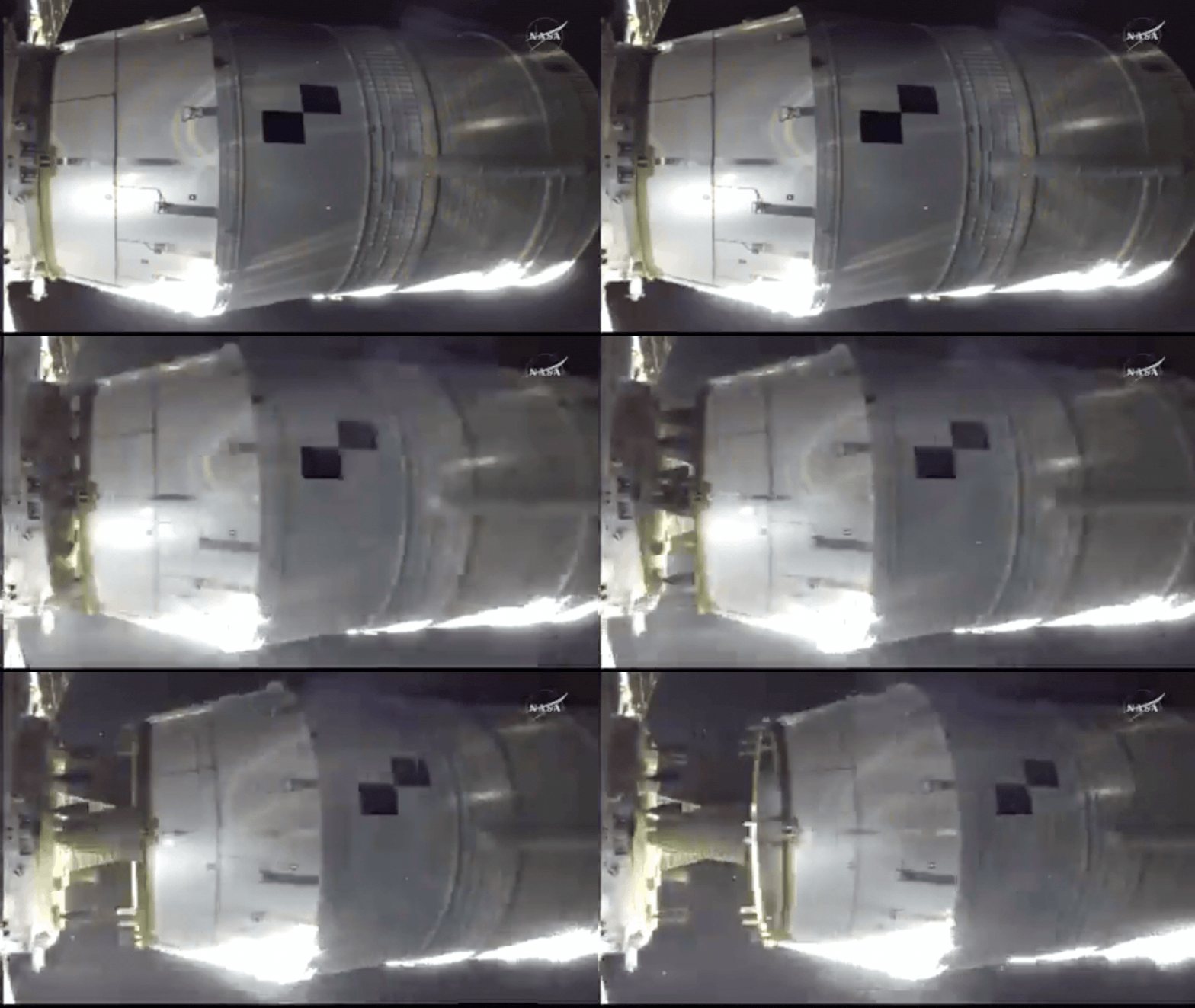
The manual piloting demonstration specifically targets the period after the Orion separates from the Interim Cryogenic Propulsion Stage (ICPS). The crew uses the ICPS as a relative target. The objective is not to dock—Artemis II lacks a docking port—but to maintain a precise relative distance and orientation. This exercise quantifies three specific performance variables:
- Relative Navigation Accuracy: The ability of the crew to estimate distance and rate of closure using only visual cues and the spacecraft’s onboard LIDAR/optical sensors.
- Propellant Efficiency: Comparing the amount of hypergolic fuel consumed during manual station-keeping versus the theoretical minimum calculated by the flight computer.
- Human-Machine Interface (HMI) Intuition: Assessing the ergonomics of the glass cockpit displays under the high-G loads and vibration environments characteristic of early mission phases.
The Physics of Orbital Proximity Operations
Manual piloting in space is counterintuitive due to the constraints of orbital mechanics. In a terrestrial environment, pointing a vehicle at a target and accelerating moves the vehicle toward that target. In orbit, specifically during the Artemis II proximity demo, an increase in velocity ($+ \Delta v$) raises the spacecraft’s orbital altitude, which actually slows its angular velocity.
This leads to a paradoxical result: accelerating toward a target in a similar orbit can cause the pilot to move higher and fall behind the target. Pilots must master "V-bar" and "R-bar" approaches:
- V-bar (Velocity vector): Approaching along the line of the orbit.
- R-bar (Radial vector): Approaching from toward or away from the Earth/Moon center.
The manual intervention capabilities of the Artemis II crew—Reid Wiseman, Victor Glover, Christina Koch, and Jeremy Hansen—are focused on managing these relative motions without the "crutch" of ground-based Deep Space Network (DSN) updates. This autonomy is vital because communication latency at lunar distances (approximately 1.3 seconds each way) renders ground-controlled manual piloting impossible.
Redundancy as a Mission Constraint
The necessity for manual control is driven by the Probabilistic Risk Assessment (PRA) of the Orion flight software. While the software is rated for extremely high reliability, the "Loss of Crew" (LOC) and "Loss of Mission" (LOM) metrics are significantly improved when a human pilot can intervene during sensor failures.
Consider a scenario where the Star Trackers—optical sensors that determine the spacecraft's orientation by mapping star patterns—are blinded by the Sun or debris. In an automated-only system, the spacecraft might lose its attitude reference, leading to "tumbling" and loss of communication. A manual pilot can use a periscope or window-based COAS (Crew Optical Alignment Sight) to fix the spacecraft’s orientation relative to the Earth or Moon, regaining control where a computer would fail.
The Cost of Manual Overrides
While manual control increases safety, it introduces a "tax" on mission resources. Human inputs are inherently "noisier" than algorithmic control. Each manual adjustment triggers the Reaction Control System (RCS) thrusters, which utilize a finite supply of Monomethylhydrazine (MMH) and Nitrogen Tetroxide (NTO).
The Artemis II mission profile includes a rigorous "Propellant Book" which dictates exactly how much mass is allocated for the manual demonstration. If the crew exceeds this allocation during the proximity operations, it directly reduces the safety margin for the subsequent lunar flyby. This creates a high-pressure environment where the pilot must balance the precision of the maneuver against the conservation of delta-v.
Mechanical and Digital Integration Points
The Orion cockpit utilizes three main display units and a series of physical switches for critical "abort" functions. The manual piloting interface is primarily digital. The "Electronic Display System" provides the pilot with a "synthetic vision" of the target.
The logic of the manual control law in Orion is "Pulse" vs "Proportional":
- Pulse Mode: A single tap on the controller fires a thruster for a pre-set millisecond burst, providing a discrete change in velocity.
- Proportional Mode: The thrust duration is tied to the displacement of the joystick, allowing for smoother, continuous maneuvers.
During the Artemis II video sequence, the crew is testing the transition between these modes. This is the first time humans have operated these specific control laws in a deep-space vehicle. The data gathered here will refine the flight software for Artemis III, which will require manual intervention for the complex task of docking with the Starship Human Landing System (HLS) in Near-Rectilinear Halo Orbit (NRHO).
Managing the Deep Space Environment
Manual piloting in the Artemis II mission is further complicated by the lighting conditions in cislunar space. Unlike the Low Earth Orbit (LEO) of the International Space Station, where the Earth provides a massive visual reference and frequent day/night cycles, deep space offers harsh, high-contrast lighting.
The "Albedo" effect from the Moon or Earth can wash out the displays or the pilot's natural vision. The Artemis II pilots must use the "manual" phase to calibrate their own visual perception against the spacecraft's sensor data. This calibration is essential for the "Lunar shadow" portions of the mission, where the crew must operate in total darkness, relying on the high-dynamic-range cameras and the manual hand controllers to maintain attitude.
Strategic Operational Imperatives
The manual piloting of Orion is not a ceremonial nod to the past; it is a tactical requirement for the expansion of the Lunar Gateway. The mission architecture assumes that automated systems will eventually handle 95% of all maneuvers, but the remaining 5%—the edge cases—require a pilot with the cognitive flexibility to solve problems that are not pre-programmed into the GN&C.
The demonstration of manual flight on Artemis II establishes the baseline for "Pilot Proficiency Requirements" for all subsequent cislunar missions. It moves the program from the theoretical "automated bus" model to a "commanded vessel" model.
The critical path forward requires the integration of HMI data from Artemis II into the training simulators at Johnson Space Center. By mapping the exact thrust-to-response curves experienced by the crew in HEO, NASA can tighten the fuel-reserve requirements for Artemis III. The ultimate strategic goal is the reduction of the "Human Error Margin." By quantifying exactly how a human pilot interacts with Orion's unique mass distribution and thruster placement, mission planners can reduce the "padding" in the propellant budget, allowing for more scientific payload to be carried to the lunar surface.
Future mission success depends on this transition from "can we fly it manually?" to "how efficiently can we fly it manually?" The Artemis II mission provides the first empirical dataset to answer that question in the deep space environment.