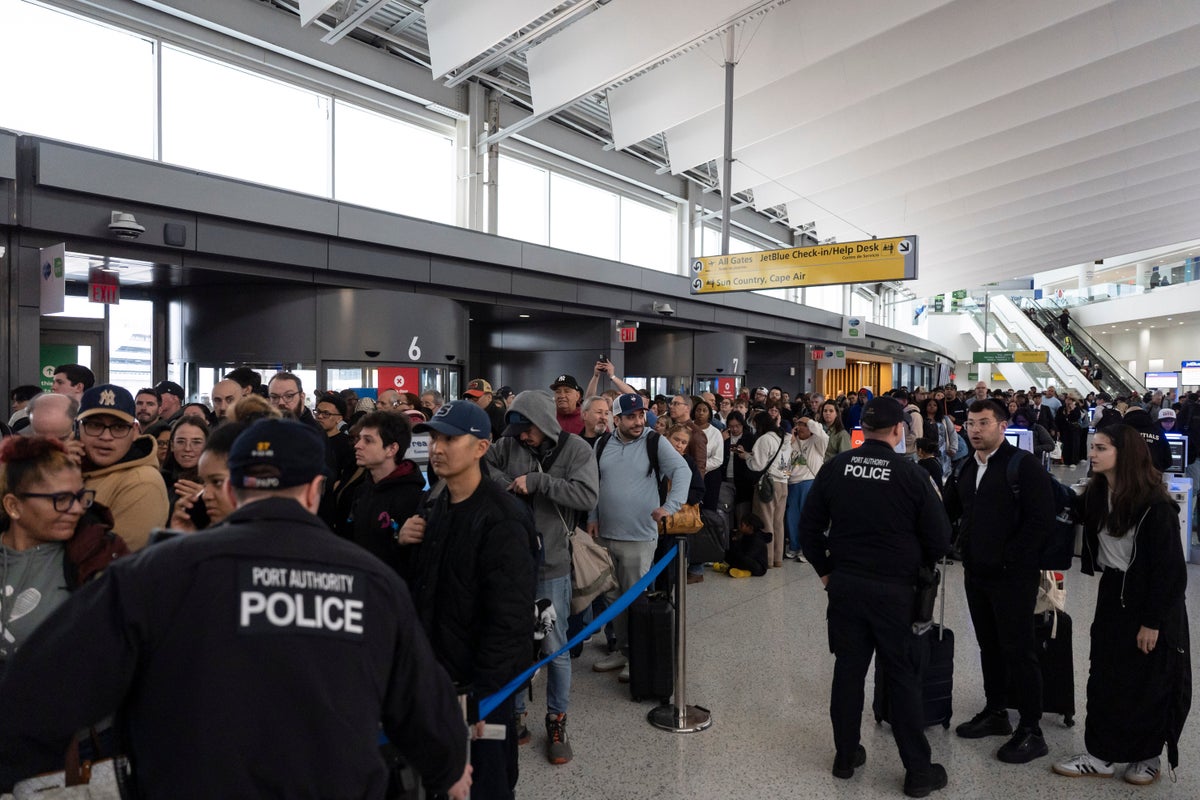
The morning light had barely touched the tarmac at major international hubs this Monday when the presence of Immigration and Customs Enforcement (ICE) officers became the defining feature of the terminal. While the public expected a gradual ramp-up following recent executive threats, the reality on the ground was a coordinated, high-visibility surge that bypassed traditional processing centers and moved straight to the gates. This was not a routine enforcement action. It was a calculated demonstration of federal reach designed to alter the operational flow of American aviation and test the legal limits of local jurisdiction.
For those traveling through Tier 1 airports, the shift was immediate. Uniformed agents, supported by tactical units and mobile processing vans, established perimeters near baggage claims and international arrivals. This deployment serves as the first concrete realization of the White House’s promise to utilize federal personnel in ways that move beyond standard border security. By placing agents directly in the path of domestic and international commerce, the administration has turned the airport into a theater of high-stakes immigration enforcement.
The Architecture of a Coordinated Strike
Logistically, moving hundreds of federal agents into active aviation environments on a Monday morning requires months of planning, yet this move appeared to catch even seasoned airport authorities off guard. The friction between federal mandates and local airport police departments is the first crack in the system. While the Federal Aviation Administration (FAA) governs the air, the physical ground of the airport is often a patchwork of municipal and state ownership.
The surge utilized a specific legal mechanism known as "extended border" authority. Under this interpretation, the federal government argues that its power to search and detain extends well beyond the physical fence of the border and into any functional equivalent, such as an international airport. This is a massive expansion of scope. It turns every terminal into a legal gray zone where Fourth Amendment protections against unreasonable searches are significantly weakened.
Agents were not just checking IDs. They were seen monitoring specific flight manifests, utilizing real-time data streams to cross-reference passenger lists with active warrants and deportation orders. This is the integration of "big data" with "boots on the ground" at a scale we have not seen in previous administrations. The precision of the pickups suggests a deep-level coordination with airline carrier data, raising questions about the privacy agreements between private corporations and federal enforcement agencies.
Economic Ripple Effects and the Cost of Enforcement
Disruption is the hidden tax of this operation. When a major terminal is swarmed by federal agents, the primary casualty is the efficiency of the global supply chain. It isn't just about the person being detained. It is about the two-hour delay for the 300 other people on that aircraft, the missed connections, and the grounding of high-value cargo.
Airlines are caught in an impossible vice. On one side, they must comply with federal directives to avoid heavy fines or the loss of landing slots. On the other, their business model relies on a friction-free experience for the passenger. The presence of tactical gear and k-9 units in the "sterile" areas of an airport creates a climate of apprehension that directly impacts consumer behavior. History shows that when travel becomes a gauntlet, discretionary spending drops.
The Logistics of Mass Detention
The bottleneck for any mass enforcement action is never the arrest. It is the housing. Current detention facilities are already at or near capacity, meaning this Monday morning surge likely includes a secondary logistical chain involving private contractors and temporary holding sites.
- Private Transport: Leased buses and chartered flights are the backbone of this movement.
- Staging Areas: Hangers and repurposed warehouses near airport property are being utilized to bypass the transit time to permanent facilities.
- Medical Screening: The sudden influx of detainees requires a massive scale-up of contracted health services to manage liability.
The Legal Battle for the Terminal
What we are witnessing is a direct challenge to "Sanctuary" policies at the municipal level. Many airports are located in cities that have explicitly barred local police from cooperating with ICE. By deploying federal agents directly to these sites, the administration is effectively bypassing local law enforcement. This creates a dangerous vacuum of communication. When federal agents and local police do not share a radio frequency or an operational plan, the risk of "blue on blue" incidents—accidental confrontations between different law enforcement branches—skyrockets.
Legal challenges are already being filed in federal courts. Civil liberties groups argue that the use of ICE agents for domestic flight monitoring exceeds the statutory authority granted by Congress. They contend that an airport, while a port of entry, cannot be used as a dragnet for the general population. However, the courts have historically been deferential to executive power in matters of national security and border integrity. The definition of "border" is being stretched to its breaking point.
Operational Realities vs Political Messaging
There is a significant difference between a targeted enforcement action and a political stunt. Critics argue that the visibility of this Monday morning surge is the point. If the goal was simply to apprehend individuals with active warrants, it could be done quietly at their places of residence or work. By doing it at the airport, the administration is communicating a message of total visibility.
However, from an analyst's perspective, the "noise" of the operation serves a functional purpose. It creates a deterrent effect that can be more powerful than the actual number of arrests. If a specific demographic believes that every flight carries the risk of a federal encounter, the "voluntary" movement of people changes. This is psychological warfare applied to domestic policy.
The Technology Behind the Surge
The agents are equipped with mobile biometric devices that allow for instant fingerprint and facial recognition. These tools are linked to the IDENT database, providing a near-instant history of an individual's interactions with the U.S. government.
- Biometric Scanners: Handheld units that can process a subject in under thirty seconds.
- License Plate Readers: Positioned at airport entrances and exits to track the movement of vehicles associated with "subjects of interest."
- Manifest Scraping: Software that identifies patterns in travel history to predict where a target will be.
The Strain on the Federal Workforce
We must also consider the human cost on the enforcement side. To pull off a surge of this magnitude, agents are being reassigned from other vital duties. Investigations into human trafficking, narcotics smuggling, and intellectual property theft are being sidelined to provide the manpower for terminal deployments. This is a reallocation of resources that may have long-term consequences for national security.
Veteran agents have expressed concerns about "mission creep." When the agency becomes a tool for high-profile public displays, the specialized investigative work that takes months or years to build can fall by the wayside. The morale of the rank-and-file is often overlooked in these discussions, but a workforce stretched thin by constant "surges" is a workforce prone to errors.
The Global Perspective
International partners are watching this play out with growing concern. The U.S. airport system is a node in a global network. When the U.S. changes the rules of engagement within its terminals, it sets a precedent that other nations may follow. This could lead to a reciprocal hardening of borders globally, making international travel more difficult for everyone, regardless of legal status.
Foreign ministries have already begun issuing travel advisories, warning their citizens that they may encounter increased federal presence and questioning at U.S. ports. This has a direct impact on the "soft power" of the United States. An airport is often the first and last impression a visitor has of a country. If that impression is one of militarization and aggressive interrogation, the brand of the United States as a destination for tourism and investment suffers.
Jurisdictional Cold War
The coming weeks will likely see a series of "standoffs" between airport authorities and federal agents. We are looking at a scenario where city-owned airports may attempt to restrict the access of federal agents to non-public areas, such as employee breakrooms or specific gate areas, citing safety and operational concerns. ICE, conversely, will rely on federal supremacy clauses to override these restrictions.
This is not just a policy shift. It is a fundamental restructuring of how power is exercised at the borders of our society. The Monday morning surge is the opening salvo in a long-term campaign to redefine the American airport from a hub of transit to a fortress of enforcement.
Check the flight boards at any major hub today and you will see the delays. Look at the gates and you will see the green and black uniforms. The infrastructure of the country is being repurposed in real-time. Whether this results in a safer nation or a more fractured one is a question that will be answered not in the press releases of the White House, but in the courtrooms and terminals of the cities where this surge is currently unfolding.
Map out the nearest transit hubs in your jurisdiction and monitor the daily "Notice to Airmen" (NOTAM) filings for any unusual security-related ground stops.