The scent usually hits first. It isn't the smell of rain as most of the world knows it—that damp, earthy petrichor of moss and soaking wood. In Dubai, the arrival of a storm smells like wet dust and electrified expectations. It is the scent of a million grains of sand suddenly pinned to the pavement by cold, heavy droplets.
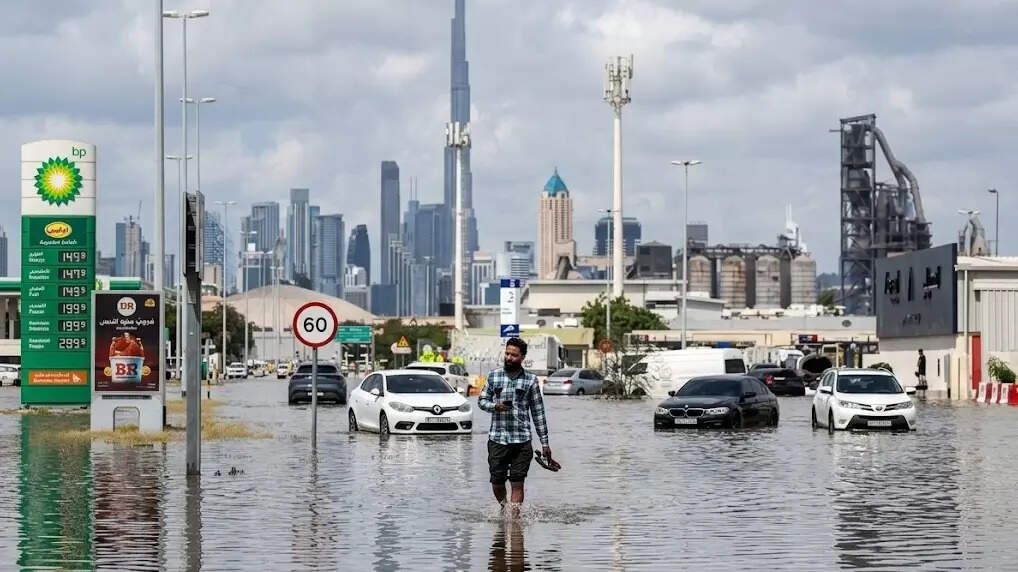
By 3:00 PM, the sky over the Sheikh Zayed Road had traded its permanent hazy cerulean for a bruised, metallic violet. The Burj Khalifa, usually a needle piercing the sun, was being swallowed from the top down by a ceiling of rolling grey vapor. For those sitting in the glass-walled offices of the Financial District, the transition was cinematic. For those on the asphalt below, it was the beginning of a frantic, slow-motion survival dance.
We often treat the weather in the United Arab Emirates as an afterthought, a static backdrop of heat that varies only in its intensity. But when the atmospheric pressure drops and the thunder begins to rattle the floor-to-ceiling windows of the Marina skyscrapers, the city's relationship with its environment changes instantly. It becomes fragile.
The Commute That Stood Still
Consider Sarah. She is a composite of a thousand commuters I watched from my balcony, but her reality is documented in every stalled engine and red-lit brake light across the city. She left her office in Business Bay at 3:30 PM, hoping to beat the worst of the "unsettled weather" warned about by the National Centre of Meteorology (NCM).
She didn't make it.
Ten minutes into her drive, the sky opened. This wasn't a gentle drizzle. This was a vertical ocean. In the UAE, rain often comes in violent, concentrated bursts known as "convective clouds." Because the ground is sun-baked and non-porous, the water has nowhere to go. It pools. It rises. It claims the low-lying slip roads and the underpasses.
Within thirty minutes, the arterial veins of the city—the E11, the E311, the E44—became parking lots of floating dreams. Sarah sat in her white SUV, the wipers thumping at maximum speed, watching the water rise toward her door handles. To her left, a delivery rider on a motorbike huddled under a bridge, shivering in a thin nylon jacket, his livelihood paused by a force he couldn't outrun.
This is the invisible stake of a Dubai storm: the total suspension of a city built on the premise of perpetual motion.
The Physics of a Desert Deluge
Why does a few inches of rain cause more chaos in Abu Dhabi than a foot of snow does in Oslo? The answer lies in infrastructure and psychology.
Most cities are built to breathe. They have sprawling drainage systems designed over centuries to funnel water away. In the Emirates, the rapid pace of urban development means that when a year’s worth of rain falls in six hours—as it frequently does during these "unstable weather patterns"—the pumps simply cannot keep pace. The desert doesn't absorb water; it rejects it.
Then there is the human element. Driving in the UAE is an exercise in high-speed precision. When you add slick, oil-coated roads and "white-out" visibility, the math turns deadly. The Dubai Police reported hundreds of accidents within a single afternoon during this most recent bout of thunder and lightning.
It isn't just the water. It’s the lack of experience. When you spend 350 days a year in the sun, you forget how to feel the road through a puddle. You forget that hydroplaning happens in a heartbeat. You forget that a car, no matter how expensive, is just a heavy metal box when the tires lose their grip on the earth.
The Quiet Heroes in Neon Vests
While the headlines focused on the "traffic chaos" and the dramatic lightning strikes hitting the tip of the Burj, a different story was unfolding in the residential backstreets of Al Quoz and Sharjah.
In these neighborhoods, the storm isn't a spectacle; it’s a battle. I walked out into the street during a lull in the downpour. The silence was eerie, punctuated only by the distant hum of industrial vacuum trucks—the "tankers"—that are the city’s literal lifelines. These drivers work eighteen-hour shifts during a weather alert. They are the ones who wade into waist-deep water to clear the drains, their neon vests the only bright spots in a world of grey sludge.
There is a strange, communal vulnerability that emerges when the desert floods. You see it in the way strangers help push a stalled sedan out of a rising pool, or how a cafe owner in Jumeirah opens his doors to stranded pedestrians, offering tea while the thunder shakes the mugs on the shelves.
The "Safety Warnings" issued by the Ministry of Interior aren't just bureaucratic noise. They are a recognition that our mastery over the environment is a polite fiction. When the authorities tell people to stay indoors, they are acknowledging that for all our architectural marvels, we are still guests in a landscape that occasionally decides to reclaim its space.
The Toll on the Invisible City
We talk about the traffic, but we rarely talk about the logistics. The school closures that send parents into a tailspin of remote-work juggling. The flight cancellations at DXB that strand thousands of travelers in a transit purgatory. The construction sites—the heartbeat of the UAE’s growth—that go silent, thousands of workers huddled in their camps as the wind howls through the scaffolding of half-finished dreams.
Lightning in the Emirates is particularly fierce. It doesn't just flicker; it cracks. It illuminates the entire horizon, turning the desert into a strobe-lit stage. For a few hours, the hierarchy of the city dissolves. The CEO in the penthouse and the laborer in the port are both staring at the same sky, feeling the same primal shudder when the thunder follows the flash.
The meteorologists call it a "surface depression." The residents call it "The Big Rain." But what it actually is, is a reminder.
By the time the sun set, the storm had moved toward the Northern Emirates, leaving behind a city that felt scrubbed clean but exhausted. The luxury malls were islands of light in a sea of flooded parking lots. The news reports began to tally the damage—the broken trees, the water-damaged storefronts, the thousands of insurance claims that would follow.
But there is a specific moment that happens after the clouds break. The air is suddenly cold—actually cold, not just "air-conditioned" cold. The sky turns a deep, royal velvet. The mountains in the distance, usually hidden by a veil of dust, stand out in sharp, jagged relief.
The desert has been watered.
As I watched the last of the tankers pull away from a cleared intersection, a single car moved tentatively through the receding water. Its headlights reflected off the wet asphalt, creating a long, shimmering ribbon of gold. The chaos was over, but the memory of the water remained—a reminder that under the glass and steel, there is an ancient earth that still knows how to roar.
The desert is never truly conquered; it is only negotiated with. And on days like today, the desert wins the negotiation.