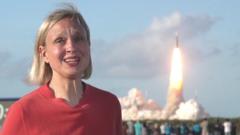
The visceral reaction of a seasoned science editor watching a rocket clear the pad is more than just good television. It is a rare moment of genuine human vulnerability in an industry defined by cold calculations and rigid engineering. When the engines ignite and the ground begins to shake, the technical jargon about telemetry and payload capacity evaporates. What remains is the raw, terrifying reality of controlled explosions pushing metal into the vacuum. This emotional resonance captures a public imagination that has been dormant for decades, yet it also masks the brutal industrial shift currently reshaping how we reach the stars.
The launch isn't just a success of physics. It is the culmination of a high-stakes gamble on reusable hardware and private capital that has fundamentally broken the old monopoly of national space agencies. For years, space flight was a slow, bureaucratic trudge. Now, it is a high-frequency commercial operation. The spectacle we see on screen is the marketing department’s dream, but the real story lies in the refurbishing bays and the balance sheets where the cost per kilogram to orbit is being hacked away with ruthless efficiency.
The Engineering Behind the Emotion
Watching a rocket launch remains a miracle of synchronization. To the casual observer, it is a pillar of fire. To the engineer, it is a nightmare of vibrating components and thermal stress. The reason experts lose their composure during these events is that they understand exactly how many thousands of things must go right simultaneously. A single valve sticking, a sensor misreading a pressure gradient, or a minor flaw in a weld can turn a billion-dollar asset into an expensive firework display in milliseconds.
The current era of space flight has introduced a new variable that increases this tension: reusability. In the past, every launch was a suicide mission for the hardware. You built a masterpiece, used it once, and dropped it into the ocean. Today, the goal is to bring the most expensive parts back to Earth, upright and ready to go again. This adds a second climax to the event. The launch is no longer the end of the show; the landing is the true test of the modern aerospace business model.
Why the Cost of Entry is Plummeting
For fifty years, the price of reaching orbit remained stagnant, tethered to the massive overhead of government-run programs. The shift toward private launch providers changed the incentive structure. Instead of cost-plus contracts that rewarded delays and overspending, the new guard operates on fixed-price models. Efficiency is now the primary driver of design.
- Mass Production: Rockets are starting to be built more like airplanes than hand-crafted prototypes.
- Rapid Iteration: Failure is handled differently. Instead of years of committee reviews after a setback, private firms often push hardware to the breaking point, analyze the wreckage, and fly again within months.
- Fuel Management: Moving toward methane-based fuels like methalox simplifies the plumbing and makes engine refurbishment faster than traditional kerosene-based systems.
This industrialization of the launch pad has dropped the price of putting a satellite into space from $20,000 per kilogram to under $3,000. Some projections suggest we are heading toward a world where that number hits triple digits. When the price drops that low, the types of businesses that can exist in orbit change completely. It is no longer just the domain of massive telecommunications giants and national spy agencies. Small startups and university researchers are now part of the manifest.
The Hidden Environmental Toll
We cannot ignore the soot in the stratosphere. While the public cheers for the "spectacular" ascent, the environmental impact of high-frequency launches is a growing concern that the industry is hesitant to discuss. Every time a rocket pierces the atmosphere, it leaves behind a trail of carbon, water vapor, and alumina particles. In the lower atmosphere, this is negligible compared to the aviation industry. However, in the upper layers, these particles can persist for years, potentially affecting the ozone layer and the planet's radiative balance.
As launch cadences move from once a month to multiple times a week, the cumulative effect becomes a legitimate scientific question. We are essentially conducting a massive, unplanned experiment on the chemistry of the upper atmosphere. The industry argues that the benefits of global connectivity and climate-monitoring satellites outweigh the local pollution of the launch, but as volume increases, that defense becomes harder to maintain without significant changes to propellant chemistry.
The Geopolitical Chessboard
Space is no longer a neutral ground for scientific discovery. It has become the ultimate high ground for terrestrial power struggles. The spectacular launches we witness are often carrying "dual-use" technology—hardware that serves a commercial purpose but can be instantly pivoted for military surveillance or signal jamming.
The rapid deployment of satellite constellations is creating a crowded environment where the risk of collision is rising. The Kessler Syndrome, a theoretical scenario where a single collision creates a debris cloud that triggers a chain reaction of destruction, is no longer a plot for science fiction. It is a live risk managed by tracking stations every hour of the day. When a journalist reacts with awe to a launch, they are seeing the beauty of the ascent, but they are also witnessing another piece being moved on a global chessboard where the rules are still being written.
The Problem of Space Situational Awareness
As the number of objects in Low Earth Orbit (LEO) grows, our ability to track them is struggling to keep pace.
- Old Data: Many tracking systems rely on radar technology that hasn't seen a significant upgrade in decades.
- Small Debris: Pieces of metal the size of a marble, moving at 17,000 miles per hour, can disable a spacecraft, yet they are nearly impossible to track consistently.
- Active Maneuvering: Satellites with their own propulsion systems can change orbits, making the "traffic map" of space a constantly shifting puzzle.
The Spectacle as a Distraction
There is a danger in the "spectacular." When we focus entirely on the awe-inspiring nature of the launch, we stop asking hard questions about the mission's utility or the company's ethics. The visual triumph of a rocket launch is a powerful tool for manufacturing consent for increased space spending and the deregulation of the orbital economy.
We are seeing a gold rush where the "miners" are tech billionaires and the "gold" is the control of global data streams. The excitement of the launch provides a layer of heroic narrative to what is, at its core, a ruthless expansion of corporate infrastructure. The science editor's gasp is real, but it is also the sound of a new era of industrialization taking flight, one that will eventually make these launches as common—and as ignored—as a cargo ship leaving a harbor.
The Technical Reality of Deep Space Ambitions
While LEO is becoming a busy highway, the "spectacular" launches intended for the Moon or Mars face a different set of physics. The energy requirements for deep space travel are orders of magnitude higher. You cannot just build a bigger rocket; you have to solve the problem of refueling in orbit. This is where the industry currently hits a wall.
Current designs for Mars-capable craft require multiple "tanker" launches just to fill the tanks of a single departing ship. This means the spectacle we see today is just the first act. The real test of our future in space won't be the single, dramatic launch of a massive rocket, but the boring, repetitive, and flawless execution of dozens of docking and refueling maneuvers in the dark.
The Human Cost of the New Space Race
Behind every successful countdown is a workforce pushed to the limit. The "move fast and break things" culture of Silicon Valley has hit the aerospace sector with a vengeance. We hear the cheers in mission control, but we don't often hear about the grueling shift work, the burnout, or the safety corners that might be trimmed to meet aggressive launch windows.
The history of flight is written in blood. Every safety regulation currently in place exists because someone, somewhere, died. As we accelerate the pace of launches to satisfy investors and achieve "spectacular" milestones, the pressure to bypass traditional safety checks grows. The veteran eye looks at a launch and sees the triumph, but also remembers the silence that follows when the fire goes out for the wrong reason.
Orbital Sovereignty and the Law
Who owns the sky? As private companies launch thousands of satellites, they are effectively colonizing the night sky. Astronomers are already complaining that their long-exposure images are being ruined by streaks of reflected sunlight from satellite trains. This isn't just an aesthetic issue; it's a loss of our collective heritage and a hindrance to actual deep-space science.
The current legal framework, largely based on the Outer Space Treaty of 1967, is woefully inadequate for a world of private lunar bases and commercial asteroid mining. We are launching hardware into a legal vacuum. The "spectacular" launch is the physical manifestation of a "might makes right" approach to orbital real estate. The first companies to get there and stay there will set the rules for everyone else, regardless of international consensus.
The Shift from Exploration to Extraction
We are moving away from the era of "we came in peace for all mankind" and into the era of "we came for the resources." The launches that elicit such strong emotional reactions are the delivery trucks for a new extractive economy. Whether it is Helium-3 from the lunar surface or precious metals from near-Earth objects, the motivation for the next decade of space flight is profit.
This isn't necessarily a bad thing—profit drives innovation in a way that pure science rarely does—but it requires a different kind of scrutiny. We should be looking past the flames and the smoke to see what exactly is being carried in those fairings. Is it a tool for the advancement of human knowledge, or is it another layer of digital control?
Essential Metrics for Evaluating Launch Success
- Refurbishment Time: How many days between flights for the same booster?
- Payload Integration Speed: How quickly can a customer go from contract to orbit?
- Anomaly Rate: Are "minor" issues being ignored in favor of launch frequency?
The visceral thrill of a rocket launch is a testament to human ingenuity, but the awe should be tempered with an understanding of the machinery—both mechanical and political—that puts that rocket in the air. We are no longer in the age of pioneers; we are in the age of infrastructure. The spectacle is the hook, but the reality is a high-speed, high-risk transformation of the space above our heads into a trillion-dollar marketplace.
The next time you see a veteran journalist lose their breath at the sight of a rising booster, remember that the fire they are seeing is the most expensive and complex energy transfer in human history. It is beautiful, yes, but it is also a signal that the barrier between Earth and the rest of the solar system is finally, permanently, coming down. The question is no longer if we can go, but who will own the destination once we arrive. Stop looking at the fire and start looking at the manifest.