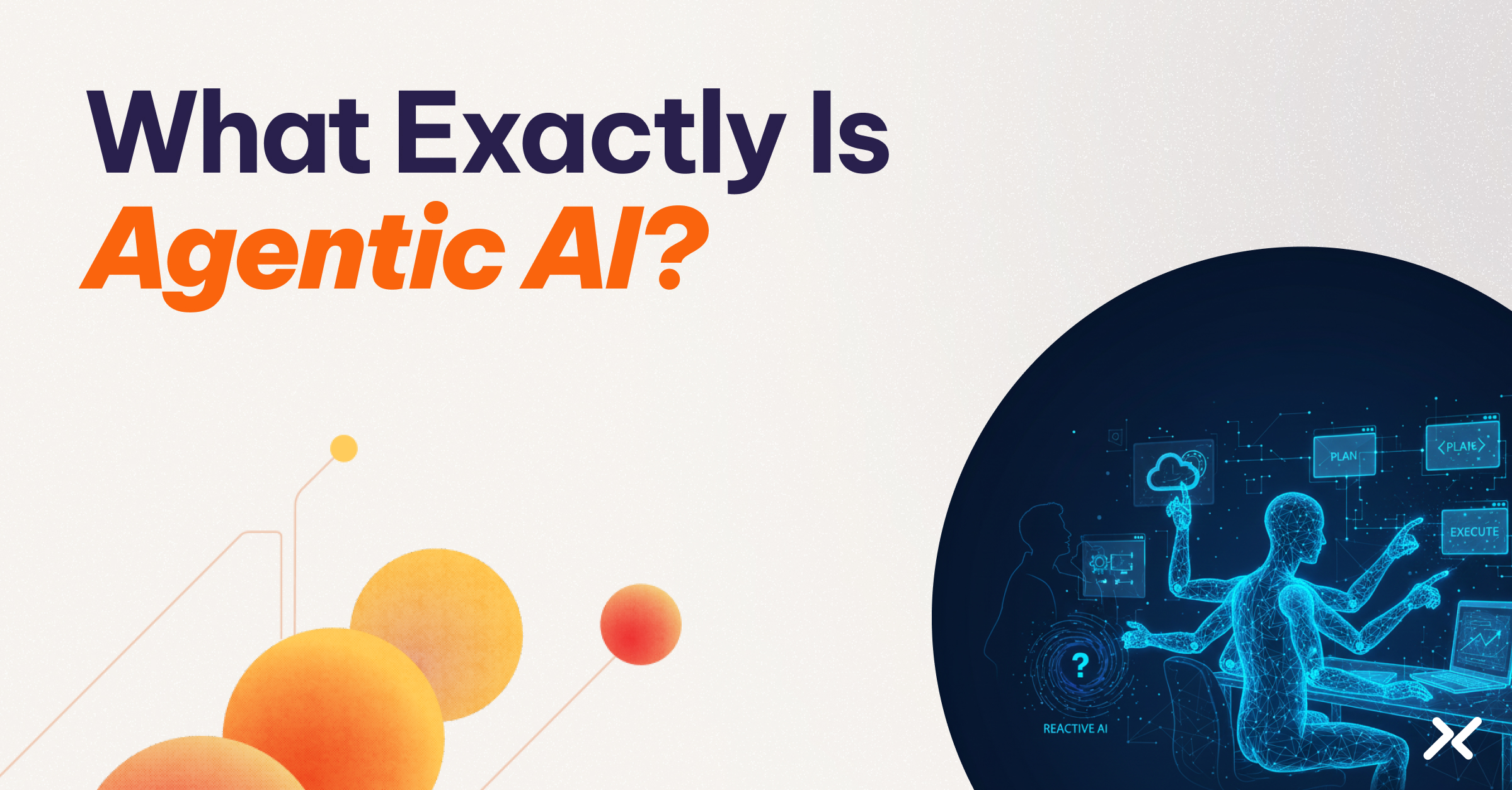
Stop waiting for a robot to hand you a pink slip. Most people spend their lunch breaks scrolling through doom-and-gloom headlines about LLMs replacing white-collar workers, yet they’re doing absolutely nothing to change how they actually work. If you’re worried about AI taking your job, you’re already losing, but not for the reasons you think. The real threat isn’t the software. It’s your own passivity.
The term "agentic" has become a buzzword in Silicon Valley, but it’s actually a survival strategy for the rest of us. Being agentic means you stop acting like a cog in a machine and start acting like the person who owns the machine. Most employees are reactive. They wait for instructions. They follow a checklist. That’s "non-agentic" behavior, and frankly, that’s exactly what an algorithm can do better than you.
If your daily output can be mapped out in a flow chart, you’re in trouble. But if you’re the one deciding which flow charts are worth building, you’re the boss.
The Problem with Playing Defense
Most workers are playing defense right now. They’re trying to hide from AI or hoping their boss doesn't realize a prompt can do their weekly reporting. That’s a losing game. You can’t outrun a tool that gets twice as smart every six months.
Think about the traditional project manager. If your job is just "checking in" on people and moving tickets from "To Do" to "Done," you’re a human router. Routers are replaceable. An agentic project manager doesn't just move the tickets; they ask why the project exists, identify the bottlenecks before they happen, and use AI to simulate five different budget outcomes before the meeting even starts.
You have to move from being a "doer" to an "architect."
What Agentic Behavior Actually Looks Like
Being agentic isn't about working harder. It’s about high-agency problem-solving. It’s the difference between saying "I couldn't find the data" and "The data wasn't in the system, so I built a scraper and found a proxy metric that gives us the same insight."
Sam Altman and other leaders at OpenAI often talk about "Agentic AI"—systems that can set their own goals and execute them. If the software is becoming more independent, you have to stay three steps ahead. You need to be the one giving the intent.
Take a look at how coding has changed. A junior dev who just writes syntax is basically an expensive version of GitHub Copilot. But a dev who understands the business logic, uses AI to churn out the boilerplate, and spends their time on system architecture? That person is ten times more valuable than they were two years ago. They’ve increased their "surface area" of impact.
The Myth of the Neutral Tool
We like to say AI is just a tool, like a hammer. That’s wrong. A hammer doesn't get better at swinging itself while you sleep. AI is more like a high-speed engine. You can either be the person standing in the middle of the road or the person in the driver’s seat.
There’s a psychological shift that needs to happen. You have to stop viewing AI as a competitor and start viewing it as a staff of unpaid interns. If you had ten interns, would you sit around worrying they’d take your job? No. You’d be busy figuring out how to direct them to build something massive.
The people getting ahead in 2026 aren't the ones who know the "best prompts." They’re the ones who have the "best vision." Vision is something LLMs still struggle with because they don't have skin in the game. You do.
Stop Asking for Permission
High agency means you stop asking for permission to innovate. Don't wait for your company to buy a corporate license for an AI tool. Use the free versions. Experiment on your own time. Figure out how to automate the boring 40% of your job so you can focus on the 60% that actually requires a human brain.
I’ve seen writers spend hours complaining about ChatGPT’s bland prose. Meanwhile, the smart writers are using it to research obscure historical facts, outline complex structures, and then applying their unique voice to the final product. One is a victim; the other is a director.
Practical Steps to Build Agency Today
You don't need a degree in data science to be agentic. You just need a change in mindset.
Start by auditing your calendar. Look at every task you did this week. If it didn't require an original opinion, a difficult conversation, or a creative leap, it’s a candidate for automation.
- Build your own "Second Brain." Use tools to store your insights and connections. When you can recall information faster than your peers, you look like a genius.
- Own the outcome, not the process. If your boss asks for a report, don't just give them a report. Give them the three things the report implies they should do next.
- Fail faster. The cost of experimentation is now near zero. Run three different versions of a project through an AI model and see which one breaks first.
The world is moving toward a "Winner Takes Most" economy for individuals. The gap between the person who uses these tools effectively and the person who ignores them is becoming a canyon. You don't want to be on the wrong side of that split.
Go find a problem in your department that everyone has been complaining about for years. Don't ask if you should fix it. Just use the tools available to you and present a solution. That’s agency. That’s how you become indispensable.
Stop worrying. Start acting. The "agentic" person doesn't fear the future because they’re the ones busy coding it into existence. Be the person who uses the tool, not the person replaced by it. It’s really that simple. Reach out to a colleague today and show them a workflow you’ve improved using an agentic approach. Better yet, just do it and let the results speak for themselves.