The checks are finally on the way, but the uniforms are not changing back. While the White House has moved to restore pay for roughly 50,000 Transportation Security Administration (TSA) officers who have spent six weeks working for IOUs, the armed Immigration and Customs Enforcement (ICE) agents who replaced them at security checkpoints are not packing their bags. This is not a temporary logistical patch for a funding crisis. It is the beginning of a permanent shift in how American air travel is policed.
White House border czar Tom Homan confirmed as much Sunday. When pressed on whether the deployment was a fleeting response to the Department of Homeland Security (DHS) shutdown, Homan’s answer was a cold "we’ll see." He cited a "heightened threat level" and the reality that many TSA officers have simply vanished from the federal payroll for good.
The numbers tell a story of a hollowed-out agency. Nearly 500 TSA officers have quit since the Valentine’s Day funding lapse began. At major hubs like Houston and Baltimore, call-out rates hit 40% last week. The administration’s solution was to fill the gaps with ICE agents who, unlike their TSA counterparts, remained fully funded by the One Big Beautiful Bill Act passed last year.
The Force Multiplier Myth
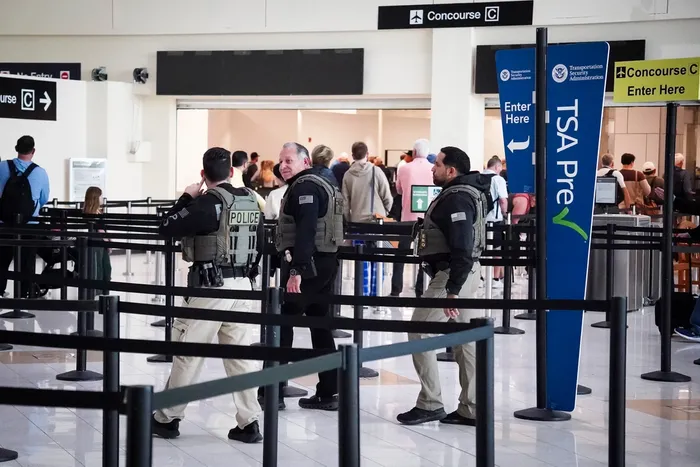
For a week, travelers have watched ICE agents in tactical gear perform "line management" and "document verification" at Hartsfield-Jackson and JFK. The administration calls them a force multiplier. Critics call it a hostile takeover of civil aviation.
The technical reality is that an ICE agent is not a TSA screener. They lack the months of specialized training required to interpret X-ray imagery or identify the latest iterations of non-metallic explosives. This gap in expertise led to an absurd compromise. ICE agents are currently "guarding exits" and "plugging security holes," while the remaining, exhausted TSA staff are chained to the scanners.
By offloading the "non-significant roles" to ICE, the administration is effectively creating a two-tier security system. One tier handles the technical screening. The other tier—armed, empowered to arrest, and focused on immigration status—handles the people.
The Recruitment Crisis as a Trojan Horse
The shutdown did more than just delay paychecks. It broke the back of the TSA’s already fragile retention strategy. It is hard to convince a low-wage federal worker to return to a high-stress job after they have been used as a political poker chip for 44 days.
Homan’s hesitation to withdraw ICE agents suggests the administration is counting on this attrition. If the TSA cannot restaff to pre-shutdown levels, the "temporary" ICE presence becomes the new baseline. This is a dream scenario for a White House that has prioritized internal enforcement over traditional administrative oversight.
Consider the legal shift. A TSA officer’s authority is strictly defined by administrative security protocols. An ICE agent, however, operates under 8 U.S.C. § 1357. They have broad powers to question, search, and arrest anyone they have "reasonable suspicion" to believe is in the country illegally. By moving these agents into the security queue, the administration has successfully moved the border to the boarding gate.
A Calculated Power Vacuum
The funding of ICE through separate, long-term appropriations while leaving the TSA to rot in annual budget brawls was a deliberate legislative choice. It created a reality where one agency is "essential" enough to be paid, and the other is a disposable asset.
We are witnessing the "borderization" of the American interior.
When you walk into an airport today, you are no longer just entering a secure transportation zone. You are entering a zone of active immigration enforcement. The administration argues this is about safety. Yet, the union representing TSA workers, the AFGE, points out that putting untrained, armed agents in high-pressure passenger environments is a recipe for a "dangerous escalation." They aren't wrong. ICE agents are trained for high-risk apprehensions, not the customer service-heavy friction of a 3:00 PM rush at O'Hare.
The New Normal
Travelers expecting a return to "normal" once the back pay hits accounts on Tuesday will be disappointed. The lines may move faster, but the atmosphere has fundamentally shifted. The presence of masked, plainclothes, or tactical-clad ICE agents at "non-traditional" security posts is likely here to stay.
The administration has discovered that a staffing crisis is the perfect cover for a policy shift that would have never survived a standard congressional debate. They didn't need to pass a law to put ICE in charge of airport exits. They just needed the TSA to go broke.
Watch the exits at your next flight. If the person standing there is wearing a badge that says "Immigration and Customs Enforcement" instead of "TSA," the shutdown didn't really end. It just succeeded.