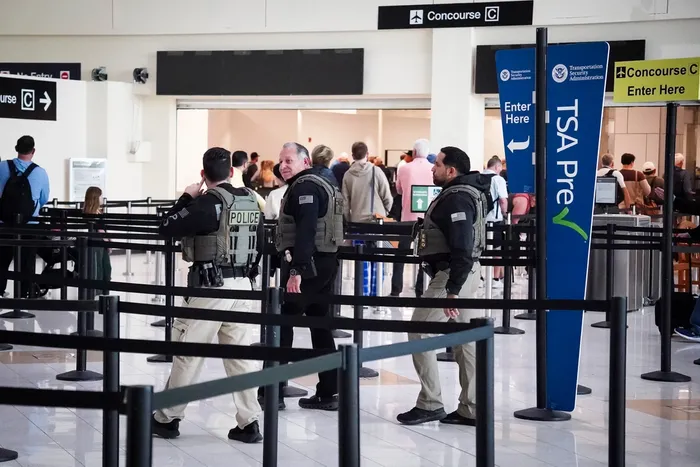
The surge in unauthorized border crossings has created a systemic bottleneck that now requires a forced reallocation of federal human capital to maintain the integrity of the U.S. aviation network. While public discourse focuses on the political optics of the "Border Czar" role, the underlying reality is an exercise in crisis-driven resource optimization. The deployment of Immigration and Customs Enforcement (ICE) personnel to assist the Transportation Security Administration (TSA) at major airports is not a permanent solution but a tactical bridge to prevent a total collapse of throughput efficiency. This strategy addresses two distinct friction points: the immediate labor deficit in screening operations and the long-delayed fiscal reconciliation of TSA personnel compensation.
The Dual-Pronged Resource Deficit
The current strain on aviation security is the result of a compounding effect between historic attrition and record-breaking passenger volumes. When ICE personnel are integrated into airport environments, they do not function as primary screeners—a role requiring specific Title 49 certification. Instead, they serve as "force multipliers" for the non-technical aspects of the security queue. This creates a tiered operational structure:
- Technical Core (TSA): Retains exclusive control over X-ray analysis, explosive trace detection, and physical pat-downs.
- Operational Support (ICE): Assumes responsibility for document verification, queue management, and secondary perimeter security.
This delegation allows TSA to consolidate its certified officers at the "glass-to-glass" interface of the checkpoint, theoretically increasing the number of active lanes. The metric for success here is not the presence of ICE uniforms, but the reduction in "Time-to-Clear" (TTC) for the average traveler. Until the TSA workforce reaches "100 percent" capacity—defined by the agency’s authorized full-time equivalent (FTE) levels—the reliance on external agency support remains the only alternative to massive terminal congestion.
The TSA Pay Equity Mechanism
A significant driver of the current staffing crisis is the historical disparity between TSA compensation and the General Schedule (GS) pay scale utilized by nearly every other federal agency. The announcement of pay increases arriving "this week" marks the culmination of a multi-year effort to align TSA with the rest of the federal workforce under the TSA Modernization Act.
The economic logic of this shift is grounded in the Replacement Cost Theory. The cost of recruiting, vetting, and training a new TSA officer is substantially higher than the cost of a 25-30% salary increase for an experienced veteran. By moving TSA employees to a pay structure that mirrors the GS scale, the agency aims to solve for:
- Attrition Reduction: High turnover at the TSO (Transportation Security Officer) level has historically bled the agency of its middle-management pipeline.
- Recruitment Competitiveness: In a tight labor market, TSA has frequently lost candidates to private sector security firms or local law enforcement agencies offering better base pay and more predictable raises.
This pay adjustment is not a bonus; it is a structural correction. The "100 percent" staffing goal is unattainable without this fiscal realignment, as the rate of attrition has previously outpaced the rate of onboarding.
Measuring Throughput and Security Trade-offs
The deployment of ICE to airports introduces a complex variable into the security equation: the Security-Efficiency Frontier. Every security protocol adds a layer of friction. In a high-volume environment, friction leads to delays, and delays create "soft targets"—large crowds of people gathered in unsecured areas before the checkpoint.
By utilizing ICE to manage the "pre-checkpoint" environment, the agency is attempting to move the frontier.
- Case A (No ICE): TSA manages the entire process. Crowds build up at the entrance because screeners are distracted by crowd control.
- Case B (Hybrid ICE/TSA): ICE manages the crowd. TSA focuses purely on the technical screening.
The risk in Case B is a lack of specialized training in airport-specific behavioral detection. While ICE agents are highly trained in enforcement, the civil aviation environment requires a specific cadence and customer-interaction model that differs from field enforcement or detention center management.
The Fiscal Impact of Inter-Agency Reallocation
There is no "free" labor in the federal government. The movement of ICE personnel to airports incurs a specific Opportunity Cost. For every ICE agent standing in a terminal in Atlanta or Los Angeles, there is a gap in interior enforcement or border processing.
This creates a zero-sum game of national security. The decision to prioritize airports suggests a strategic assessment that the economic impact of a broken aviation system—lost revenue for airlines, slowed commerce, and public dissatisfaction—outweighs the marginal loss of efficiency in ICE’s primary missions. This is a temporary triage maneuver. The "TSA Pay Coming This Week" headline is the actual long-term fix, whereas the ICE assistance is the surgical gauze applied to a bleeding system.
The 100 Percent Threshold: A Moving Target
The "100 percent" metric mentioned by officials is often misunderstood as a static number. In reality, it is a dynamic target adjusted for seasonal travel peaks and evolving threat levels. Reaching 100 percent involves more than just filling seats; it requires a specific ratio of "Lead" and "Supervisory" officers to "Entry-level" officers to ensure compliance with federal security mandates.
The integration of technology—such as Computed Tomography (CT) scanners and Credential Authentication Technology (CAT)—is intended to lower the raw headcount needed per lane. However, these technologies have a steep learning curve. The current strategy assumes that as the pay raises take effect, the agency will see an immediate spike in retention among those who have already mastered these technical systems.
Strategic Trajectory for Aviation Security
The current reliance on ICE at airports identifies a failure in the federal workforce planning model that has persisted for two decades. To move beyond this crisis-management phase, the following structural shifts are necessary:
- Decoupling from Political Cycles: The "Border Czar" nomenclature often obscures the technical requirements of the Department of Homeland Security (DHS). The synchronization of TSA pay with the GS scale must be permanent and protected from future budget freezes to prevent a recurrence of the current labor shortage.
- Cross-Training Standardization: If inter-agency support is to be a recurring tool, DHS must implement a standardized "Airport Support" certification for non-TSA personnel. This would ensure that ICE or CBP officers deployed to airports understand the specific legal and operational constraints of the civil aviation space.
- Dynamic Staffing Models: Moving from a static "100 percent" goal to a data-driven model that predicts volume surges based on airline scheduling data will allow for more surgical deployments rather than blanket agency-wide reallocations.
The immediate priority for aviation stakeholders is to monitor the TTC metrics over the next 14 days. If the combination of ICE support and the initial rollout of the new pay scale does not result in a measurable decrease in checkpoint wait times, the bottleneck is likely deeper than mere headcount—it may signal a need for a total overhaul of the physical throughput architecture of major U.S. hubs.
The strategic play here is clear: leverage the temporary ICE labor to stabilize the system while using the new pay scale as a "hard reset" for the TSA workforce. Failure to hit the 100 percent staffing mark within two fiscal quarters of the pay adjustment will indicate that salary was only a secondary factor, and that the deeper issue lies in the operational culture or the physical limitations of the airport infrastructure itself.