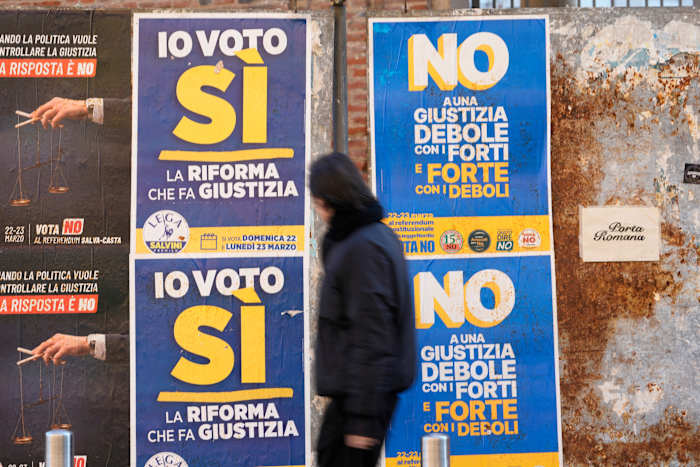
Italy is heading to the polls this weekend, March 22 and 23, 2026, for a vote that could fundamentally reshape how its democracy functions. Prime Minister Giorgia Meloni has staked significant political capital on this constitutional reform, but the noise surrounding the "separation of careers" often drowns out what’s actually happening behind the scenes. This isn't just a technical tweak to courtroom procedures. It’s a high-stakes gamble on the power balance between politicians and the men and women who wear the robes.
You’ve likely heard the government’s pitch. They say the current system is broken because judges and prosecutors are too cozy. They argue that if a prosecutor and a judge start their careers together, eat in the same cafeterias, and belong to the same professional body, the "third-party" impartiality of the judge is compromised. It’s a compelling story. But if you look at the actual text of the Nordio Reform—named after Justice Minister Carlo Nordio—you’ll see the changes go much deeper than just separate career tracks.
The Three Pillars of the Nordio Reform
To understand why this referendum matters, you have to look at the three structural shifts being proposed. Most media outlets focus on the first one, but the second and third are where the real institutional friction lies.
First, there's the separation of career paths. Currently, Italian magistrates are a unified group. You can start as a prosecutor (the accuser) and later become a judge (the decider). While recent laws already made this switch difficult, Meloni’s reform makes it impossible. From day one, you pick a side and stay there.
Second, the reform splits the High Council of the Judiciary (CSM) into two. Instead of one body governing all magistrates, there will be one for judges and one for prosecutors. Both will still be chaired by the President of the Republic, but they’ll operate in totally different silos.
Third—and this is the part that has the judiciary screaming—is the introduction of sortition. Instead of magistrates electing their representatives to these governing councils, many members will be drawn by lot. The government says this will kill the "correnti" (internal political factions) that have long plagued the system. Critics say it’s a lottery that devalues merit and hands control to the "lay members" appointed by Parliament.
Why Meloni Is Risking a Plebiscite
Giorgia Meloni knows the history of Italian referendums. She remembers Matteo Renzi’s 2016 disaster, where a lost constitutional vote ended his premiership. She’s trying to avoid making this a vote on her own face, but in Italian politics, that’s almost impossible. The opposition, led by the Democratic Party and the 5-Star Movement, is already framing a "No" vote as the first step to toppling her coalition.
Why take the risk? Because the right-wing coalition has felt "persecuted" by what they call "red magistrates" for decades. For Meloni, this reform is about more than efficiency. It’s about ending the era where the judiciary could, in their view, interfere with the executive branch's mandate.
The High Disciplinary Court Controversy
One detail that often gets buried is the creation of the High Disciplinary Court. Right now, if a magistrate screws up, the CSM handles the discipline. The reform moves this to a new, separate court.
This sounds like a boring administrative change, doesn't it? It isn’t. By moving disciplinary power away from the peer-review system and into a new body where the selection process is heavily influenced by political appointments and random draws, the government is essentially creating a new "judge of judges."
Opponents argue this is a "special court" that violates Article 102 of the Constitution. They fear it’ll be used to intimidate judges who make rulings the government doesn't like. If you’re a judge and you know the body that can fire you is potentially influenced by the ruling party, you might think twice before signing that warrant against a politician.
The Quorum Trap
Here’s something most people miss: this is a confirmatory referendum. Unlike the ones used to legalize divorce or try to scrap the nuclear program, this one does not require a quorum.
In an ordinary referendum, 50% of the population plus one must show up for the result to count. For this constitutional vote, that rule doesn't exist. Even if only 10% of Italians vote, the result is binding. This makes the "Yes" campaign’s job easier if the public is indifferent, but it also means a motivated opposition can win with a smaller, more energized base.
Is Italian Justice Actually Slow Because of Career Ties?
The government claims this reform will speed up trials. Honestly, that's a stretch. Italy’s justice system is notoriously slow, with civil cases often dragging on for nearly a decade. But is that because the judge and the prosecutor were classmates twenty years ago? Probably not.
The real bottlenecks are a lack of digital infrastructure, a shortage of administrative staff, and an overwhelming volume of appeals. Data from the "Cartabia Reform" in 2022 showed that less than 1% of magistrates actually switch from being a prosecutor to a judge. The "closeness" problem might be more of a narrative than a statistical reality.
If you’re voting this weekend, you’re deciding on a philosophy, not a fix for your local court's backlog. Are you okay with a judiciary that is more accountable to a system designed by politicians, or do you prefer the current "autonomous order" despite its flaws and factionalism?
What Happens Monday Night
When the results come in on Monday evening, March 23, the fallout will be immediate.
If "Yes" wins, Meloni secures a historic victory. She’ll have succeeded where Silvio Berlusconi failed for twenty years. It’ll give her the momentum to push for the "Premierato" (the direct election of the Prime Minister), which is her even bigger constitutional goal.
If "No" wins, the "Meloni honeymoon" is officially over. It’ll signal that while Italians might like her tough talk on the EU or migration, they aren't ready to let her touch the fundamental checks and balances of the state.
If you want to follow the results in real-time, the Ministry of the Interior’s "Eligendo" portal is the only place to get the raw numbers. Don't rely on the exit polls—they're historically shaky in Italy. Watch the "affluenza" (turnout) figures released at 12:00, 19:00, and 23:00 on Sunday. They'll tell you everything you need to know about which side managed to get their people to the booths.