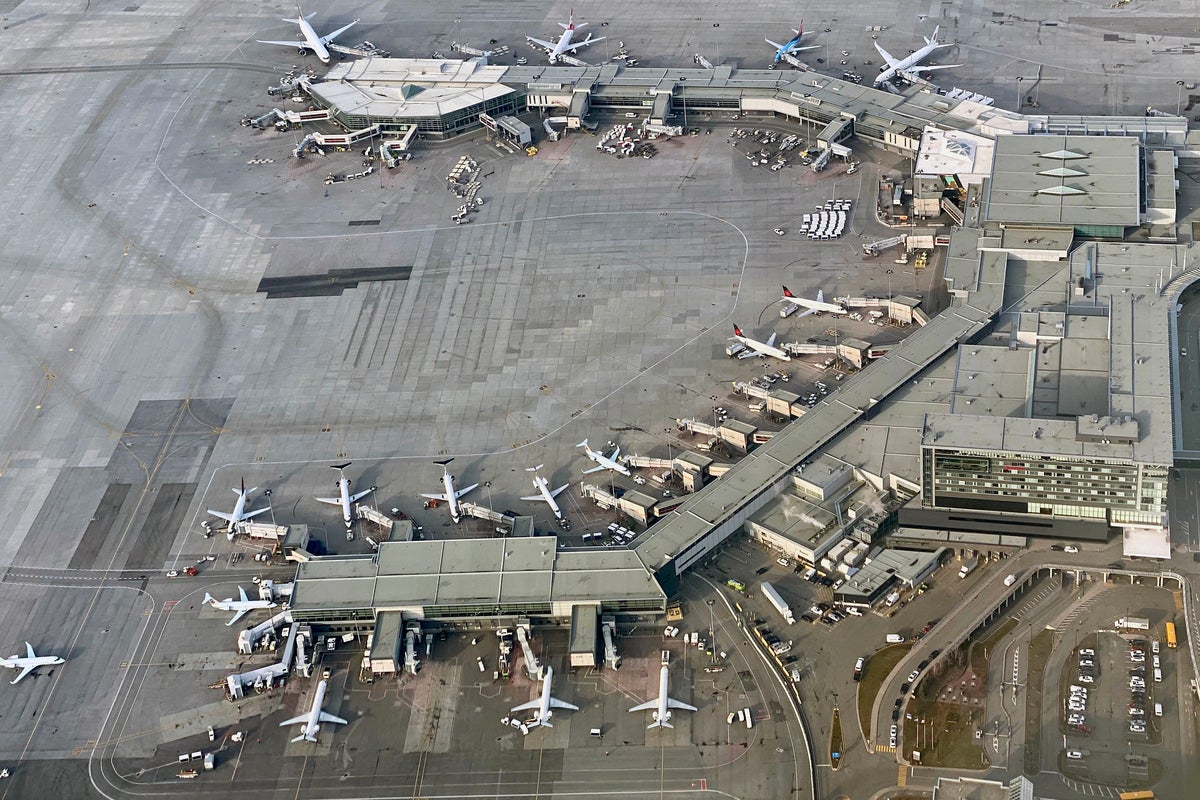
The deployment of F-15 Eagle interceptors to escort two Air Canada flights into Montreal-Trudeau International Airport represents a catastrophic misalignment between digital fraud detection and national security trigger points. While surface-level reporting focuses on the spectacle of fighter jets flanking civilian aircraft, the underlying logic reveals a systemic failure in how airline "red flags" are communicated to the North American Aerospace Defense Command (NORAD). When a ticketing irregularity—traditionally a back-office financial loss—escalates into a supersonic military response, the operational friction suggests that the threshold for "uncertain intent" in the cockpit has become decoupled from the reality of modern cyber-crime.
The Escalation Architecture: From SQL Error to Scramble Order
The transition of a passenger from a "fraudulent booking" to a "national security threat" follows a rigid, albeit flawed, causal chain. In the Montreal incident, the catalyst was not a physical breach of the cockpit or a vocal threat, but a post-departure verification of ticket authenticity. This creates a data-action paradox: if the airline identifies a passenger as a fraudster while at 35,000 feet, the pilot is legally and procedurally obligated to notify ground control.
The moment the word "suspicious" or "unauthorized" enters the communication loop between the pilot and Air Traffic Control (ATC), the incident is categorized under the Domestic Air Intercept Protocol. This protocol does not allow for nuance regarding the type of suspicion. Once the squawk code or verbal report indicates a potential security compromise, the machinery of NORAD moves into a binary state: intercept or monitor.
The decision to scramble jets from the 104th Fighter Wing or similar units is governed by a Risk Assessment Matrix that prioritizes the "Unknown" over the "Probable."
- Validation Latency: The time between the passenger boarding and the fraud department flagging the credit card.
- Communication Distortion: The dilution of specific information (ticket fraud) into general terms (unauthorized person/security risk) as it passes from the airline to the FAA/NAV CANADA and finally to the military.
- Precautionary Maximums: The doctrinal requirement to assume a worst-case scenario (hijacking via identity theft) until visual confirmation proves otherwise.
The Cost Function of Kinetic Interventions
Deploying military assets for administrative errors creates a massive economic and operational drain. The "Cost Per Flight Hour" (CPFH) for an F-15C is approximately $42,000. When factoring in two jets, tanker support, and the ground crew's readiness state, a single escort mission can exceed $150,000 in direct taxpayer costs.
The true cost, however, is measured in Strategic Opportunity Loss. Every minute a high-performance interceptor spends shadowing a Boeing 737 over Quebec is a minute that airframe is unavailable for genuine sovereignty missions or training. Furthermore, the "cycle time" of the airframe—the wear and tear on engines and avionics—is accelerated for a mission that could have been resolved through a simple digital handshake between the airline and the arrival gate’s law enforcement.
The Identity-Security Gap: Why "Fraud" Equals "Threat"
The aviation industry operates on a foundation of "Known Travelers." The entire security apparatus—TSA PreCheck, Clear, and the No-Fly List—is designed to convert an anonymous human into a verified data point. Ticket fraud shatters this model. If a passenger is on a plane using a stolen identity or a fraudulent payment method, they are, by definition, an Unverified Entity.
In the eyes of post-9/11 security protocols, an unverified entity is a variable with an unknown payload. The logic holds that if a person is willing to commit federal-level fraud to board a plane, their motives cannot be assumed to be benign. This creates a bottleneck in the logic:
- The Airline's View: A financial loss of $600 to $2,000 per seat.
- The Pilot's View: A potential breach of the manifest's integrity.
- NORAD’s View: A non-compliant or incorrectly identified aircraft in high-traffic airspace.
The disconnect exists because there is no intermediate "yellow alert" for non-violent administrative discrepancies. The system is designed for a binary world: you belong on the plane, or you are an intruder.
Tactical Limitations of Visual Interception
When the F-15s pull alongside a civilian flight, the pilots are performing a Visual Identification (VID). They are looking for specific indicators:
- Cockpit activity (Are the pilots under duress?)
- Control surface movement (Is the plane being flown erratically?)
- Cabin environment (Is there visible smoke or struggle?)
In cases of ticket fraud, the VID is almost entirely useless. The intercepting pilot sees a normal flight deck and a calm cabin. This confirms that the aircraft is not a projectile, but it does nothing to resolve the underlying identity crisis. The jets then enter a "Shadow Phase," where they remain in the vicinity until the wheels touch the tarmac. This is a psychological deterrent, not a tactical solution. It serves to signal to any potential bad actor that the state has regained "escalation dominance," even if the "actor" is simply a college student using a stolen credit card.
Structural Failures in Airline-to-Government Data Sharing
The Montreal incident highlights a lack of real-time telemetry between airline fraud departments and the Integrated Command Centers. Currently, fraud detection is a "back-end" process, often lagging behind the "front-end" boarding process.
To prevent future kinetic escalations for digital crimes, the industry requires a Validated Manifest Protocol. This would involve:
- Pre-Departure Authentication: Moving the fraud check to the "reservation-hold" phase rather than the "post-takeoff" phase.
- Granular Coding: Implementing a specific ATC code for "Administrative Discrepancy - Non-Threat" to prevent the automatic triggering of NORAD scramble orders.
- Liability Shifting: Holding airlines financially responsible for the cost of military scrambles if the cause is a failure in their own internal verification systems.
Without these shifts, the military becomes a de facto "collections agency" or "security guard" for private corporations that failed to secure their own payment gateways.
The Strategic Play: Hardening the Digital Gate
The military-industrial response to a credit card dispute is an unsustainable model of national defense. The objective for airline regulators and security consultants is to decouple financial integrity from flight deck security.
Airlines must implement Biometric-Linked Ticketing or Blockchain-Verified Manifests to ensure that the person in seat 12B is the person who paid for seat 12B, verified at the point of entry. Until the "Data Identity" of a passenger is as secure as the "Physical Screening" of their luggage, NORAD will continue to be forced into the role of an overqualified escort for white-collar criminals. The next evolution in aviation security is not faster jets, but more integrated data pipes that allow ground-based law enforcement to intercept a passenger at the gate without requiring $80 million worth of hardware in the sky.
Airlines should immediately audit their "In-Flight Fraud Discovery" procedures. If a fraud is detected post-departure, the protocol should mandate a silent notification to ground-based law enforcement (RCMP/SPVM) rather than a general security alert to ATC, unless a secondary threat indicator—such as aggressive behavior or a breach of the sterile area—is present. This moves the resolution from the kinetic domain back to the administrative domain, where it belongs.