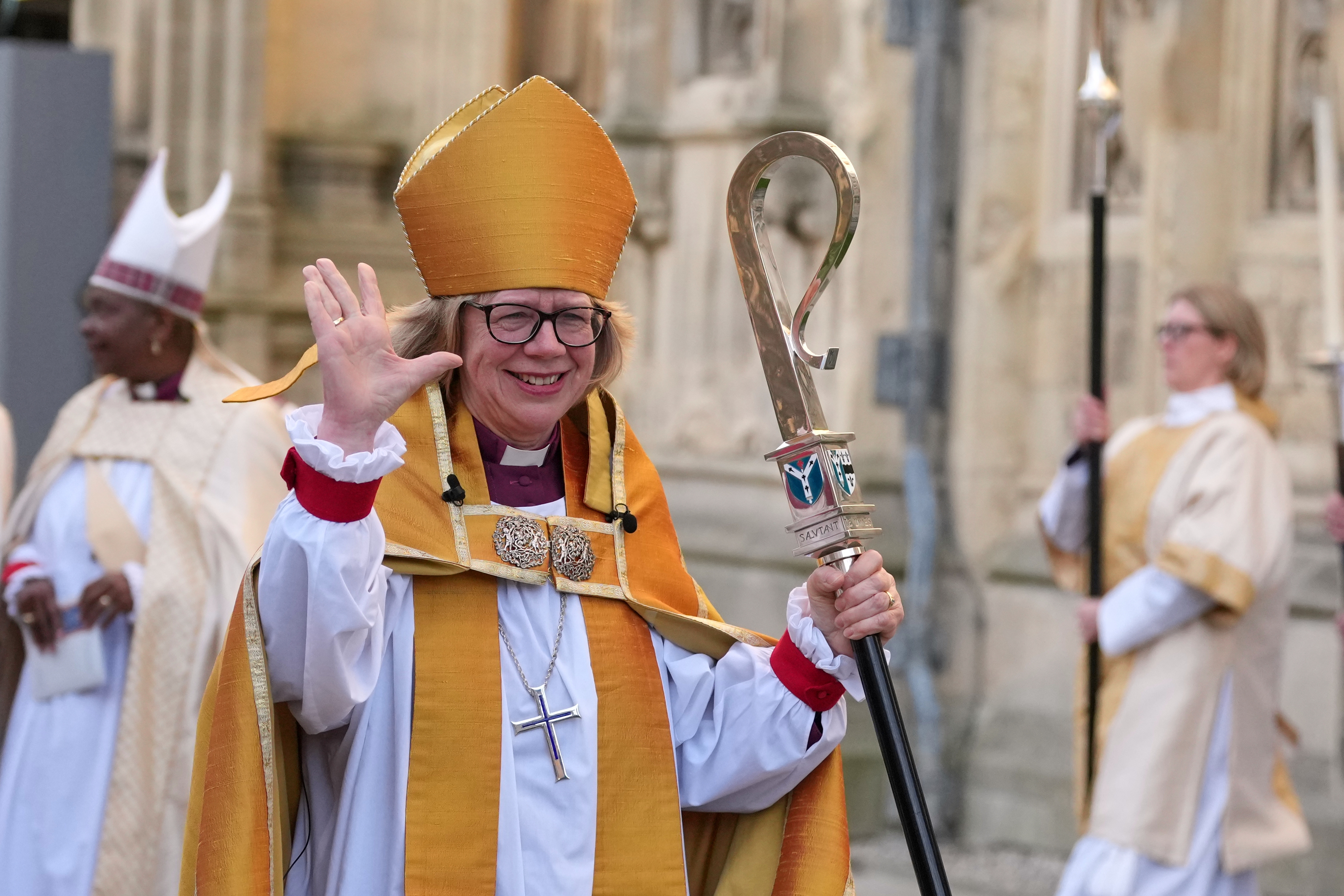
The appointment of the Right Reverend Libby Lane as the Bishop of Stockport, and subsequently the broader integration of women into the highest echelons of the Church of England, represents more than a cultural shift; it is a fundamental reconfiguration of an institutional hierarchy that remained static for 450 years following the Elizabethan Settlement, and 1,400 years if measuring from the arrival of Augustine of Canterbury. This transition is not merely a "first" in a chronological sense but a systemic response to a dual-pressure environment: the internal theological evolution of the Anglican Communion and the external legislative pressure of the United Kingdom’s Equality Act.
To understand the mechanics of this shift, one must analyze the Church not as a static religious entity, but as a complex organization managing a legacy brand while attempting to maintain relevance in a secularizing market. The transition to female leadership functions as a critical update to the Church’s operational software, addressing a structural bottleneck that previously excluded 50% of its high-potential human capital.
The Tripartite Framework of Ecclesiastical Authority
The authority of a Bishop in the Church of England is derived from three distinct sources, each of which faced unique friction points during the transition to female leadership.
- Sacramental Authority (Apostolic Succession): This is the belief that bishops represent an unbroken chain of laying on of hands from the original apostles. The primary logical hurdle for opponents was the "taint" theory—the idea that if one link in the chain (a female bishop) is invalid, all subsequent ordinations performed by her are also invalid.
- Legislative Authority (The Lords Spiritual): As the established church, the Church of England holds 26 seats in the House of Lords. The exclusion of women created a constitutional anomaly where a state-sanctioned institution practiced gender discrimination that was illegal in almost every other sector of British public life.
- Jurisdictional Authority (The Ordinary): A bishop serves as the "Ordinary" of a diocese, meaning they hold the final word on administrative and disciplinary matters. The shift required a total rewrite of Canon Law to ensure that a female bishop's administrative commands carried the same legal weight as her male predecessors.
The Cost Function of Institutional Resistance
The delay in appointing women to the episcopate, despite women being ordained as priests since 1994, created a "theological debt" similar to technical debt in software engineering. This debt manifested in several quantifiable ways.
The first manifestation was Demographic Attrition. The Church of England has seen a steady decline in "usual Sunday attendance," dropping at an average rate of 1% to 2% annually over the last two decades. By maintaining a glass ceiling, the Church signaled a disconnect from the values of the Millennial and Gen Z cohorts, accelerating the exit of younger demographics who view gender equality as a baseline requirement for institutional legitimacy.
The second manifestation was Legislative Vulnerability. The Church operates under a "Royal Supremacy" model, where Parliament must approve changes to Church Law (Measures). In 2012, when the General Synod initially voted down the proposal for female bishops, it triggered an existential crisis. Members of Parliament openly discussed removing the Church's exemptions from the Equality Act or, more drastically, pursuing disestablishment. The 2014 approval of the House of Bishops’ declaration was, in many ways, a defensive maneuver to preserve the Church’s unique status as the state religion.
Structural Accommodations and the "Two Integrity" Model
To pass the legislation, the Church had to implement a "Five Guiding Principles" framework. This is a pragmatic, albeit messy, logical compromise designed to prevent a schism. It recognizes that two "integrities" exist within the same body: those who accept women’s ministry and those who, for theological reasons, cannot.
This led to the creation of the Provincial Episcopal Visitors, commonly known as "Flying Bishops." These are male bishops who provide oversight to parishes that refuse the leadership of a female diocesan bishop. From an organizational design perspective, this is a redundant system. It increases administrative overhead and creates a bifurcated chain of command within a single geographic diocese.
The mechanism works as follows:
- A Parochial Church Council (PCC) passes a resolution stating they cannot accept the ministry of a woman.
- The female Diocesan Bishop remains the legal head, but she delegates "sacramental and pastoral care" to a male substitute.
- This creates a "buffered" leadership structure where the female leader holds the budget and the legal title, but the male substitute holds the spiritual influence.
The Pipeline Problem and Leadership Velocity
Replacing a 1,400-year-old precedent does not happen instantly upon the passage of a law. The Church faces a "Pipeline Velocity" constraint.
To become a Bishop, a candidate typically moves through several career stages:
- Selection/Discernment: Identifying potential in ordinands.
- Incumbency: Running a parish (usually 5–10 years).
- Senior Leadership: Serving as an Archdeacon or Cathedral Dean (5–10 years).
- Suffragan Appointment: Serving as a "junior" bishop.
- Diocesan Appointment: Running a full diocese.
Because women were only allowed into the priesthood in 1994, the pool of female candidates with the requisite 20+ years of senior experience was statistically small in 2014. This created an "Experience Gap" that the Church has had to bridge through aggressive talent management and fast-tracking certain individuals. This isn't just about diversity; it is about filling a massive leadership vacuum created by the retirement of the "Baby Boomer" clergy cohort.
Economic and Social Implications of the Female Episcopate
The shift to female leadership coincides with a period of radical financial restructuring within the Church. The Church Commissioners, who manage an endowment of approximately £10 billion, have increasingly tied "Strategic Development Funding" to growth metrics.
Female bishops often bring a different approach to the Social Capital of the Church. Data suggests that female clergy often excel in "community-facing" roles—social justice, poverty alleviation, and local networking—which are the primary drivers of growth in modern Anglicanism. However, they also inherit a crumbling infrastructure of Grade I and II listed buildings. The leadership challenge for the new generation of female bishops is less about "being the first" and more about managing a massive real estate portfolio with a shrinking donor base.
The Bottleneck of Global Anglicanism
The Church of England is the "Mother Church" of the 85-million-strong Anglican Communion. The decision to ordain female bishops in England has created a massive friction point with the Global South, particularly in provinces like Nigeria, Uganda, and Kenya, which represent the largest and fastest-growing segments of the communion.
The logic of the Global South is rooted in "Biblical Primacy" and traditionalist hermeneutics. By promoting women to the episcopate, the Church of England has effectively signaled that its alignment with Western liberal democratic values is more important than its alignment with its most populous global partners. This has resulted in a "De Facto Schism," where many Global South provinces no longer recognize the authority of the Archbishop of Canterbury as primus inter pares (first among equals).
Strategic Risk Assessment
While the appointment of women as leaders solves the legitimacy crisis in the UK, it introduces three specific risks:
- Internal Fragmentation: The "Two Integrity" model is a temporary truce, not a permanent peace. As the first generation of female bishops retires, the pressure to abolish the "Flying Bishop" system will increase, potentially forcing traditionalists out of the Church entirely.
- Asset Management Stress: The focus on leadership diversity can sometimes distract from the core financial reality: the Church is "asset-rich but cash-poor." The new leadership must pivot from theological debate to aggressive fiscal restructuring within the next decade.
- Ecumenical Cooling: Relations with the Roman Catholic and Orthodox Churches have hit a ceiling. Since those bodies do not recognize the validity of female orders, the prospect of "reunion" is effectively dead for the foreseeable future.
The Church of England has successfully navigated the transition from a traditionalist patriarchy to a modern, inclusive bureaucracy. This was a survival imperative. The next logical step for the institution is the "Great Rationalization"—using this new, more representative leadership to aggressively prune underperforming parishes and consolidate resources into "Resource Churches" that can sustain the organization through the mid-21st century.
Leaders within the Church must now move beyond the "celebration of the firsts" and apply rigorous performance metrics to diocesan growth. The focus should shift toward a "High-Density, Low-Friction" model of ministry, where the gender of the bishop is secondary to their ability to manage a radical transition from a territorial parish system to a network-based spiritual provider. This requires a shift from pastoral leadership to executive-level strategic management.