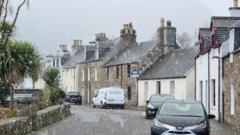
The British media has a pathological obsession with "Arctic plumes" and "Snow bombs." Every time the mercury dips below 5°C, newsrooms across the country recycle the same frantic templates. They warn of a "cold snap" as if the UK were suddenly relocating to the Siberian tundra. It is a tired, predictable cycle of meteorological sensationalism that masks a much deeper problem: our total inability to distinguish between weather and climate, and our refusal to build infrastructure that reflects either.
The current headlines are screaming about a "snow forecast for some." This is the peak of lazy journalism. Of course it might snow in late March or early April. It is called early spring in the North Atlantic. By framing a standard seasonal shift as a "brace for impact" event, the media creates a false sense of crisis that distracts from the actual structural failures of the British energy and transport sectors.
The Myth of the Unprecedented Freeze
Let’s dismantle the "unprecedented" narrative. The UK weather is defined by its variability. We sit at the intersection of five major air masses. The Polar Maritime and Arctic Maritime air masses are not "snaps"; they are permanent features of our geographic reality.
When the Met Office issues a yellow warning for snow, the public reacts with a mix of hoarding and paralysis. But look at the data. Most "cold snaps" in the UK involve temperatures that would be considered a mild spring day in Oslo or Toronto. We aren't dealing with a climate catastrophe; we are dealing with a competence catastrophe.
I have spent years analyzing how public perception of risk is manipulated by short-term weather reporting. I've seen local councils blow their entire annual gritting budget in forty-eight hours because a tabloid predicted a "Big Freeze" that turned out to be a light dusting of sleet. We are reacting to headlines, not to the actual atmosphere.
Why the "Snow Bomb" is a Mathematical Fluke
The term "Snow Bomb" is a bastardization of the meteorological term "bombogenesis." A true weather bomb requires a central pressure drop of at least 24 millibars in 24 hours. Most of what the UK press calls a "bomb" is just a standard low-pressure system moving at a brisk pace.
$$P_{24} = P_{t} - P_{t+24} \ge 24 \text{ hPa}$$
If that equation isn't met, it isn't a bomb. It's just raining sideways in Manchester.
By overusing this terminology, we desensitize the public to actual risks. When a genuinely dangerous weather event occurs—like a Beast from the East—the warnings go unheeded because the "boy who cried snow" has been shouting for three months straight.
The Wrong Question: "Will it Snow?"
The public is obsessed with the wrong question. They ask if it will snow so they can decide whether to work from home. The question we should be asking is why our national grid is so fragile that a three-day frost threatens to spike energy prices to usurious levels.
We treat the cold as a surprise visitor. It isn't. It’s a recurring tenant.
The Infrastructure Gap
- Housing Stock: The UK has the draftiest housing in Western Europe. We focus on the "cold snap" instead of the fact that we lose heat at three times the rate of German homes.
- Transport Paralysis: Why does 2cm of snow shut down the rail network? It isn't the snow. It’s the lack of investment in heated points and the absurd reliance on third-rail electrification in the south, which is uniquely vulnerable to icing.
- The Gritting Farce: We grit roads reactively. By the time the trucks are out, the ice has already bonded to the tarmac.
The Economic Cost of Sensationalism
The "cold snap" narrative isn't just annoying; it’s expensive. Every time a "major freeze" is predicted, retail footfall drops, supply chains preemptively pivot, and productivity dips. This is a self-inflicted wound.
Imagine a scenario where the UK accepted that winter exists. If we invested in the same level of winter-readiness as Helsinki, the "cold snap" would be a non-event. It would be Tuesday. Instead, we choose to live in a state of perpetual shock, which allows insurance companies to hike premiums and energy firms to "manage demand" by charging you more to stay warm.
Stop Bracing and Start Building
The "lazy consensus" says we should be afraid of the cold. The truth is that the cold is the most predictable thing about our island. The real danger isn't the snow; it’s the institutional laziness that prevents us from insulating our homes, burying our power lines, and stoping the annual pantomime of weather-induced panic.
The next time you see a headline about the UK "bracing" for weather, ignore the thermometer. Look at the insulation in your loft. Look at the state of your local roads. The cold isn't coming to get you. Your own infrastructure has already failed you.
Stop reading the forecast. Start demanding better windows.
Would you like me to analyze the specific thermal efficiency ratings of UK housing compared to the European average to show you exactly where your heat is escaping?