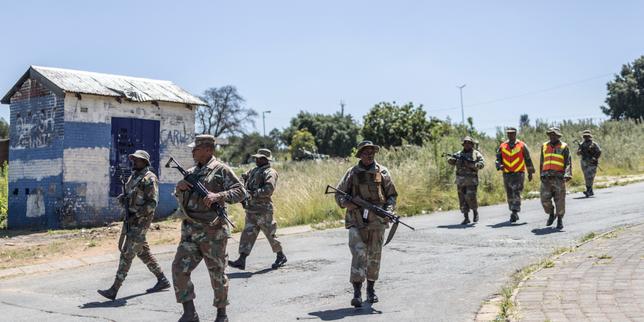
The deployment of the South African National Defence Force (SANDF) into the Diepkloof district of Soweto for a duration of two hours represents a fundamental collapse of the state’s monopoly on violence. When a sovereign entity utilizes high-value military assets for durations shorter than a standard transit cycle, the objective shifts from operational suppression to symbolic performance. This disconnect between the scale of the crisis—Johannesburg’s escalating violent crime rate—and the brevity of the intervention highlights a structural breakdown in the South African security apparatus. To understand why such "flash deployments" fail, one must analyze the interplay between urban density, criminal entrenchment, and the diminishing marginal utility of brief military presence.
The Friction of Urban Insurgency and the Two Hour Paradox
Criminality in Johannesburg, specifically within dense zones like Soweto, functions as a decentralized insurgency rather than a series of isolated incidents. For an intervention to achieve even a temporary "cool-down" effect, it must exceed the OODA loop (Observe, Orient, Decide, Act) of the criminal organizations it targets.
A two-hour deployment is mathematically insufficient to disrupt these cycles for several reasons:
- Intelligence Lag: Military units entering a high-density urban environment require an orientation phase to identify high-risk nodes. Criminal elements, possessing superior local knowledge, can simply wait out a 120-minute window.
- The Elasticity of Crime: Law enforcement presence acts as a temporary deterrent that creates a "pressure cooker" effect. Without sustained presence, the crime rate does not decrease; it merely displaces temporally. Once the SANDF vehicles exit the perimeter, the vacuum is filled instantly, often with increased volatility as groups re-establish dominance.
- Resource Exhaustion: The logistical cost of mobilizing armored personnel and specialized infantry for a 120-minute window yields a negative return on investment. The fuel, man-hours, and wear on equipment are expended without capturing any strategic territory or dismantling any criminal infrastructure.
The Three Pillars of State Impotence
The Soweto deployment serves as a diagnostic tool for identifying the three primary failures within the South African Department of Defence and the Police Service (SAPS).
1. The Erosion of Operational Permanence
Security is a function of consistency. In high-crime corridors, the "Broken Windows Theory" is superseded by the "Control of Space Theory." If the state cannot maintain a 24-hour presence in a contested zone, it signals to non-state actors that the territory is up for grabs. The SANDF is being used as a cosmetic patch for a SAPS that is currently suffering from a 20% deficit in frontline personnel relative to the population growth of Gauteng province.
2. Information Asymmetry and the Look-Out Economy
In neighborhoods like Diepkloof, criminal syndicates utilize a "look-out economy" where residents are paid to monitor police movements. A military convoy is high-visibility and low-speed. By the time the first SANDF vehicle enters the Soweto arterial roads, every high-value target has already transitioned into a "stealth mode" or exited the area. The military is effectively shadow-boxing with an enemy that has been alerted via encrypted messaging long before the deployment begins.
3. The Legal-Tactical Mismatch
The SANDF is trained for conventional warfare, not urban policing. When soldiers are deployed into Soweto, they operate under restrictive Rules of Engagement (ROE) that often leave them less effective than specialized police units like the Hawks or the Tactical Response Team (TRT). This creates a situation where the army is present but legally toothless, further eroding the fear-based deterrence that is the army's only real currency in domestic settings.
Quantifying the Security Gap: The Cost of Performative Policing
The economic impact of Johannesburg's insecurity can be calculated through a Cost of Risk Function. As the probability of violent crime ($P$) increases, the cost of doing business ($C$) rises exponentially due to insurance premiums, private security requirements, and lost labor hours.
$$C(R) = \int (P \cdot L) + S$$
Where:
- $P$ = Probability of a criminal event
- $L$ = Magnitude of loss (physical or capital)
- $S$ = Static costs of private security infrastructure
When the state provides a two-hour window of safety, $P$ remains virtually unchanged for 92% of the day. For businesses and residents, the $S$ variable (private security) remains a permanent necessity. Therefore, the SANDF deployment provides zero economic relief to the district. It is a sunk cost that fails to lower the risk premium for local stakeholders.
Structural Bottlenecks in the SAPS-SANDF Integration
The failure of the Soweto intervention is not merely a matter of time; it is a failure of integration. There is a documented lack of "joint-command" proficiency between the military and civilian police.
- Communication Silos: Radio frequencies and data sharing protocols between SAPS and SANDF are often incompatible, leading to delayed response times during active contact.
- Jurisdictional Friction: Soldiers cannot perform arrests without a police officer present. If the ratio of soldiers to officers is skewed—as it was during the Soweto "show of force"—the military becomes a high-priced security guard service rather than an enforcement body.
- Lack of Post-Operational Continuity: A military raid is only as good as the subsequent investigation. When the army leaves after two hours, there is rarely a follow-up "hold and build" phase. The dockets are handed over to overstretched local precincts where cases often stagnate due to lack of forensic capacity.
The Psychological Diminishing Returns
Every time the military is deployed and fails to produce a tangible change in the safety of a neighborhood, the "Aura of the Uniform" is degraded. In 1994, the sight of a military convoy commanded immediate behavioral shifts. In 2026, it is viewed as a momentary traffic inconvenience.
This degradation of symbolic power is dangerous. Once the populace—and the criminal element—realizes the military is a finite and exhausted resource being used for PR stunts, the deterrent effect hits zero. We are currently observing a transition from "State Deterrence" to "Community Vigilantism." When the SANDF fails to secure a neighborhood in two hours, the neighborhood creates its own, often violent, security structures (such as Zama Zama protection rackets or extremist community policing groups).
Tactical Reconfiguration: The "Persistence" Model
To move beyond the failure of the Soweto incident, the security strategy must pivot from high-visibility, short-duration patrols to low-visibility, high-persistence saturation.
The focus must shift to the "Logistics of Crime." Criminality in Johannesburg relies on specific bottlenecks: stolen goods markets, illegal gold processing sites, and transit hubs. Instead of a two-hour sweep of a residential street, resources should be diverted to a 72-hour blockade of the supply lines feeding the criminal economy.
- Isolation of Infrastructure: Identify the three main exit/entry points of a township and maintain a 24/7 technical surveillance perimeter (drones and CCTV) supported by rapid-reaction teams.
- Intelligence-Led Interdiction: Utilize SIGINT (Signals Intelligence) to identify the "command and control" nodes of Soweto gangs rather than focusing on low-level street offenders.
- The "Hold" Phase: If the military is used, it must stay. A minimum 30-day "Hold" period is required to break the social habits of criminal dominance in a specific sector.
The Soweto deployment was not a security operation; it was an admission of exhaustion. The state is attempting to use the military to "signal" a presence it can no longer afford to maintain. Until the intervention duration exceeds the recovery time of the criminal network, these deployments will continue to be expensive exercises in futility. The immediate strategic requirement is the permanent re-allocation of military logistics to support a decentralized, high-tech police presence that operates in minutes and days, rather than hours. Stop the convoys; start the saturation.