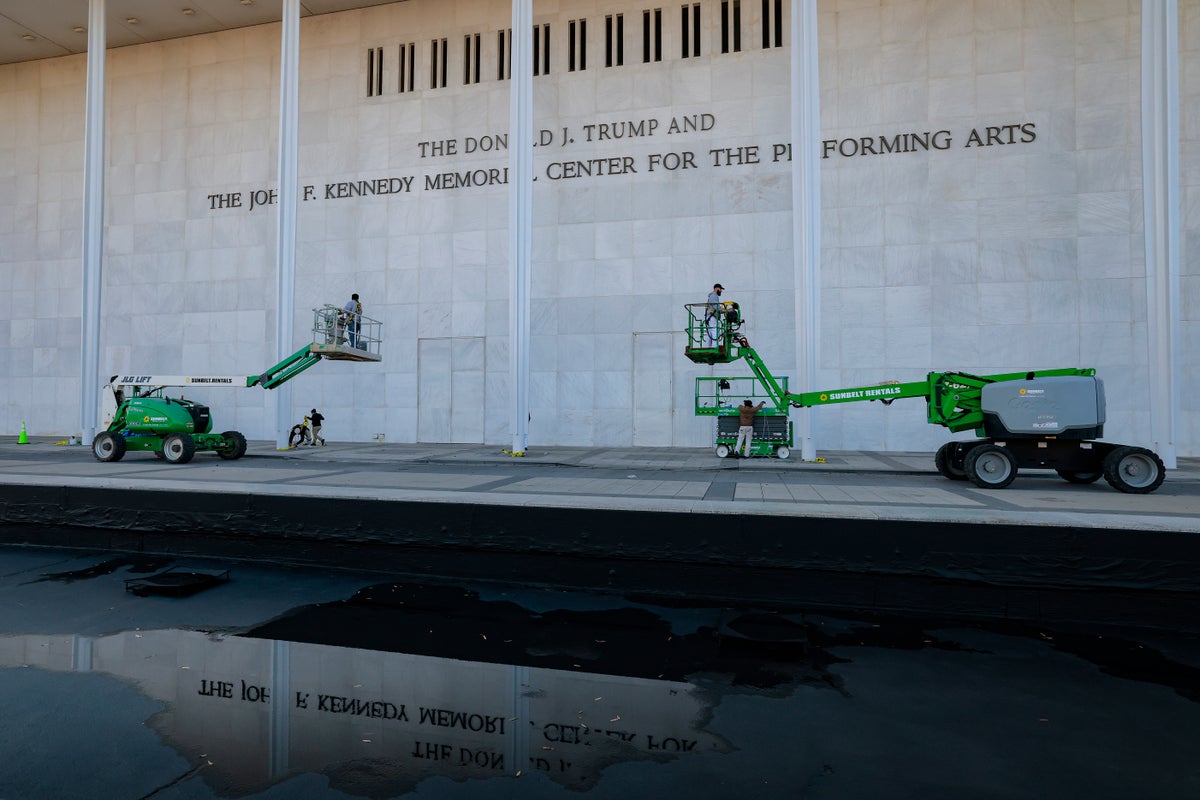
The marble of the Kennedy Center doesn’t just sit there; it glows. On a humid July evening, when the sun dips behind the Potomac and the cicadas begin their rhythmic, mechanical screaming, the building becomes a massive, white lantern. It was never meant to be a fortress of high culture. It was built as a "living memorial," a place where the American spirit wasn't etched into a static bronze statue, but whispered through the vibrato of a cello or the thundering footfalls of a dance troupe.
Now, a quiet war has moved from the stage to the scaffolding.
To understand why a coalition of architects and historians is currently standing in a federal courtroom, you have to look past the press releases and the political posturing. You have to look at the stone itself. The Trump administration has moved with a velocity that has left the preservation community breathless, pushing a "hastily" conceived makeover that critics say will permanently scar Edward Durell Stone’s mid-century masterpiece.
It isn't just about a new wing or a fresh coat of paint. It is about the soul of a space that was designed to be the nation’s front porch.
The Architect’s Ghost
Edward Durell Stone was a man obsessed with light. When he designed the John F. Kennedy Center for the Performing Arts, he didn't want a heavy, neoclassical tomb. He wanted something that floated. He gave it thin, golden columns and an ethereal airiness that felt like the optimism of the 1960s.
Imagine, for a moment, a hypothetical young violinist named Elena. She has practiced in windowless basements for fifteen years. When she finally walks into the Kennedy Center, she feels the height of the ceilings and the deliberate flow of the Grand Foyer. The architecture tells her that her art matters. It tells her she is part of a lineage.
But if you strip away the intentionality of that design—if you gut the interiors or slap on additions that ignore the original proportions—you break that spell.
The lawsuit filed by groups like the Committee of 100 on the Federal City and various architectural preservationists isn't a petty squabble over floor plans. It is a desperate attempt to stop what they call a "gutting." They argue that the administration is bypassing the slow, grinding, but necessary gears of federal oversight. Usually, when you touch a national treasure, you have to answer a thousand questions from a dozen different boards. You have to prove that your "progress" won't destroy the very history you claim to be honoring.
In this instance, the plaintiffs claim the process wasn't just fast—it was a sprint toward a foregone conclusion.
The Invisible Stakes of Speed
Speed is the enemy of nuance. In the world of urban planning, "hasty" is a four-letter word. When the executive branch decides to bypass the standard review processes, it ignores the collective memory of the city.
Consider the "living" part of the memorial. The Kennedy Center was always intended to be a place for the people. But there is a delicate balance between modernization and desecration. The current plans involve significant alterations to the landscape and the structural integrity of the original vision. To the casual observer, a new glass wall or a relocated entrance might seem like a minor convenience. To a historian, it is like taking a Sharpie to a Monet because you wanted to see more blue.
The administration’s defense often hinges on the idea of efficiency. They want to "get things done." They want to modernize a facility that they view as aging and inefficient. There is a certain logic to that—anyone who has tried to navigate the parking garage or find a bathroom during a sold-out intermission knows the building has its quirks.
However, the cost of efficiency is often the loss of character. We have become a culture that prizes the "new" over the "enduring." We want everything to be a "game-changer," a word that has been used so often it has lost all meaning. But some things shouldn't change. Some things are meant to be anchors.
The Human Cost of a Concrete Scar
Walk down the long, red-carpeted halls of the Hall of States. Look at the flags. There is a specific silence there, even when the building is crowded. It is the silence of a shared identity.
The architects suing to stop the project are worried that once the demolition begins, there is no going back. You cannot "un-gut" a building. You cannot restore the original patina of a vision once it has been sliced open to accommodate a different aesthetic.
There is a man named Arthur, a hypothetical retired schoolteacher who has attended the National Symphony Orchestra every month since 1978. For him, the Kennedy Center is a map of his life. He remembers where he sat when he heard Rostropovich play. He remembers the specific way the light hit the plaza before the new additions started creeping in. For Arthur, this isn't about politics or "Trump's DC makeover." It’s about the erasure of his landscape. It’s about the feeling that the places he loves are being treated as disposable assets rather than sacred trusts.
The lawsuit alleges that the "haste" of the project has prevented the public from fully understanding what is being lost. It suggests that by the time the dust settles, the "Living Memorial" will be a different creature entirely—one that serves the ego of the present more than the legacy of the past.
The Trial of the Trowel
The legal battle centers on the National Environmental Policy Act and the National Historic Preservation Act. These aren't just dry pieces of legislation; they are the shield for our national heritage. They require the government to stop and listen. They require an accounting of the "invisible stakes"—the psychological impact of losing a piece of our collective history.
Critics of the lawsuit call it "NIMBYism" or political obstruction. They point to the need for updated security and modern amenities. And they aren't entirely wrong. A museum or a theater that cannot adapt will eventually die.
But there is a middle ground between stagnation and destruction.
The plaintiffs aren't asking for the building to be encased in amber. They are asking for the law to be followed. They are asking for the "haste" to be replaced with "hesitation." In a world that moves at the speed of a thumb-swipe, hesitation is a radical act. It is the act of saying: Wait. Is this actually better? Or is it just newer?
The Kennedy Center was born out of a tragedy—a tribute to a president who believed that the arts were the ultimate expression of a free society. To "gut" it without the proper discourse feels like a betrayal of that very freedom. It suggests that the beauty of our public spaces is subject to the whims of whoever holds the pen at any given moment.
The Echo in the Foyer
If you visit the center today, you can still feel the original intent. You can see the way the light reflects off the Potomac and spills into the glass. You can hear the ghosts of a thousand performances echoing in the rafters.
But if the cranes arrive and the walls come down before the courts can decide if the process was fair, those echoes will change. They will become the sound of jackhammers.
The architects and history groups aren't just fighting for marble and mortar. They are fighting for the idea that some things are bigger than any one administration. They are fighting for the right of future generations to walk into that white lantern and feel the same sense of wonder that Elena the violinist feels today.
Progress is often measured in cubic feet of poured concrete. But true progress is knowing when to leave the trowel in the bucket. It is the wisdom to recognize that a masterpiece isn't something you finish; it’s something you protect.
As the sun disappears completely and the lights of the Kennedy Center flicker on, the building stands as a testament to a specific American dream. It is a dream of elegance, of accessibility, and of a history that breathes. Whether that breath will be cut short by the rush of a "makeover" remains to be seen in a courtroom. Until then, the marble continues to glow, defiant and fragile, waiting for the verdict of the people who call it their own.
One day, the scaffolding will come down. The only question is whether we will recognize what is left behind. Or if we will realize, too late, that in our hurry to build the future, we accidentally demolished the foundation of our past.
The wind off the river picks up, catching the flags in the Hall of Nations. They snap and flutter, a restless sound in a building that was designed to be a sanctuary. For now, the sanctuary holds. But the shadows of the cranes are long, and the clock in the courtroom is ticking.
The marble stays cold. The debate stays white-hot. And the living memorial waits to see if it will survive the very people it was built to inspire.