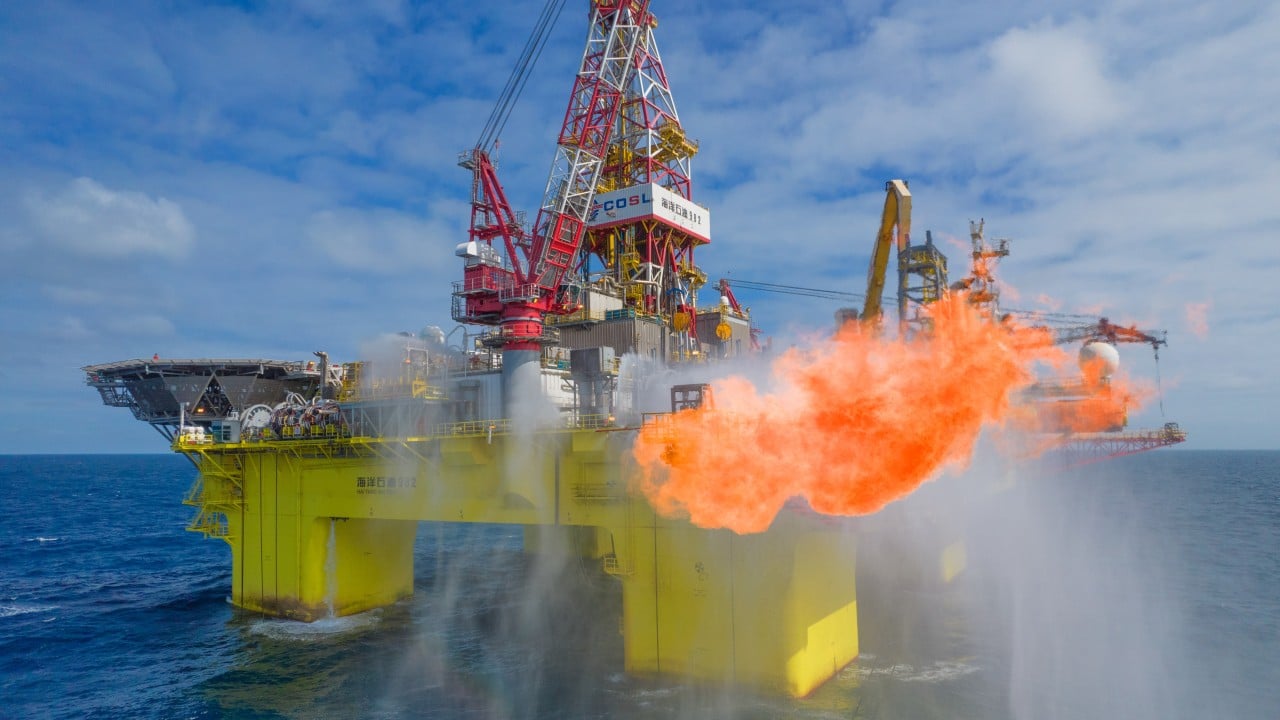
China National Offshore Oil Corporation (CNOOC) is currently executing a capital expenditure strategy designed to decouple Chinese energy security from Middle Eastern volatility. This shift is not merely a reaction to "strife" but a calculated recalibration of the risk-adjusted return on domestic vs. international assets. While Western supermajors face intensifying pressure to pivot toward low-carbon portfolios, CNOOC is doubling down on hydrocarbon extraction, specifically targeting deepwater and unconventional reserves within the South China Sea and Bohai Bay. This creates a divergence in the global energy market where a state-backed entity optimizes for volume and security of supply over short-term dividend yield.
The Triad of Energy Sovereignty
CNOOC’s operational model rests on three distinct pillars that dictate its current production surge. Each pillar addresses a specific vulnerability in the Chinese economy.
- Supply Chain Immunization: By increasing domestic offshore production, CNOOC reduces the percentage of crude oil that must pass through the Malacca Strait—a primary strategic choke point.
- Cost-Curve Domination: Unlike private entities, CNOOC’s cost of capital is subsidized by state policy, allowing it to greenlight projects with internal rates of return (IRR) that would be non-viable for competitors.
- Technological Leapfrogging: The shift to deepwater exploration serves as a laboratory for indigenous subsea technology, reducing reliance on Western oilfield services.
Measuring the Displacement of Middle Eastern Imports
The core objective of CNOOC’s production hike is the reduction of the "Import Dependency Ratio." In 2023, China’s reliance on foreign crude surpassed 70%. The logic of CNOOC’s 2024–2026 production targets—aiming for 700 to 720 million barrels of oil equivalent (boe)—is to flatten this dependency curve.
Every additional barrel produced in the Bohai Sea or the Pearl River Mouth Basin functions as a hedge against a potential blockade or a price spike triggered by regional conflict in the Persian Gulf. The marginal cost of domestic production may be higher than extracting Saudi Light, but the "Security Premium" (the value of having guaranteed access during a crisis) justifies the expenditure.
The Offshore Extraction Function
To understand how CNOOC achieves these targets, we must examine the Offshore Extraction Function ($E$). Production ($P$) is a result of capital injection ($I$), technological efficiency ($T$), and the geological decline rate ($D$) of existing brownfield sites:
$$P = f(I, T) - D$$
CNOOC has aggressively inflated $I$ to counteract the natural $D$ of aging fields. The 2024 capital expenditure budget, set between 125 billion and 135 billion yuan, focuses heavily on "Frontier Exploration." This is a departure from the "Harvest Phase" logic of the 2010s. The company is now in an "Aggressive Replacement Phase," seeking to prove reserves faster than it can pump them.
Deepwater Horizons and the Subsea Tech Stack
The transition from shallow-water to deepwater (depths exceeding 300 meters) and ultra-deepwater (depths exceeding 1,500 meters) represents a quantum leap in engineering complexity. CNOOC’s "Shenhai-1" (Deep Sea No. 1) station is the physical manifestation of this strategy.
- Weight Constraints: Designing semi-submersible platforms that can withstand typhoons while supporting massive drilling rigs.
- Pressure Management: Managing the extreme hydrostatic pressure at the seabed which requires specialized alloy pipelines.
- Thermal Regulation: Preventing paraffin buildup in subsea pipes where temperatures are near freezing, despite the crude being hot.
These technical challenges create a high barrier to entry. By mastering these, CNOOC ensures that it remains the sole operator capable of exploiting the disputed territories of the South China Sea, effectively using industrial capacity as a tool of maritime sovereignty.
Geopolitical Friction and the Strait of Hormuz Variable
The intensification of conflict in the Middle East acts as a catalyst for CNOOC’s "Acceleration Clause." When the Houthi movement disrupts Red Sea shipping or tensions rise in the Strait of Hormuz, the Brent-WTI spread becomes secondary to the physical availability of molecules.
CNOOC’s strategy assumes a permanent state of global instability. This "Permacrisis" mindset leads to different capital allocation than the "Peace Dividend" mindset of the late 1990s. The company is prioritizing "Proved Undeveloped" (PUD) reserves, moving them into the "Proved Developed Producing" (PDP) category at an accelerated clip.
The Mismatch in Global Refining
A critical bottleneck often ignored in high-level analysis is the refining mismatch. Chinese refineries, particularly the "teapots" in Shandong, were originally optimized for heavy, sour crudes from the Middle East and Russia. CNOOC’s domestic offshore production tends to be lighter or requires different processing configurations. Consequently, the production surge necessitates a secondary wave of capital investment in refinery retrofitting to ensure that the domestic "crude-to-fuel" pipeline is friction-less.
Natural Gas as the Transition Bridge
CNOOC is not just an oil company; it is increasingly a gas company. The "Green Development Plan" mandates that natural gas becomes a larger share of the total output mix, targeting 35% by 2025. This is driven by three factors:
- Urban Air Quality: Converting coal-fired heating to gas in coastal provinces.
- Industrial Feedstock: Providing a reliable supply for the massive petrochemical clusters in Guangdong and Zhejiang.
- Electricity Baseload: Supplementing intermittent wind and solar power with fast-ramping gas turbines.
The development of the "Gas Powerhouse" in the South China Sea—specifically the Yinggehai and Qiongdongnan basins—is intended to create a subsea "Power Grid" of pipelines feeding directly into the Greater Bay Area. This reduces the need for expensive Liquefied Natural Gas (LNG) imports from the United States or Australia, which carry both high price volatility and political risk.
Financial Risk and the ESG Divergence
While CNOOC’s operational trajectory is upward, it faces a bifurcated financial environment. Western institutional investors, bound by Environmental, Social, and Governance (ESG) mandates, have largely divested from CNOOC due to its fossil fuel intensity and its placement on various U.S. sanctions lists.
This divestment has forced CNOOC to rely on domestic equity markets and state-directed bank credit. The result is a company that is immune to the "Carbon Activism" seen in the boardrooms of Shell or BP. This immunity allows CNOOC to pursue a 10-year horizon for oil projects that Western peers would be forced to abandon. The primary risk here is not a lack of capital, but a lack of "Operational Discipline" that comes from rigorous market scrutiny. Over-investment in marginal fields could lead to a massive "Stranded Asset" problem if global demand peaks earlier than anticipated.
The Cost of Indigenous Innovation
A second risk factor is the "Technology Gap." While CNOOC has made strides in semi-submersible rigs, it still lags in high-end sensors, precision seismic imaging software, and certain types of specialized drilling bits. The restriction on Western technology transfers means CNOOC must often "reinvent the wheel," leading to higher R&D costs and longer project timelines.
Strategic Forecast for the 2026 Horizon
By 2026, CNOOC will likely hit its production ceiling of approximately 780 million boe. At this point, the gains from shallow-water brownfield optimization will be exhausted. The company’s long-term viability will then depend entirely on its success in the ultra-deepwater "Frontier" zones.
The strategic play for CNOOC is to maintain a "Dual-Track" system:
- Track A: Aggressive domestic extraction to insulate the Chinese economy from external shocks.
- Track B: Strategic partnerships with "Global South" producers (Guyana, Brazil, Africa) to secure equity oil that does not rely on Western financial infrastructure.
CNOOC’s expansion is the most significant indicator of a world fracturing into regional energy blocs. The era of a singular, liquid global oil market is being replaced by a fragmented system where "Molecular Security" is valued more highly than "Market Efficiency."
For the global observer, the signal is clear: China is preparing for a world where the Middle East is no longer a reliable gas station. To compete or cooperate with CNOOC requires an understanding that they are playing a game of "Physical Hedging," where the rig on the horizon is as much a defensive fortification as it is an industrial asset. The next strategic move is the integration of offshore wind with oil platforms—using "Green" energy to power "Brown" extraction—thereby lowering the carbon intensity of the barrel while maintaining the volume necessary for national survival. This "Energy Hybridization" will be the next frontier of CNOOC’s operational evolution.