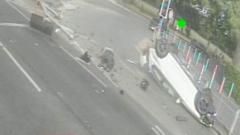
A man loses control of his car. It slams into a barrier. Most people would call for help or wait for the police. Instead, he climbs out of the wreckage and kills a total stranger. This isn't a plot from a low-budget horror flick. It happened. The CCTV footage capturing the moments before and after the tragedy provides a chilling look at a mind that had clearly snapped.
When we talk about "random acts of violence," we usually mean a mugging gone wrong or a bar fight that escalated. This was different. There was no connection. No history. Just a sequence of chaotic events that ended in a senseless loss of life. Understanding how a routine traffic accident turned into a homicide investigation requires looking closely at the evidence the court finally went through.
The Seconds That Changed Everything
The video starts like any other traffic camera feed. You see the car traveling at a speed that's clearly too high for the conditions. Then comes the impact. Metal twists. Glass shatters. For a few seconds, the scene is quiet. You'd expect the driver to be slumped over the wheel or stumbling out in a daze.
He didn't look dazed. He looked purposeful.
According to the evidence presented during the trial, the perpetrator didn't check his own injuries. He didn't look at the smoking engine. He scanned the immediate area for a target. The victim happened to be in the wrong place at the exactly wrong time. This wasn't a crime of passion. It wasn't premeditated in the traditional sense where you plan for weeks. It was an explosion of lethal intent triggered by a mechanical failure.
Why Random Violence Breaks Our Sense of Safety
We like to believe that if we play by the rules, we’re safe. Don't get into debts with the wrong people. Stay away from dark alleys. Keep your doors locked. But this incident throws all those "rules" out the window. The victim was just living their life.
Psychologists often point out that these types of crimes are the hardest for a community to process. There's no "why" that makes sense. If someone is robbed, we understand the motive is greed. If there's a domestic dispute, we understand the motive is anger or control. When a car crash leads directly to a murder of a bystander, the motive is a void.
The CCTV footage serves as a brutal reminder that the thin veneer of civilization can peel back in an instant. The prosecutor noted that the transition from "driver" to "killer" took less than a minute. That’s a terrifyingly short window for a human life to be extinguished.
The Role of Digital Evidence in Modern Convictions
Gone are the days when a case like this would rely solely on shaky eyewitness accounts. People forget details. They get the color of the jacket wrong. They misjudge how much time passed.
The camera doesn't forget.
In this specific case, the high-definition footage allowed the jury to see the perpetrator's body language. It wasn't the body language of someone in shock. It was aggressive. It was predatory. This kind of digital trail makes it nearly impossible for a defense team to argue "temporary insanity" or "diminished capacity" effectively when the movements look so deliberate.
What the Court Reports Don't Always Mention
Publicly available documents and news snippets often skip the technical details of the crash itself. Forensic mechanical experts had to determine if the car failed first or if the driver’s erratic behavior caused the crash. The consensus was clear: the driver's actions were the primary catalyst.
There's also the ripple effect. We focus on the victim and the killer, but the people who watched the CCTV in real-time—the operators and the first responders—carry that weight too. Seeing a murder happen through a screen in high definition is a specific type of trauma that's becoming more common in our surveillance-heavy society.
Breaking Down the Timeline of the Incident
- The initial loss of vehicle control.
- The high-speed impact with stationary objects.
- The exit from the vehicle without self-assessment.
- The immediate pursuit of a nearby pedestrian.
- The fatal encounter.
Each step happened with a terrifying fluidity. The police arrived within minutes, but the damage was already done. It’s a testament to how fast a situation can turn from a code blue to a homicide.
Reality Check on Public Safety and Mental Health
It’s easy to call this man a "monster" and move on. That’s the comfortable route. But the reality is more complex. We have to ask what kind of state someone is in to react to a car wreck with a violent outburst. Was it a psychotic break? Was it under the influence of synthetic substances that don't always show up on standard panels?
The defense often tries to paint these individuals as victims of their own chemistry. The prosecution, however, stuck to the facts of the footage. You can't argue with what everyone can see with their own eyes. The victim’s family had to sit through those loops of video, watching the final moments of their loved one over and over again. It’s a grueling part of the legal process that rarely gets enough empathy.
Staying Aware in an Unpredictable World
You can't live your life in a bunker. That’s no way to exist. But incidents like this crash-turned-murder highlight the importance of situational awareness. It sounds like "prepper" talk, but it’s just basic survival. If you see a high-impact collision, your instinct might be to run toward it to help.
Sometimes, helping is the right move. Other times, you need to keep your distance until you can see the temperament of the people involved. It’s a cynical way to look at the world, but in 2026, it’s a necessary one.
The legal system eventually caught up with the man in the video. He won't be back on the streets anytime soon. But the footage remains, archived in a cloud somewhere, a digital ghost of a day when everything went wrong.
If you ever find yourself witnessing a major traffic incident, prioritize your own safety before jumping in. Call emergency services immediately. Describe the behavior of the occupants of the car, not just the damage to the vehicle. That information is vital for the responding officers. Keeping a cool head and a sharp eye can be the difference between being a witness and being a victim.