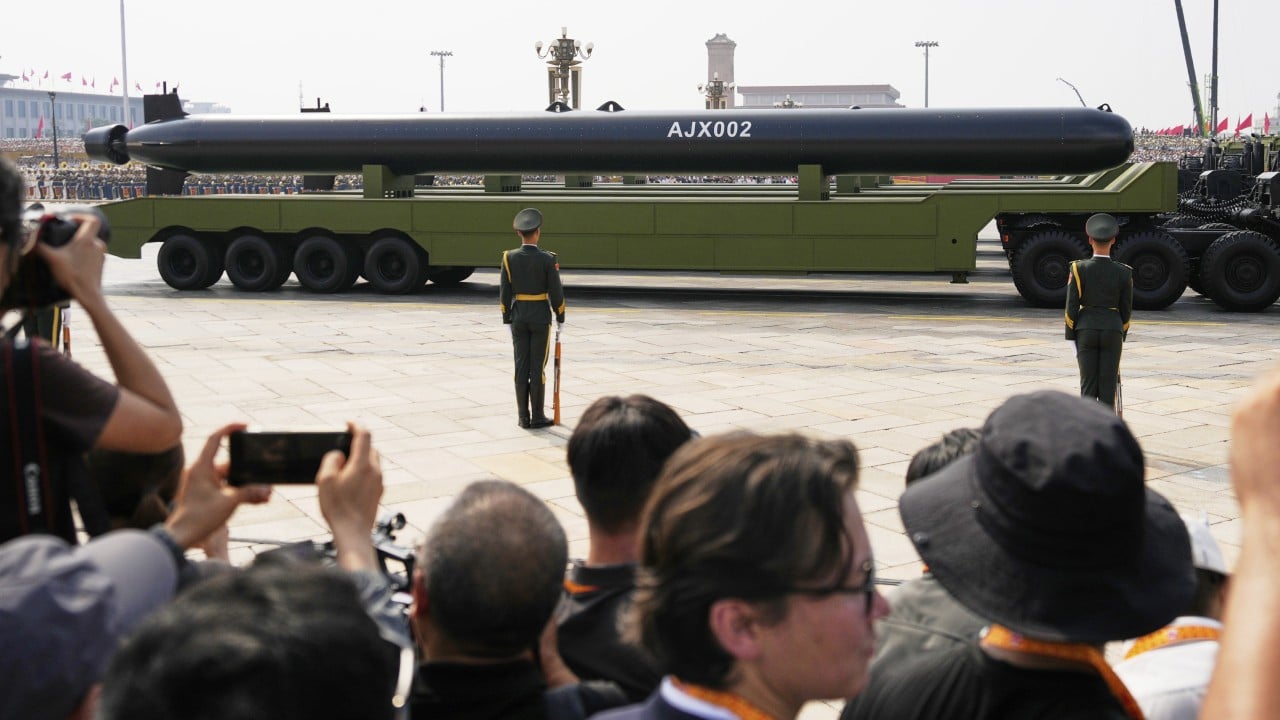
The headlines are practically screaming for your attention: "China not targeting US West Coast with ultra-large underwater drones." It sounds like a sigh of relief. A lead scientist stands at a podium and assures the world that these massive, autonomous leviathans are just for research, for science, for anything but sinking a carrier or severing an internet cable near San Francisco.
If you believe that, you are playing right into the hands of a very deliberate shell game.
The debate over whether an Extra-Large Uncrewed Underwater Vehicle (XLUUV) is "targeting" a specific shoreline is the wrong question. It’s a distraction designed for people who still view naval warfare through the lens of 1944. Modern maritime dominance isn't about parking a drone outside the Port of Los Angeles to blow up a pier. It is about the "gray zone"—the space where deniability meets absolute strategic paralysis.
When a scientist claims a drone isn't for an attack on the West Coast, they are technically telling the truth because the West Coast isn't the prize. The prize is the invisible infrastructure of the global economy, and you don't need a drone to cross the Pacific to hold it hostage.
The Myth of Range and the Reality of Persistence
The "lazy consensus" in defense reporting focuses on range. Journalists look at the fuel capacity of a drone like the HSU-001 or its larger successors and calculate if it can reach San Diego from Qingdao. This is amateur-hour analysis.
Subsea warfare is no longer about the "voyage." It is about persistence.
A nuclear submarine is a marvel of engineering, but it is loud, expensive, and carries a hundred souls. When it moves, the acoustic signatures are tracked by SOSUS (Sound Surveillance System) arrays and handled by P-8 Poseidons. An XLUUV, however, doesn't need to return for dinner. It can sit on the seafloor in a low-power "hibernation" mode for months.
I have seen planners spend years trying to solve the "battery problem" for autonomous systems. The breakthrough isn't making a drone that swims further; it’s making a drone that waits better. If China or any other power deploys these assets, they aren't "targeting the coast" in a linear path. They are seeding the environment.
The Cable Trap: Why Ships Don't Matter
Everyone loves a photo of a carrier. They are the shiny objects of geopolitics. But the real vulnerability—the one these drones are actually designed to exploit—is the fiber-optic network.
Ninety-nine percent of international data travels through undersea cables. If you want to crash the US economy, you don't need to fire a single shot at a coastal city. You just need to snip the lines.
The competitor's article focuses on the "scientific" nature of these drones. Let’s look at that through a different lens. A drone designed to "map the seabed for minerals" uses the exact same sensors required to identify the precise location of a shielded communication cable.
The Cost-Exchange Ratio
- A Virginia-class submarine: ~$3.5 billion.
- An XLUUV: ~$10 to $50 million.
- The Damage: Cutting the Pacific Light Cable Network could freeze billions in financial transactions per second.
The math is brutal. You can lose fifty drones for every one submarine you disable, and you still win the economic war. This is the "nuance" the mainstream press misses: the drone doesn't have to be a high-tech masterpiece. It just has to be cheap enough to be a nuisance that costs the enemy billions to find and counter.
Dismantling the "Scientific Research" Alibi
We’ve seen this play before. The "Dual-Use" doctrine is the ultimate get-out-of-jail-free card.
When a lead scientist says a drone is for "oceanographic data collection," they are being honest. They are collecting data. They are mapping the thermoclines—layers of water with different temperatures—that reflect sonar.
If you know exactly where the thermoclines are in the Philippine Sea or the Central Pacific, you know exactly where a manned submarine can hide to be invisible to surface radar. "Research" is just another word for "battlefield preparation."
To claim these drones aren't "targeting" the West Coast because they are doing science is like saying a thief isn't targeting your house because he’s just "testing the durability of your window locks."
The "People Also Ask" Delusion
When people ask, "Can a drone reach the US?" they are looking for a "yes" or "no" to feel safe. The brutal truth is that it doesn't matter.
The strategy is Distributed Maritime Operations.
Imagine a scenario where dozens of these ultra-large drones are deployed from merchant vessels—not warships—thousands of miles from their target. They aren't "launching an invasion." They are becoming a permanent, autonomous presence in the shipping lanes.
Why Conventional Defense Fails
- Acoustic Masks: These drones are small enough to hide in the acoustic shadows of large cargo ships.
- No Bio-Signatures: They don't breathe. They don't have a heartbeat. They don't need oxygen.
- Attrition: We have a limited number of expensive torpedoes. They have a potentially unlimited number of cheap drones.
We are trying to fight a swarm with a sniper rifle. It doesn't work.
The Power of Deniability
The most terrifying thing about an XLUUV isn't its payload; it's its lack of a flag.
If a Chinese destroyer fires a missile at a US ship, that’s World War III. If a "civilian" research drone, operating autonomously, happens to collide with a submarine or settle on top of a cable, what is the response?
"It was a technical glitch."
"The AI malfunctioned."
"It was a private research firm, not the military."
This is the "gray zone" I mentioned earlier. By the time we've finished the legal debate over whether the drone's presence constituted an act of war, the strategic damage is already done. The competitor's article plays right into this by focusing on "intent" and "targeting." In the world of autonomous systems, intent is whatever the programmer says it was after the fact.
Stop Looking at the Map, Start Looking at the Clock
The West is obsessed with "the line." We look at the First Island Chain, the Second Island Chain, and the West Coast. We think in terms of crossing those lines.
The adversary is thinking in terms of time.
If they can populate the ocean floor with "scientific" sensors today, they own the undersea domain tomorrow. These ultra-large drones are the construction equipment for a new, submerged Great Wall. They aren't meant to travel to California; they are meant to ensure that nobody else can travel through the Pacific without being heard, tracked, and—if necessary—neutralized.
The Hard Truth About Maritime Superiority
The era of the "uncontested ocean" is dead.
We’ve spent decades assuming the deep ocean was a desert that only we had the technology to cross. These drones prove that the desert is being occupied.
The talk about "not targeting the West Coast" is a sedative. It’s meant to keep the public focused on a Hollywood-style invasion scenario while the real war—the war for the seabed, for the cables, and for acoustic dominance—is being won through "oceanographic research."
Don't look for a drone off the coast of California. Look for the hundreds of "research" vessels currently mapping every inch of the Pacific floor. That is where the attack is happening.
The drones aren't coming for our shores. They are already under our feet.