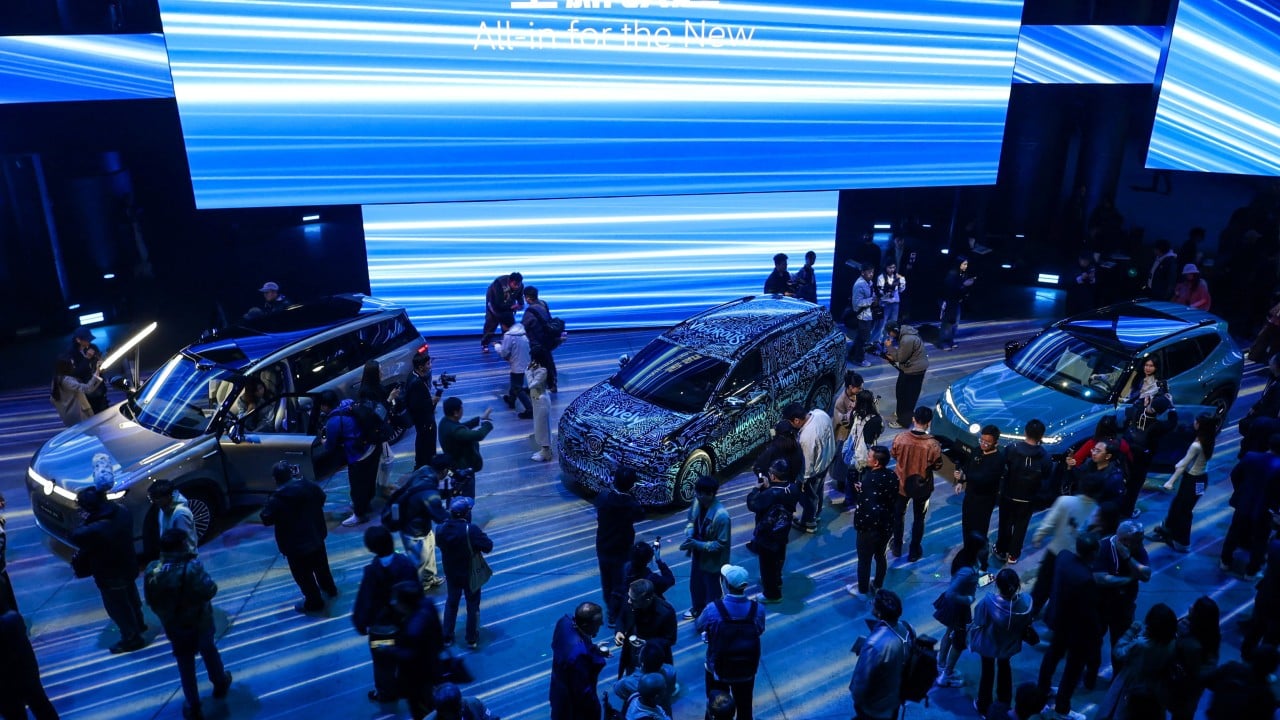
Volkswagen is attempting to buy its way out of an existential crisis by surrendering the one thing German engineers hold sacred: total control. The company is currently rolling out a massive "In China, for China" strategy that effectively treats its European headquarters as a legacy back office while handing the keys of innovation to local partners and a new R&D nerve center in Hefei. By launching the ID.UNYX 08—the first vehicle co-developed with Chinese EV upstart XPeng—Volkswagen is betting that a hybrid of German manufacturing and Chinese software can stop a catastrophic slide in market share.
The urgency is fueled by a brutal reality check. Just two years ago, VW was the undisputed king of the Chinese road. Today, it is fighting to stay in the top three as local giants like BYD and tech insurgents like Xiaomi rewrite the rules of what a car should be. To compete, VW has had to slash its development cycles by 30% and its costs by nearly half. This isn't just a product launch; it is a controlled demolition of the traditional "Wolfsburg knows best" hierarchy. Don't miss our previous post on this related article.
The Hefei Pivot
For decades, Volkswagen operated on a centralized model. A part designed in Germany would be slightly modified for the Chinese market, a process that took roughly 50 months. In the current Chinese EV market, 50 months is an eternity. By the time a German-designed EV hit the showroom in Shanghai, its infotainment system looked like a relic and its battery specs were already superseded by three different local rivals.
The solution is the Volkswagen Group China Technology Company (VCTC) in Hefei. This isn't a mere satellite office. It is the largest development hub outside of Germany, staffed with over 3,000 engineers who have the autonomy to source local components and make executive decisions without waiting for a signature from Lower Saxony. This hub is the birthplace of the China Main Platform (CMP), a dedicated architecture designed to achieve cost parity with local brands in the hyper-competitive compact segment. To read more about the history here, The Motley Fool provides an in-depth breakdown.
The XPeng Injection
The most radical shift in this strategy is the partnership with XPeng. VW invested $700 million into the Guangzhou-based firm not just for a seat at the table, but for its nervous system. The result is the China Electronic Architecture (CEA), a zonal E/E structure that reduces the number of electronic control units (ECUs) by 30%.
Traditional cars are a "spaghetti" of wires and independent computers for every function—one for the windows, one for the brakes, one for the seats. The CEA collapses these into a high-performance central computing platform.
- Speed: It allows for full-vehicle over-the-air (OTA) updates, meaning the car can actually improve after it leaves the lot.
- Cost: By streamlining the hardware, VW claims it can reduce development costs for new models by up to 50% in specific projects.
- Integration: This architecture is being baked into both EVs and internal combustion engines, a desperate move to ensure that even their gas-powered cars don't feel like "dumb" machines compared to a Xiaomi SU7.
Survival by Sub-Brand
The launch of ID.UNYX represents a psychological break for the brand. VW realized that the "ID" badge, while successful in Europe, carried the baggage of being perceived as "sensible" rather than "tech-forward" in China. UNYX is the attempt to capture a younger, lifestyle-oriented demographic that views a car as a mobile device rather than a status symbol of traditional engineering.
The ID.UNYX 08 SUV, which started series production in March 2026, is the lead scout for an army of 30 new models planned through 2027. The cadence is relentless—on average, a new vehicle or major update every two weeks. This "China Speed" is the only way to counter the "blitzkrieg" tactics of local manufacturers who launch new models with the frequency of smartphone releases.
The Subsidy Mirage
Ironically, while VW is racing to modernize, it recently reclaimed the top spot in overall monthly sales—but not because it won the EV war. A reduction in government subsidies for EVs and the end of purchase tax exemptions hit local budget brands like BYD harder than expected. Consumers briefly retreated to the perceived safety of Toyota and VW hybrids and high-efficiency gas cars.
However, this is a temporary reprieve. The structural shift toward "Intelligent Connected Vehicles" (ICVs) is permanent. VW’s leadership knows that the current sales bump is a "dead cat bounce" for internal combustion if they cannot master the software-defined vehicle. If the CMP and the XPeng-powered architecture fail to resonate, VW risks becoming a "white label" manufacturer—providing the metal and the wheels while Chinese tech firms provide the brains and the profits.
The Cost of Autonomy
The "In China, for China" strategy is a double-edged sword. By creating a China-specific ecosystem, VW is effectively bifurcating its global operations. A Volkswagen bought in Berlin will soon have almost nothing in common with one bought in Beijing, from the software stack to the chassis underpinnings.
This fragmentation kills the "Global Platform" dream that made VW a titan in the 2000s. It creates massive internal complexity and risks a future where the Chinese division becomes so autonomous that it no longer needs Wolfsburg at all. But for a company that watched its profits in China drop 44% in a single year, the risk of fragmentation is nothing compared to the risk of irrelevance.
Volkswagen isn't just testing the market's appetite for locally developed EVs. It is testing whether a 90-year-old industrial giant can transplant its heart and still keep walking. The ID.UNYX 08 is the first pulse of that new heart. If it falters, no amount of German engineering will be able to jumpstart the brand's future in the world's most important car market.