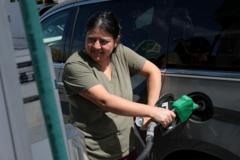
The plastic handle of the pump is always colder than you expect it to be. It’s early morning in a suburb outside of Des Moines, and the digital numbers on the screen are blurring past with a speed that feels aggressive.
Five dollars. Ten. Fifteen.
Elena watches the flicker of the red LED display. She isn't looking at the gallons; she’s looking at the ticking cost of her commute. She knows the math of her life to the penny. A year ago, this stop was a minor chore, a background noise in the symphony of a Tuesday. Now, it is a calculation of sacrifice. If the total hits sixty, the organic milk stays on the shelf this week. If it hits seventy, she skips the Friday night takeout.
This isn't just a story about oil. It is a story about the invisible tax on breathing room.
According to the latest federal data, the United States is currently grappling with the sharpest inflationary spike in nearly two years. The culprit sitting center stage is gasoline. While the economy had shown signs of cooling, a sudden, sharp rise in energy costs has sent the Consumer Price Index (CPI) on a trajectory that has left economists and families alike checking their blind spots.
The Friction of Distance
Money is energy. In a country as vast as the United States, that isn't a metaphor; it’s a physical law. When the price of a gallon of regular unleaded jumps, the very geography of the nation changes. Distances grow longer. The road to work becomes more expensive. The bridge between a paycheck and a stable life becomes more fragile.
Inflation is often discussed in the abstract, as if it were a weather pattern or a distant tide. But for the millions of people like Elena, inflation is the sound of a pump clicking off too early because they can't afford to fill the tank all the way to the top. It’s the "short-fill," a survival tactic that has become a staple of the American morning.
The recent surge is driven by a messy cocktail of global supply constraints and domestic refinery hiccups. When OPEC+ decides to tighten the taps, or when a heatwave in the Gulf Coast forces a refinery to throttle back production for safety, the ripple effect doesn't just stay in the boardroom. It travels through the pipes, under the asphalt, and directly into the wallet of anyone trying to get their kids to school.
Why the Core is Rotting
Economists like to talk about "Core Inflation." This is a version of the math that strips out food and energy because those sectors are "volatile." They jump up and down like a heart rate monitor. To a policy maker in Washington, core inflation provides a clearer picture of the long-term trend.
But nobody lives in the core.
Humans live in the volatility. You cannot choose not to eat. You cannot choose not to drive to the job that pays for the food. When gasoline prices surge, it acts as a lead weight on every other sector of the economy. Think about a box of cereal. Before it reaches the grocery store shelf, it has to be harvested by machines that run on fuel. It has to be processed in plants powered by energy. It has to be hauled across three states in a semi-truck that swallows diesel by the hundreds of gallons.
When the price at the pump goes up, the price of the cereal follows. It’s a ghost in the machine, haunting every transaction.
The Federal Reserve’s Impossible Tightrope
Inside the marble halls of the Federal Reserve, the mood is likely one of frustrated vigilance. For months, the strategy has been to raise interest rates to "cool" the economy—a polite way of saying they want people to spend less money so prices stop rising.
It was working. Sort of.
The fever was breaking. But these new energy-driven numbers have thrown a wrench into the gears. If the Fed keeps rates high for too long, they risk a recession—a total engine stall. If they cut rates too early while gas prices are still stoking the fire of inflation, the fire might spread out of control again.
Imagine trying to steer a massive cargo ship through a narrow canal during a hurricane. That is the current state of American monetary policy. Every move is magnified. Every delay is dangerous.
The data shows that gasoline accounted for more than half of the monthly increase in the CPI. That is a staggering concentration of pressure. It means that while you might be saving a few dollars on a new television or a pair of shoes, those savings are being vacuumed up before you even leave the gas station parking lot.
The Psychology of the Sign
There is something uniquely visceral about gas prices. Unlike the price of a haircut or a streaming subscription, gas prices are broadcast on giant, glowing signs every few blocks. They are the most visible indicator of economic health in the American psyche.
When those numbers climb, consumer confidence doesn't just dip; it craters. People feel poorer even if their bank balance hasn't changed yet. They start to tighten up. They stop going to the movies. They defer the car repair. This psychological shift creates a self-fulfilling prophecy of economic slowdown.
We are currently seeing a disconnect between the "official" narrative of a strong labor market and the "lived" reality of the fluctuating pump. Yes, unemployment is low. Yes, wages have risen. But those wage gains are being chased by a predator that moves faster than a paycheck. If your raise was five percent but your cost of living jumped eight percent, you didn't get a promotion. You got a pay cut.
The Global Echo
We often think of our local gas station as a neighborhood entity, but it is actually the tail end of a ten-thousand-mile whip.
When tensions rise in the Middle East, the whip cracks. When a pipeline in Eastern Europe is threatened, the whip cracks. The American consumer is at the very end of that leather strand. We are currently feeling the sting of a world that is increasingly fractured and unpredictable.
The transition to green energy is the long-term solution, but we are in the "messy middle." We are still tethered to the old world while the new one is being built, and that transition is expensive. It is a period of friction where the old systems are becoming less reliable and the new systems aren't yet at the scale needed to provide relief.
Beyond the Numbers
Elena finishes her fill-up. The total is $64.12. She stares at the number for a second too long.
Behind her, a truck idles, its exhaust a visible plume in the chilly air. The driver is impatient. Life is moving. The economy is moving. But for millions of people, that movement is becoming a luxury they have to weigh against the cost of their next meal.
This isn't a "two-year high" in a spreadsheet. It’s a two-year high in anxiety. It’s the feeling of running a race where the finish line keeps moving further away just as your legs start to give out.
The numbers in the next report might go down. A refinery might come back online. A diplomatic deal might be struck. But the scar tissue of this volatility remains. Every time we pull up to that glowing sign, we aren't just buying fuel. We are buying time. And lately, time has never been more expensive.
The ghost in the tank isn't going away. It’s just waiting for the next time we turn the key.