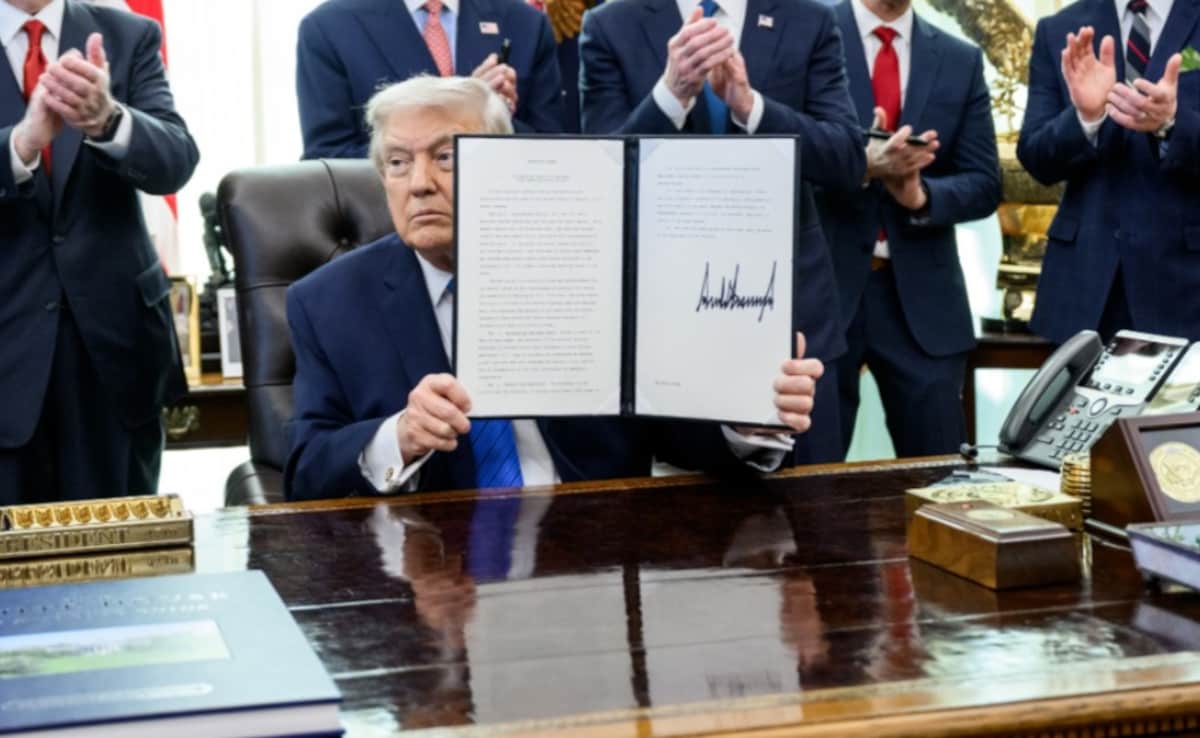
You’ve seen the headlines, but most of them miss the point. Seeing a sitting president’s signature on paper currency isn't just a design change. It’s a break from a century of tradition. Typically, the U.S. dollar carries the signatures of the Treasurer of the United States and the Secretary of the Treasury. That’s how it’s been since the beginning of the modern era of the Federal Reserve.
But things changed when Donald Trump’s signature began appearing on the $1 and $5 bills. While some called it a massive ego trip, others saw it as a bold branding move for the American economy. Whatever your politics, the reality is that this was a first. No other sitting president has had their literal handwriting printed on the money you use to buy a cup of coffee.
Why the Signature Matters More Than You Think
Money is built on trust. That sounds like a cliché, but it’s the literal truth of a fiat currency system. The signatures on a bill are there to "validate" the note. They're essentially a guarantee from the government that this piece of paper is worth what it says it is. Usually, these signatures belong to the "money people"—the bureaucrats at the Treasury.
When a president puts their name on the bill, the message shifts. It becomes more personal. It’s no longer just an institutional guarantee; it becomes a political one. For collectors, this created an immediate frenzy. Numismatists (the fancy word for coin and bill collectors) look for "firsts." A first-of-its-kind signature on a high-volume note like the $1 bill makes that specific run of currency a historical artifact the moment it leaves the press.
The Bureau of Engraving and Printing Process
The process of getting a signature onto a plate isn't as simple as signing a Sharpie on a piece of paper and hitting "print." The Bureau of Engraving and Printing (BEP) uses a complex intaglio printing process. This involves etching the design into metal plates. The ink is then forced into the recessed lines of the plate and transferred to the paper under huge pressure.
When a new signature is added, the BEP has to create entirely new plates for every denomination. This isn't cheap. It takes months of calibration to ensure the fine lines of a signature—especially one as jagged and recognizable as Trump’s—don't blur during high-speed production. We're talking about millions of notes per day.
Collector Value and the Rarity Myth
Don't go quitting your job because you found a "Trump dollar" in your change. While it’s a historical first, "rare" and "valuable" aren't the same thing in the world of currency. The BEP prints billions of $1 bills every year. Even with a unique signature, the sheer volume of these notes means they'll likely never be worth more than a dollar to a grocery store clerk.
However, there are exceptions. If you find a note with a "Star" in the serial number (a replacement note) or a low serial number (like 00000001), that’s where the money is. A Trump-signature $1 bill with a fancy serial number could easily fetch hundreds or even thousands of dollars at auction. Most people miss these details because they’re too busy looking at the name. Don't be that person. Look at the numbers.
Legal Tender and Political Statements
There was a lot of noise about whether this was even legal. The short answer? Yes. The Treasury Secretary has broad authority over the design of U.S. currency. If the Secretary decides the President’s signature belongs there alongside their own, it happens.
Interestingly, this move sparked a conversation about the "politicization" of the dollar. For decades, the Fed and the Treasury tried to stay somewhat invisible. They wanted the currency to feel like a permanent, unchanging force of nature. Putting a sitting president’s name on the money breaks that illusion. It reminds everyone that the value of their savings is tied to the people currently in power.
How to Spot a Keeper
If you're looking to hold onto these for the long haul, condition is everything. A folded, dirty bill is worth a dollar. Period. If you want a piece of history that actually appreciates, you need "Uncirculated" notes. These are crisp, have no folds, and look like they just came off the press.
- Check the corners. They should be sharp enough to poke a finger.
- Look for "centering." If the green border is perfectly even on all sides, it’s more valuable.
- Keep them in a PVC-free plastic sleeve. Humidity and oils from your skin will ruin the paper over time.
The Practical Side of Currency Changes
Beyond the signature, the U.S. currency is constantly undergoing minor tweaks to fight counterfeiting. While the signature gets the headlines, the BEP is more worried about the security threads, 3D ribbons, and color-shifting ink.
If you're a business owner, you don't need to do anything differently. These bills work in every vending machine and bill validator. The technology in those machines looks for magnetic signatures and paper density, not the specific name written on the bottom right.
Keep an eye on your change over the next few months. Even if you aren't a collector, holding onto a few crisp examples of a historical "first" isn't a bad idea. Just don't expect them to pay for your retirement unless you happen to snag a serial number that starts with a lot of zeros.
Get a dedicated currency holder if you're serious about saving these. Leaving them in a drawer will lead to "toning" or yellowing of the paper, which kills the resale value immediately. Check the BEP’s production reports online if you want to see exactly how many of these notes are being pumped into circulation each month. Knowledge of the mintage numbers is the only way to stay ahead of the "hype" prices you see on eBay.