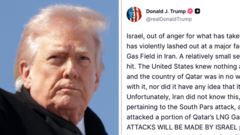
The alliance between the U.S. and Israel usually looks like a solid wall, but the cracks are finally showing. On Wednesday night, Donald Trump took to Truth Social to drop a bombshell. He claimed the U.S. "knew nothing" about Israel's massive strike on Iran’s South Pars gas field. This isn't just a communication breakdown. It’s a public distancing that suggests the two allies are no longer reading from the same playbook as the war with Iran enters its third week.
If you’re looking for a clear sign that the regional strategy is fraying, this is it. While the Israeli Defense Forces (IDF) are busy "violently lashing out"—Trump’s words, not mine—the White House is trying to play the role of the disciplined enforcer. The target of this latest escalation, South Pars, is the crown jewel of global energy. It’s the world’s largest gas field, shared by Iran and Qatar. By hitting it, Israel didn't just hurt Tehran; they kicked a hornet’s nest that sent energy prices screaming toward $116 a barrel.
The South Pars strike changed the rules
For years, we’ve heard about "red lines" in the Middle East. Most of those were ignored. But hitting "upstream" energy production—the actual wells and refineries—is a boundary nobody crossed until now. This wasn't a strike on a drone factory or a general’s villa. This was a direct hit on the global economy’s juggernaut.
Iran didn't wait around. Within hours, they retaliated by hammering Qatar’s Ras Laffan LNG hub. This is where the U.S. interest gets personal. Qatar hosts the largest American military base in the region. They’re a "very innocent" party in this specific spat, according to Trump. When Iran hit Qatar, they essentially dared Trump to back up his "America First" rhetoric.
Trump is drawing a new line in the sand
Trump’s post was calculated. He basically told Israel to sit down and let the "big boys" handle the next phase. He explicitly stated that there would be no more attacks by Israel on South Pars. But he followed that with a terrifying caveat. If Iran touches Qatar again, the U.S. will "massively blow up" the entirety of the South Pars field with "power that Iran has never seen."
It’s a classic Trump move:
- Disavow the partner: Claiming ignorance of the Israeli strike lets him dodge the blame for the initial gas price spike.
- Protect the ally: Standing up for Qatar keeps the Gulf states from completely flipping toward Tehran.
- Escalate the threat: He’s moving the goalposts from "helping Israel" to "protecting global energy," which gives him more control over the war’s off-ramp.
Are the U.S. and Israel actually aligned
The short answer? Not really. Not anymore.
Israeli officials are already pushing back. Anonymous sources in Jerusalem told Reuters and the Wall Street Journal that the strike was absolutely coordinated with Washington. They’re basically calling the President a liar. Why? Because they want the world to know the U.S. is locked into this regime-change mission. They don't want Trump to have an "out."
Israel views this as an existential fight to decapitate the Islamic Republic for good. They’ve already killed the Supreme Leader and half the cabinet. They’re in "burn it all down" mode. Trump, meanwhile, is watching his poll numbers and the price of gas at the pump. He wants a win, sure, but he doesn't want a global depression caused by a total energy blackout in the Persian Gulf.
The economic fallout is real
The numbers coming in this morning are ugly.
- Brent Crude: $116 per barrel (up 8%).
- European Gas: 24% jump in a single session.
- U.S. War Cost: Already estimated at over $18 billion.
You can't sustain a war like this without the public turning on you. Trump knows that. Netanyahu, facing his own domestic pressures, seems less concerned with the price of gas in Ohio than with the threat of Iranian missiles in Tel Aviv.
What happens if the U.S. hits South Pars
If Trump follows through on his threat to "massively blow up" the rest of the field, we’re entering "doomsday scenario" territory. South Pars isn't just a revenue stream for Iran. It’s the primary source of their domestic heating and electricity. Destroying it wouldn't just hurt the IRGC; it would freeze and darken the homes of 85 million people.
From a tactical perspective, such a strike would likely involve:
- B-2 Stealth Bombers: To penetrate remaining Iranian air defenses.
- Cyber Warfare: To shut down the safety valves and cause catastrophic internal pressure failures.
- Naval Blockade: To ensure no repair equipment reaches the coast.
Iran has already signaled that their next move would be a "total blockade" of the Strait of Hormuz. They’ve started mining the waters and have even claimed to damage a U.S. F-35 near the coast. This isn't a "limited operation" anymore. It’s a full-scale energy war.
How to read the room right now
Don't believe the official "we’re in total agreement" statements coming out of the State Department. Watch what they do, not what they say.
If you see more Israeli strikes on civilian infrastructure without U.S. planes in the air, the rift is widening. If the U.S. starts moving more carrier groups toward Qatar specifically, Trump is serious about taking over the "management" of the conflict.
The immediate reality is that the U.S. is trying to put Israel on a leash, and Israel is trying to pull the U.S. into a deeper hole. Neither side seems to have a clear exit plan that doesn't involve the total collapse of the global energy market.
Keep an eye on the tankers. If the "safe corridor" proposed by the UN fails to materialize in the next 48 hours, expect those $116 oil prices to look like a bargain. You should probably top off your tanks and prepare for a very volatile month at the pump. Don't wait for the next Truth Social post to tell you the situation is getting worse.