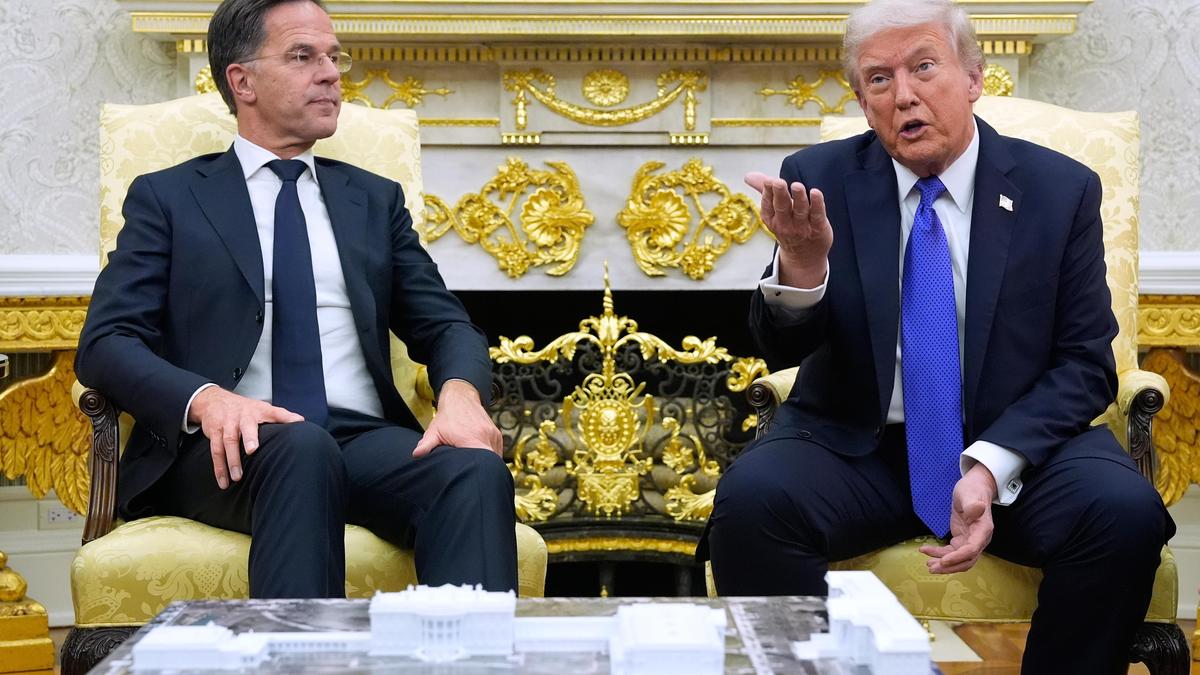
The operational viability of the North Atlantic Treaty Organization (NATO) currently rests on a precarious imbalance between historical security guarantees and contemporary fiscal realities. The meeting between Donald Trump and Secretary General Mark Rutte serves as the primary catalyst for a structural interrogation of the alliance's value proposition. While media narratives often focus on the rhetoric of "blasts" and "demands," the underlying tension is purely mathematical: a divergence between the Expected Utility of Defense and the Distribution of Contribution.
This tension creates a systemic risk for the alliance. When the primary financier of a security apparatus perceives the Return on Investment (ROI) to be negative, the risk of total withdrawal or strategic pivot increases. To understand the current friction, one must analyze the three structural pillars that define the modern NATO tension: the 2% Floor Paradox, the Defense Industrial Complex Capacity, and the Security Asymmetry Incentive.
The 2% Floor Paradox and Fiscal Free-Riding
The 11th Article of the NATO Treaty outlines a commitment to collective defense, but it lacks a built-in enforcement mechanism for financial contributions. The 2014 Wales Summit established the guideline that members should spend at least 2% of their Gross Domestic Product (GDP) on defense. However, this metric is fundamentally flawed because it measures input rather than output.
The "Free-Rider" problem in international relations occurs when a nation benefits from a public good—in this case, collective security—without paying its proportional share of the costs. The United States, by maintaining a defense budget that significantly exceeds the 2% threshold, provides a security umbrella that allows European nations to divert capital toward domestic social programs. This creates a distortion in the European market. If Germany or France were forced to provide for their own defense in a vacuum, their tax structures and social safety nets would require immediate, painful contraction.
The current friction is not merely about "fairness." It is an attempt to correct a market failure where the U.S. provides a "premium" service at a "discounted" rate for its partners. By demanding a hard adherence to the 2% floor, the U.S. is signaling a shift toward a Pay-to-Play Security Model. This model assumes that security is a purchasable commodity rather than an inherent right of membership.
Defense Industrial Complex Capacity and Procurement Velocity
A secondary, often overlooked component of the Trump-Rutte dialogue is the requirement that 20% of defense spending go toward "Major Equipment." This is where the geopolitical meets the industrial. Increased European defense spending does not instantly create increased security. There is a significant lag time between the allocation of funds and the deployment of assets.
The European defense sector is fragmented across national lines. Unlike the United States, which benefits from massive economies of scale through centralized procurement for the Pentagon, Europe maintains a patchwork of domestic industries. This fragmentation leads to:
- Inefficient Capital Allocation: Redundant research and development (R&D) costs across multiple nations for similar platforms (e.g., competing fighter jet programs).
- Interoperability Friction: Differing technical standards that complicate joint operations in a high-intensity conflict.
- Low Production Throughput: An inability to rapidly scale ammunition and equipment production, as evidenced by the supply chain bottlenecks during the ongoing conflict in Ukraine.
When the U.S. demands higher spending, it is also implicitly demanding a market for American-made defense exports. This creates a secondary layer of tension: European nations want to increase spending to satisfy U.S. demands, but they prefer to spend that capital within their own borders to stimulate domestic employment. The U.S. view is that European defense firms move too slowly to meet the immediate threat profile, making American procurement the only viable path to rapid rearmament.
The Security Asymmetry Incentive
The strategic core of the disagreement lies in the differing perceptions of the threat landscape. For many European nations, particularly those in the East, the threat is existential and immediate. For the United States, the European theater is one of several competing priorities, including the Indo-Pacific and domestic economic stabilization.
This creates a Security Asymmetry. The U.S. can afford to be a "disruptor" of NATO norms because its geographic isolation provides a natural buffer. European members do not have this luxury. Consequently, the U.S. uses its leverage—the threat of withdrawal or reduced commitment—to force fiscal concessions.
The mechanism at play is Conditional Deterrence. By making the U.S. commitment "conditional" on fiscal performance, the administration is attempting to move NATO from a treaty-based organization to a contract-based organization. In a treaty-based organization, the commitment is static. In a contract-based organization, the commitment is dynamic and contingent upon the fulfillment of specific KPIs (Key Performance Indicators).
Mapping the Strategic Outcomes
The transition from a collective security model to a transactional security model will inevitably lead to one of three structural outcomes for the alliance.
Outcome A: The European Strategic Autonomy Pivot
If the U.S. continues to escalate fiscal demands, European powers (led by France) may accelerate the development of a "European Pillar" within or parallel to NATO. This would involve a consolidated European defense budget and a move away from reliance on U.S. intelligence and heavy lift capabilities. The primary barrier here is the lack of a unified European command structure and the significant capital investment required to replace U.S. nuclear and satellite assets.
Outcome B: The Two-Tiered Alliance
We may see the emergence of a "Hard" NATO and a "Soft" NATO. The Hard NATO would consist of the U.S., UK, Poland, and the Baltic states—nations that consistently meet or exceed fiscal targets and maintain high operational readiness. The Soft NATO would consist of members that fail to meet targets and, as a result, receive lower-priority security guarantees and limited access to advanced U.S. technology.
Outcome C: The Fiscal Convergence
The most likely short-term scenario is a forced convergence where European nations implement emergency defense budgets to reach the 2.5% or 3% mark. This will lead to a period of "Austerity for Armor," where domestic social spending is curtailed to fund military modernization. This outcome favors U.S. defense contractors and maintains the status quo of U.S. leadership, albeit at a higher cost to the European taxpayer.
The meeting between Trump and Rutte is the opening salvo in a broader renegotiation of the post-WWII order. The assumption that the U.S. will indefinitely underwrite global security is no longer a valid baseline for strategic planning.
The move forward requires European states to treat defense not as a discretionary expense to be negotiated during budget cycles, but as a core utility with a fixed cost. Failure to achieve this fiscal realignment will result in a "Security Vacuum," where the lack of a credible, well-funded collective defense invites opportunistic aggression from external actors. The strategic play for European leadership is to consolidate procurement immediately, bypassing national pride in favor of industrial scale, while simultaneously providing the U.S. with a clear, audited roadmap for fiscal parity. This is the only path to maintaining the integrity of the alliance in an era of transactional diplomacy.