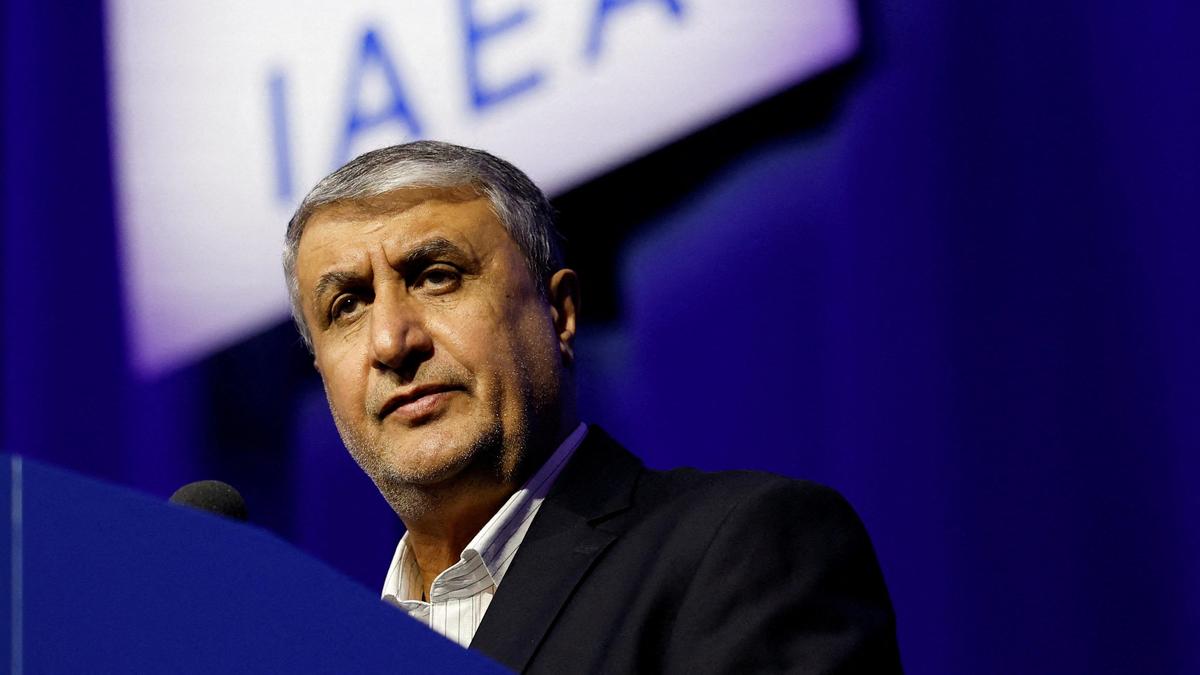
The global nuclear order is currently facing a terminal crisis. Mohammad Eslami, the head of the Atomic Energy Organization of Iran (AEOI), recently declared that the Islamic Republic will not accept any restrictions on its uranium enrichment program. This is not just another piece of diplomatic theater; it is a fundamental shift in the regional power balance. By rejecting the boundaries once set by the 2015 nuclear deal (JCPOA), Tehran is signaling that its technical progress has reached a point of no return. The "breakout time"—the period needed to produce enough weapons-grade material for a single nuclear device—has effectively shrunk to nearly zero.
While Western powers often frame this as a negotiation tactic, the reality on the ground suggests a more permanent strategy. Iran is no longer merely looking for sanctions relief; it is building a permanent nuclear infrastructure designed to withstand any external pressure.
The Infrastructure of Defiance
The refusal to curb enrichment isn't just a verbal stance. It is backed by a massive expansion of centrifuge cascades at the Fordow and Natanz facilities. These are not the primitive IR-1 centrifuges of the early 2000s. We are seeing the deployment of advanced IR-6 and IR-9 machines. These units are significantly more efficient, capable of separating isotopes at speeds that make the old limitations of the JCPOA look like relics of a bygone era.
To understand the scale of this, consider the physics of enrichment. Natural uranium contains about 0.7% of the isotope U-235. To fuel a commercial power plant, you need about 3.5% to 5% enrichment. However, the jump from 20% to 60%—where Iran is currently operating—is mathematically much smaller than the jump from 0.7% to 4%. Once you reach 60% purity, you have already done about 90% of the work required to reach the 90% threshold needed for a weapon.
By maintaining a stockpile of 60% enriched uranium, Tehran has created a "virtual deterrent." They don't need to build a bomb today to have the power of a nuclear state. They simply need the world to know they can do it over a long weekend.
The Underground Shift
Construction at the Natanz site has moved deeper into the mountains. This isn't just about security; it is about making the program immune to conventional military strikes. The "bunker-busting" munitions in the American and Israeli arsenals have limits. If the enrichment halls are buried hundreds of meters under solid rock, the diplomatic window stays open only because the military window has slammed shut.
This move underground mirrors the psychological shift in Tehran. For years, the debate was whether Iran would trade its nuclear program for economic integration. That debate is over. The hardliners in the Iranian establishment have watched the fate of nations that gave up their programs versus those that kept them. They have chosen the path of permanent capability.
The Illusion of Monitoring
The International Atomic Energy Agency (IAEA) finds itself in an impossible position. Eslami's rhetoric matches the agency's decreasing access. When Iran "rules out restrictions," it also rules out the kind of intrusive inspections that would give the world any real confidence about the program’s direction.
We are currently operating in a massive intelligence gap. The IAEA can count the containers it sees, but it cannot guarantee it sees everything. The removal of surveillance cameras and the barring of several veteran inspectors have turned the once-transparent program into a black box. This lack of transparency is a feature, not a bug, of the current Iranian strategy. It creates a fog of war in peacetime, forcing the West to guess at the actual state of play.
The Dead End of Sanctions
For two decades, the primary tool of Western diplomacy has been economic pressure. The logic was simple: make the program too expensive to maintain. That logic has failed. Iran has spent those twenty years diversifying its economy and building "resistance" networks through China, Russia, and regional partners.
The sanctions have certainly hurt the Iranian public, but they have not slowed the centrifuges. In fact, the technical advancements often accelerate after new rounds of sanctions are announced. This suggests that the nuclear program is not just a scientific endeavor but the core of the state's identity. You cannot bargain away a national identity with a freeze on bank assets.
The New Triad of Power
The geopolitical context has changed. Iran is no longer an isolated actor facing a unified global front. The deepening alliance between Tehran and Moscow has provided the AEOI with a powerful shield. Russia, once a partner in the "P5+1" effort to contain Iran, now views the Islamic Republic as a vital security partner.
- Technical Cooperation: There are persistent reports of Russian experts providing consultation on centrifuge stability and reactor design.
- Geopolitical Cover: Russia’s veto at the UN Security Council ensures that any attempt to "snap back" international sanctions will be met with a dead end.
- Military Synergy: The exchange of Iranian drone technology for Russian aerospace advancements has integrated the two nations' defense sectors.
This triangle—Tehran, Moscow, and to an extent, Beijing—means that the "maximum pressure" campaigns of the past are now toothless. Iran knows it has friends with veto power.
The Strategy of the Accomplished Fact
The Iranian nuclear program is currently a masterclass in the "salami-slicing" technique. Each step is small enough to avoid a full-scale war but significant enough to change the reality on the ground. One day it’s a new cascade; the next, it’s a higher enrichment level; the following week, it’s the denial of an inspector’s visa.
Eventually, you wake up to find the "accomplished fact." The West is now debating whether to allow 60% enrichment, whereas ten years ago, the debate was whether to allow any enrichment at all. The goalposts haven't just moved; they’ve been dismantled and rebuilt in a different stadium.
The Problem with Red Lines
Red lines only work if you are willing to enforce them with force. Since 2021, the threshold for military intervention has shifted. The global focus on the conflict in Ukraine and the instability in the Middle East has given Iran a vacuum to fill. They have filled it with enriched hexafluoride gas.
Israel remains the only actor that consistently threatens kinetic action. However, a strike on Iranian facilities today would be vastly more complex than the 1981 strike on Iraq's Osirak reactor. The Iranian program is decentralized, buried, and defended by advanced air defense systems like the S-300. A single strike won't end the program; it would likely only provide the political justification for Tehran to go to 90% enrichment immediately.
The Fallout for Non-Proliferation
The biggest victim of Eslami’s "no restrictions" policy is the Nuclear Non-Proliferation Treaty (NPT) itself. If Iran successfully achieves a virtual nuclear status while remaining a signatory to the NPT, the treaty becomes a dead letter.
Other regional powers—Saudi Arabia, Turkey, Egypt—are watching closely. If Iran is allowed to maintain a high-enrichment cycle with no oversight, why should they settle for less? We are looking at the potential for a nuclear arms race in the world’s most volatile region. This isn't a hypothetical fear; it is the logical conclusion of the current trajectory.
Saudi officials have already stated that if Iran gets a bomb, they will follow suit. The technical barriers for these nations are lower than they were for Iran 30 years ago. The blueprints are out there, the materials are more accessible, and the political will is hardening.
The Technicality of No Return
There is a point in nuclear development where "know-how" becomes the primary asset. Even if every centrifuge in Iran were destroyed tomorrow, the knowledge would remain. You cannot bomb the blueprints inside the minds of Iranian physicists.
The AEOI has successfully trained a generation of scientists who can design, build, and operate advanced cascades. This human capital is the real deterrent. It ensures that the program can be rebuilt faster than it can be destroyed. This is why Eslami can speak with such confidence; he knows that the technical base is now self-sustaining.
The West must stop treating the Iranian nuclear issue as a problem that can be "solved" or "settled." It is now a permanent reality that must be managed. The era of demanding a total cessation of enrichment is over. The only question left is what the world is willing to trade to keep that 60% from becoming 90%.
As the centrifuges spin faster in the mountain halls of Fordow, the diplomatic community remains stuck in a loop of outdated assumptions. They are looking for a deal that Iran has already outgrown. The "no restrictions" stance isn't a threat; it's a statement of the current status quo.
Move the focus away from the negotiating table in Vienna and look at the loading docks in Bandar Abbas and the research labs in Tehran. That is where the real policy is being written. The world has entered the age of the virtual nuclear Iran, and the old playbook is useless.


