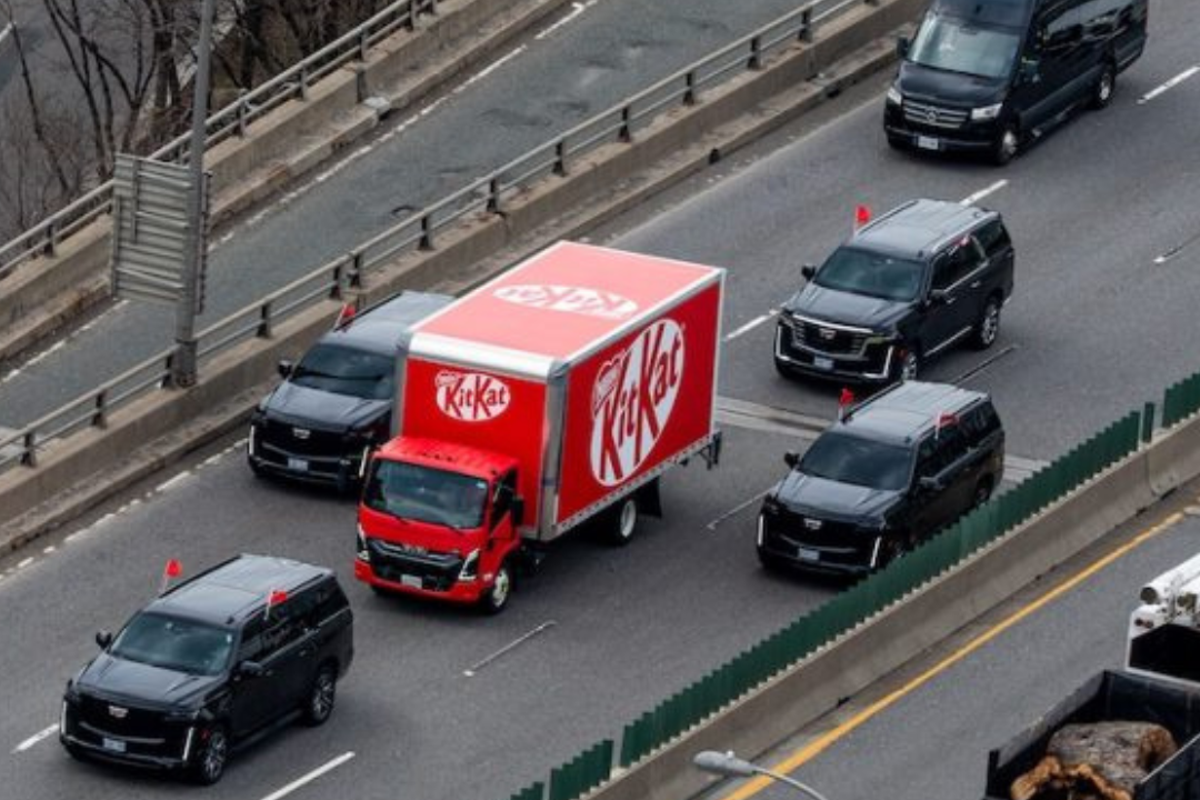
The theft of 12 tonnes of KitKat bars—a volume representing roughly 750,000 individual units—transforms a routine logistics operation into a high-stakes security failure. When a commodity product requires a multi-vehicle security convoy for transit, the underlying business model has shifted from standard FMCG (Fast-Moving Consumer Goods) distribution to high-risk asset protection. This incident exposes a critical vulnerability in the global food supply chain: the ease with which bulk, anonymous, and rapidly consumable goods can be liquidated in the grey market.
The Unit Economics of Chocolate Larceny
The illicit appeal of 12 tonnes of chocolate is not found in the raw material value, but in the Velocity of Liquidation. Unlike stolen electronics or luxury vehicles, which carry unique identifiers (IMEI numbers, VINs), confectionery is a "ghost commodity." Once the outer pallet wrapping is removed, individual bars are nearly impossible to trace through secondary retail channels.
The profitability of this theft is driven by three specific variables:
- Low Barrier to Resale: Stolen chocolate can be integrated into independent convenience stores, vending machine networks, or digital marketplaces with zero digital footprint.
- High Caloric Density per Volume: 12 tonnes of product can be transported in a single standard heavy goods vehicle (HGV), making the "value-to-logistics-effort" ratio exceptionally high for a criminal enterprise.
- Shelf-Life Stability: Unlike fresh produce or meat, processed chocolate is shelf-stable for 12 to 18 months, allowing thieves to "drip-feed" the stolen inventory into the market to avoid price crashes or detection.
The Security Convoy as a Tactical Necessity
Deploying a security convoy to flank a KitKat truck is a defensive measure intended to harden the target against High-Frequency Interception. In logistics security, this is categorized as a "Point-to-Point Escort" strategy. The presence of secondary vehicles serves several functional purposes that go beyond mere intimidation.
Surveillance and Perimeter Maintenance
The primary role of the flanking vehicles is to manage the "vulnerability windows" during transit. These windows occur most frequently at roundabouts, stoplights, and highway off-ramps—locations where the HGV must reduce speed or stop. A convoy prevents "box-in" maneuvers where two or more vehicles force the truck to a halt. By maintaining a physical buffer, the security team ensures the driver retains a clear path of egress.
The OODA Loop in Cargo Protection
Security teams operate on the Observe-Orient-Decide-Act (OODA) loop. In a standard solo-driver scenario, the driver must focus 90% of their cognitive load on navigation and vehicle physics. In a convoy, the cognitive load is distributed. The security detail handles the "Observe" and "Orient" phases, allowing for rapid "Decision" and "Action" if a threat is detected. This structural redundancy reduces the likelihood of a successful hijacking by increasing the "Time to Compromise" for the attacker.
Assessing the Grey Market Ecosystem
Where does 12 tonnes of stolen chocolate go? The market for stolen goods operates on a tiered structure.
- Tier 1: Wholesaler Displacement. The thieves sell the entire lot to a "fringe" wholesaler at 20-30% of market value. This wholesaler then mixes the stolen product with legitimate stock, effectively laundering the inventory.
- Tier 2: Fragmented Retail. The product is broken down into smaller cases and sold to "no-questions-asked" independent retailers.
- Tier 3: Direct-to-Consumer (D2C) Digital Fraud. Using secondary marketplace accounts, the product is sold at a slight discount to legitimate prices, appearing to the consumer as a standard "bulk buy" deal.
The 12-tonne theft indicates a Tier 1 or Tier 2 intent. A heist of this magnitude requires pre-existing "fencing" infrastructure. The criminals didn't just steal chocolate; they stole a pre-sold order.
Structural Failures in Logistics Integrity
The necessity of a security convoy highlights a deeper failure in standard logistics protocols. High-value thefts of this nature are rarely "cold" hits. They typically involve a compromise in the information supply chain.
Data Leakage and Insider Risk
The physical location of the truck is the final step in the theft. The first step is the acquisition of the "Manifest and Route" data. For a thief to know which truck contains 12 tonnes of KitKats—versus a truck containing lower-value dry goods—they must have access to:
- Warehouse dispatch schedules.
- GPS tracking frequencies.
- The specific loading bay assignments.
The shift toward security convoys suggests that Nestlé and its logistics partners have identified a breach in their internal data security or a systemic vulnerability in their "last-mile" dispatching.
The Cost-Benefit Threshold
Escorting a truck with private security is an expensive operational overhead. To justify this cost, the loss-prevention math must be clear. If the cost of the convoy is $C$ and the probability of theft is $P$, and the value of the cargo is $V$, the convoy is only economically viable when:
$$C < (P_{without} \times V) - (P_{with} \times V)$$
The fact that convoys are now being used indicates that $P_{without}$ (the probability of theft without an escort) has reached a critical threshold in certain geographic corridors.
Technological Mitigation vs. Physical Force
While convoys provide a physical deterrent, they are a reactive solution to a systemic problem. Modern logistics firms are increasingly looking toward "Passive Hardening" technologies to replace expensive human escorts.
- Geofencing and Remote Immobilization: Implementing systems that automatically shut down the engine if the truck deviates more than 500 meters from its programmed route.
- Smart Locking Systems: Cargo doors that can only be opened via a one-time code sent to a mobile device at the destination, authenticated by biometric data.
- Molecular Tagging: Spraying the packaging with invisible, unique chemical markers that can be detected via infrared or chemical analysis. This allows investigators to prove a chocolate bar in a random store was part of the stolen 12-tonne batch.
The Strategic Shift in FMCG Logistics
The "KitKat Convoy" is a signal that the FMCG sector is entering a period of "High-Value Cargo Normalization." Food inflation and the ease of digital resale have turned chocolate, coffee, and infant formula into "soft currencies."
The immediate strategic requirement for manufacturers is a transition from a Volume-First logistics mindset to a Security-First framework. This involves:
- Dynamic Routing: Abandoning static delivery schedules to prevent "pattern-based" hijacking.
- Vendor Auditing: Applying rigorous security background checks not just to drivers, but to all warehouse personnel with access to dispatch data.
- Inventory Obfuscation: Using plain, unbranded trailers to transport high-value goods. The branding on the side of a truck is a marketing asset but a security liability.
For the 12 tonnes of stolen KitKats, the recovery window has likely closed. The product has entered the fragmentation phase, where it is being sold bar-by-bar across thousands of points of sale. The convoy is not a sign of strength; it is an admission that the traditional, open supply chain is no longer viable in high-theft environments. The future of food logistics will mirror the armored car industry: armored, tracked, and perpetually under watch.