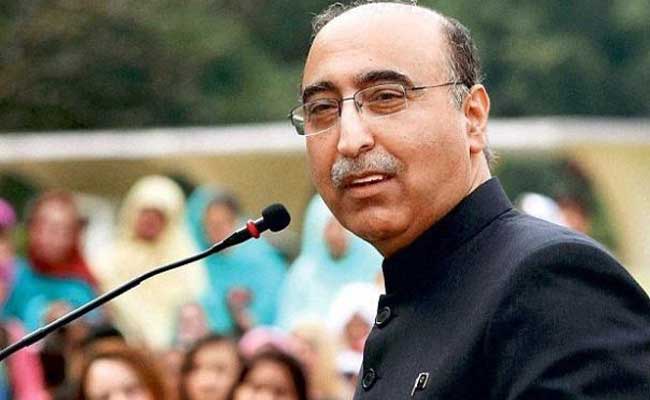
The air in a high-security television studio is always unnaturally still. It is a manufactured silence, held together by soundproofing foam and the heavy, unblinking eyes of glass camera lenses. For Abdul Basit, the former Pakistani High Commissioner to India, this was a familiar stage. He is a man who spent a career navigating the razor-thin margins of South Asian diplomacy, where a misplaced comma in a joint statement can trigger a troop mobilization. But during a recent interview, the veteran diplomat discarded the polished veneer of his office. He didn't just speak; he issued a dark invitation to catastrophe.
Basit’s suggestion was stripped of all nuance. He argued that Pakistan must "not think twice" about striking at the heart of India—specifically naming Mumbai and Delhi—if certain geopolitical triggers were pulled. To a casual observer, it might sound like the standard, heated rhetoric of a regional rivalry. To those who live in the shadow of the Himalayas, it felt like the sudden, sharp scent of ozone before a lightning strike.
Consider a tea stall owner in a crowded Mumbai alleyway near the Gateway of India. Let’s call him Rajesh. He doesn't track the shifting alliances of the Inter-Services Intelligence or the procurement cycles of the Indian Air Force. His world is the hiss of steam, the clinking of small glasses, and the rhythm of the local train. When a former diplomat talks about "hitting Mumbai," he isn't talking about a strategic objective on a map. He is talking about the end of Rajesh’s world. He is talking about turning a city of twenty million souls into a monument of ash.
Words are not merely sounds in this part of the world. They are kinetic. In the history of the subcontinent, the distance between a televised threat and a border skirmish is often shorter than a heartbeat. Basit’s rhetoric represents a terrifying shift from "deterrence"—the grim logic that keeps weapons in their silos—to "provocation." Deterrence relies on the idea that both sides are terrified of the consequences. Provocation suggests that one side is no longer afraid.
The math of modern warfare in South Asia is unforgiving. We are looking at two nuclear-armed neighbors who share a land border, meaning flight times for missiles are measured in minutes, not hours. If a command is given to strike Delhi, the decision-making window for a counter-strike is almost non-existent. There is no time for a phone call. No time for a second opinion. The logic of the machine takes over.
But the real horror isn't found in the silos. It is found in the normalization of the unthinkable. When a man of Basit’s stature speaks this way, he is moving the goalposts of acceptable public discourse. He is teaching a younger generation that the total annihilation of a neighbor is a legitimate policy tool rather than a final, desperate failure of the human imagination.
It is easy to get lost in the "why." Why now? Is it a reaction to internal Pakistani political instability? Is it a bid for relevance in a changing diplomatic landscape? Perhaps. But the "why" matters less than the "what." What happens when we stop seeing cities as collections of mothers, students, and shopkeepers, and start seeing them as bullseyes?
The history of 1947 still bleeds through the soil of the Punjab. The Partition wasn't just a political line; it was a ghost that never quite left the room. Every decade or so, that ghost demands a tribute. We saw it in 1965, 1971, and 1999. We saw it in the smoke rising from the Taj Mahal Palace Hotel in 2008. Each time, the world held its breath, waiting to see if the two giants would finally lose their grip on the ledge.
Basit’s comments act as a weight on those white-knuckled fingers. He is betting that the ledge will hold, or perhaps he no longer cares if it breaks.
There is a specific kind of coldness required to name cities. Mumbai. Delhi. These are not just administrative capitals. They are the arteries of a civilization. Delhi is a city of layers, where Mughal ruins sit beside glass skyscrapers, and where millions of people are currently sleeping, unaware that their lives were just used as a rhetorical flourish in a television studio.
The danger of this rhetoric is that it creates a feedback loop. In India, such statements are not met with silence. They are met with a mirrored intensity. Hardliners on the other side of the border point to Basit’s words as proof that peace is a fairy tale told by the weak. They use his vitriol to justify their own. Soon, the only voices left in the room are the ones shouting for fire.
The invisible stakes are the quiet years we have managed to steal. The years where trade, however limited, continued. The years where students from across the border met in third-party countries and realized they liked the same music and feared the same things. These are the fragile threads that Basit is willing to take a torch to.
Diplomacy is often mocked as a slow, boring, and toothless profession. It is criticized for its endless meetings and its obsession with protocol. But the alternative to diplomacy isn't "strength." The alternative is the sound of a door closing. It is the moment when the talking stops and the engines start.
When you strip away the flags and the national anthems, you are left with the biological reality of war. It is loud. It is messy. It does not discriminate between the diplomat who called for it and the child who happened to be in the way.
The tragedy of Basit’s remark isn't just that it was said. It is that it was said by someone who knows exactly what it means. He knows the weight of the words. He knows the fragility of the peace. And yet, he chose to lean into the chaos.
In the quiet after the broadcast, the cameras were powered down. The studio lights dimmed. Basit likely went home, perhaps satisfied with the ripples he had created in the news cycle. But somewhere in Delhi, a father is tucking his daughter into bed. Somewhere in Mumbai, a doctor is starting a night shift. They are the ones who bear the cost of a diplomat’s "chilling remark." They are the ones who live in the crosshairs of a sentence.
The world is watching, not because we enjoy the spectacle, but because we know how this story ends when the protagonists stop talking. We have seen the script before. We know that once the first "hit" is delivered, there is no "thinking twice." There is only the momentum of the fall.
The silence in that television studio wasn't peace. It was a vacuum. And in a vacuum, the only thing that travels is the heat of a coming fire.