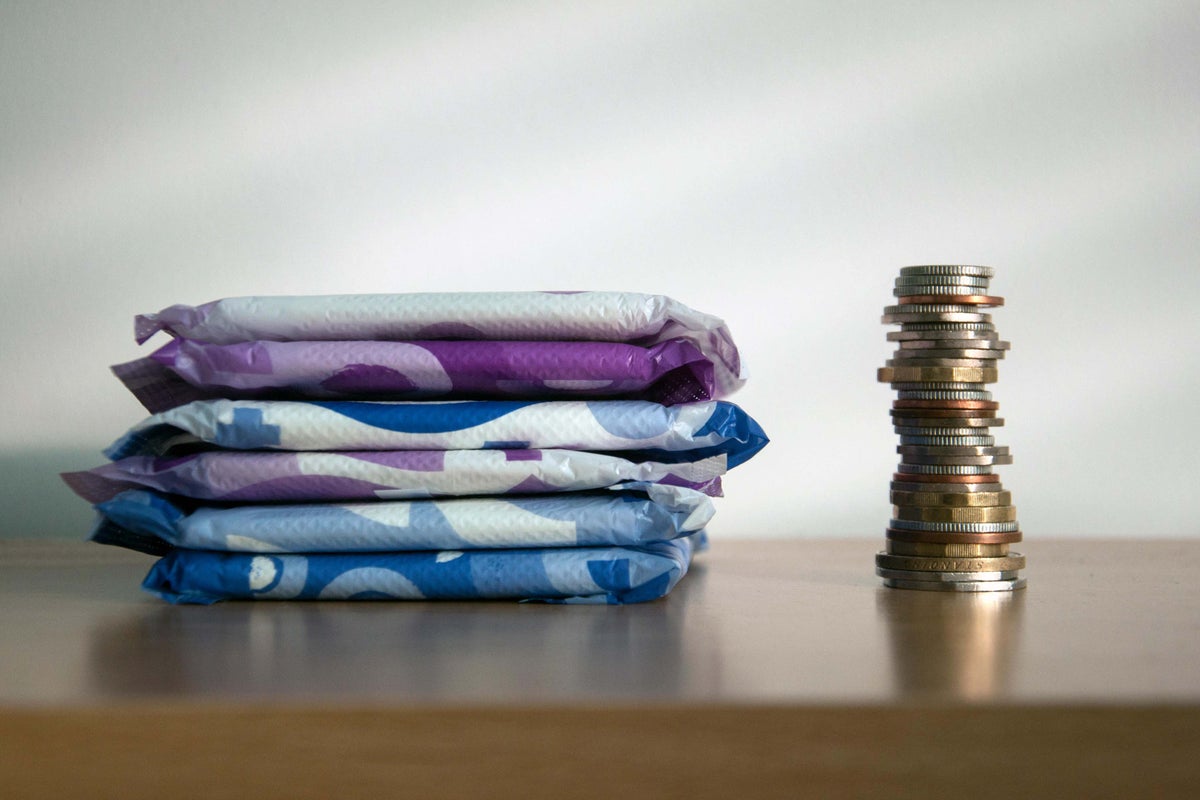
Sarah stands in the middle of the supermarket aisle, her fingers tracing the edge of a five-pound note like it’s a holy relic. In her basket sits a loaf of bread, a carton of eggs, and a tin of generic-brand beans. She looks at the shelf to her left. The bright, clinical packaging of menstrual pads stares back.
She does the math in her head. It’s a cruel, binary equation. If she buys the pads, she doesn’t eat dinner for two nights. If she buys the food, she has to spend the next five days praying the makeshift layers of toilet paper and old rags don’t fail her while she sits in her college lectures.
Sarah isn’t a character from a Victorian novel. She lives in a modern British city in 2026. She is part of the 10%.
The Ghost in the Classroom
We often talk about poverty as an abstraction—a set of data points on a government spreadsheet. But period poverty has a specific, biting scent. It smells like cheap laundry soap and anxiety. It sounds like the rustle of a plastic bag being tucked into underwear because there is nothing else available.
When campaigners warn that one in ten women and girls in the UK cannot afford basic sanitary products, they aren't just talking about a lack of cotton and adhesive. They are talking about a theft of dignity.
Consider the ripple effect. A girl misses three days of school every month. By the end of the academic year, she has lost over a month of education. She falls behind in math. She misses the chemistry lab where her peers are learning about molecular bonds. While they are bonding over shared jokes, she is at home, curled in a ball, trapped by the biology she was never taught to fear.
This is the invisible tax on being born female in a struggling economy.
The Risks We Take in the Dark
When the choice is between a meal and a box of tampons, the human brain enters a survival state. This is where the danger begins. Because the mainstream media often sanitizes the reality of period poverty, we rarely discuss the "dangerous health risks" mentioned in headlines.
Let's be blunt.
Women are using socks. They are using newspapers. Some are washing and reusing single-use pads, a practice that invites a swarm of bacteria into the most sensitive parts of the body. Others leave a single tampon in for twelve, fifteen, or twenty-four hours to "stretch" their supply.
This isn't just uncomfortable. It’s a gamble with life.
Toxic Shock Syndrome (TSS) is rare, but it thrives in the space where poverty meets desperation. When you leave a product in too long because you don't know where the next one is coming from, you are inviting a systemic infection that can shut down your organs in days.
Imagine the irony: a teenager in one of the wealthiest nations on Earth ending up in an Intensive Care Unit because she couldn't afford a fifty-pence item.
The Architecture of Shame
Why don't we see this happening? Why isn't there an outcry in every town square?
Because shame is a powerful silencer.
We have built a culture where menstruation is treated as a "discreet" problem. We hide pads in our sleeves on the way to the bathroom. We use code words. "Auntie Flo." "The time of the month." This ingrained secrecy provides a perfect cloak for poverty. If you are hungry, you might go to a food bank. But many women find it agonizingly difficult to walk up to a volunteer and ask for a packet of "heavy flow" wings.
The stigma acts as a barrier to the very solutions we claim to offer. Even as the UK government abolished the "Tampon Tax" years ago, the price of these essentials has continued to climb alongside the cost of energy and rent.
The tax may be gone, but the barrier remains financial, psychological, and systemic.
The Myth of the Level Playing Field
We like to believe that education is the great equalizer. We tell young girls they can be surgeons, engineers, or Prime Ministers. But we forget that the playing field isn't level if one player has to sit out every four weeks because they can’t afford to bleed.
The economic cost is staggering. When women miss work or girls miss school, the collective loss to the UK economy is measured in billions over a lifetime. But the human cost is measured in the look on a mother's face when she tells her daughter to "just make do" with a folded-up towel because the heating bill came in higher than expected.
It is a betrayal of the social contract.
A Shift in the Current
There is a growing movement of people who refuse to look away. Grassroots organizations and "period dignity" campaigners are pushing for more than just charity; they are demanding a fundamental shift in how we view these products.
They argue that if toilet paper is provided for free in every public stall, why aren't menstrual products? Both are biological necessities. Neither is an "optional" luxury.
Some schools and local authorities have begun to provide free dispensers. In Scotland, the move to make period products free for everyone was a global first—a beacon of what happens when policy meets empathy.
But for the rest of the UK, the struggle remains localized and precarious.
The Tin Box on the Mantelpiece
Back in the supermarket, Sarah makes her choice. She puts the pads back. She picks up a larger bag of rice instead.
She walks home through the rain, her mind already moving toward the drawer in her bedroom where she keeps an old tin box. In it, there are a few scraps of flannel she cut from an old shirt last month. She will wash them. She will dry them on the radiator. She will hope no one notices the slight bulk under her jeans tomorrow.
She is twenty-one years old. She is bright, ambitious, and hardworking.
She is also one of the millions navigating a world that expects her to perform at 100% while ignoring the fact that she is being penalized for a process she cannot control.
The silence surrounding period poverty isn't just a lack of noise. It is a heavy, suffocating blanket that keeps the status quo tucked in tight. Until we stop treating pads and tampons as "feminine hygiene" and start seeing them as essential infrastructure for a functioning society, the one-in-ten will continue to bleed in the shadows.
Sarah closes the tin box. The click of the metal lid is the only sound in the room. It is a small, sharp noise that echoes much further than we care to admit.