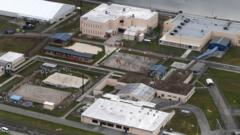
The air inside a processing center doesn’t move. It sits heavy, smelling of floor wax, industrial-grade detergent, and the sharp, metallic tang of crowded human bodies. For a teenager who has spent weeks moving through the dust of a continent, that stillness should feel like a relief. It should feel like the end of the road.
But for a seventeen-year-old boy from Mexico, whose name now sits in a government ledger as a statistic of "in-custody mortality," the stillness was the beginning of the end.
We often talk about borders as lines on a map or political debate stages. We look at them through the lens of policy, debating the "robustness" of our "infrastructure." We use sterile words to describe a raw, bleeding reality. When a child dies in the care of a superpower, we search for a systemic failure. We look for a broken protocol or a late paperwork filing.
The real failure is simpler. It is the loss of the individual in the machinery of the collective.
The Weight of a Cold Room
He arrived at the border seeking what every seventeen-year-old wants: a version of the future that doesn't look like a dead end. He was unaccompanied. That phrase—"unaccompanied minor"—carries a clinical weight. It suggests a legal category. In reality, it means a child who has looked at the horizon and decided that a thousand miles of uncertainty was safer than one more day at home.
He was processed. He was moved. He was placed in a shelter in Chicago, managed by the Office of Refugee Resettlement. This is the part of the story where the safety net is supposed to catch the falling weight. The shelters are meant to be a bridge between the chaos of the journey and the stability of a sponsor’s home.
Then, he stopped being a traveler and started being a patient.
On a Tuesday, he felt ill. On a Wednesday, he was hospitalized. By Thursday, he was gone.
There is a specific kind of silence that follows a death like this. It isn't the silence of peace. It's the silence of a vacuum. When a person dies in custody, they die behind a veil of privacy laws, security clearances, and jurisdictional hand-offs. The public sees the headline. The family, thousands of miles away, sees a hole in the world where a son used to be.
The Invisible Stakes of Efficiency
We have built a system designed for volume, not for the nuances of a human heartbeat. When thousands of people cross a line, the system prioritizes the "process." It prioritizes the check-in, the background check, and the placement. These are necessary things. But in the rush to manage the many, we lose the ability to see the one.
Consider the physical toll of the journey itself. A body under extreme stress doesn't react to illness the way a rested body does. Dehydration, malnutrition, and the constant spike of cortisol from living in a state of hyper-vigilance create a biological debt. When that debt comes due, it doesn't ask for permission. It simply shuts the system down.
If you have ever been truly exhausted—the kind of tired that settles into your bones and makes your vision blur—you know that the world becomes a series of muffled sounds. Now, imagine that exhaustion coupled with a fever. Imagine trying to explain that fever in a language that isn't your own, to a person wearing a badge who has seen five hundred other teenagers that week.
The tragedy isn't always a lack of medicine. Sometimes, the tragedy is a lack of time.
Medical staff in these facilities are often working against a tide. They are screening for infectious diseases, treating blisters, and managing chronic conditions with limited resources. They are the gatekeepers of health in a place that feels like a waiting room for the rest of one's life. When a child slips through the cracks, it isn't always because someone didn't care. It’s because the cracks have become wider than the floor.
The Geography of Grief
Chicago is a city of wind and steel, a place where the skyline speaks of ambition and permanence. It is a long way from the warmth of a Mexican village. For this boy, Chicago was supposed to be the destination. It was the place where the "walk" finally ended.
Instead, it became the site of a final, lonely struggle.
The Department of Health and Human Services released a statement. It was professional. It was timely. It expressed "heartfelt condolences." It checked every box required by a government agency facing a PR crisis. But a statement cannot hold a wake. It cannot explain to a mother why her son, who was finally "safe" in the hands of a first-world government, is never coming home.
We have to ask ourselves what we owe to the people we hold behind locked doors. If we claim the right to detain, we must accept the absolute responsibility to sustain. There is no middle ground. You cannot hold a human being in a state of legal limbo and then claim that their health is a secondary concern.
The mortality rate of children in custody is, thankfully, low. But the "low" statistic is a cold comfort when the number is one, and that one is your child.
Beyond the Ledger
The autopsy will eventually reveal a cause of death. It will be a medical term—perhaps a viral infection, a cardiac event, or a respiratory failure. The report will be filed in a cabinet. The shelter will review its procedures. A politician will mention it in a subcommittee hearing to score a point about border security or human rights.
But the cause of death isn't just a biological failure.
It is the cumulative weight of a journey that asked too much of a seventeen-year-old boy. It is the friction of a system that treats humans as units of transit. It is the isolation of dying in a room where no one knows your nickname, your favorite food, or the way your voice sounds when you’re laughing.
We often think of the border as a physical wall. The more dangerous wall is the one we build in our minds—the one that allows us to read a headline about a dead child and move on to the next link because they were "in custody" and therefore, somehow, part of a different world.
He wasn't part of a different world. He was in Chicago. He was in a bed. He was supposed to be safe.
He was seventeen.
Somewhere, there is a suitcase that will never be unpacked. There is a phone that will stop ringing because the person on the other end finally realized no one is going to pick up. There is a gap in a family tree that no policy change or "improved protocol" can ever bridge.
The wind in Chicago continues to blow through the canyons of the Loop, indifferent to the quiet departure of a boy who traveled half a world just to run out of time. He didn't ask for a monument. He asked for a future. We gave him a file number and a bed in a room where the air doesn't move.
The tragedy isn't that the system failed to save him. The tragedy is that we have designed a system where his death is an expected, if "rare," cost of doing business.
He was a son. He was a traveler. He was a boy who stopped breathing in the middle of the American Dream, and the silence he left behind is louder than any headline we will ever write.
Would you like me to look into the specific medical protocols currently required for unaccompanied minors in US federal custody?