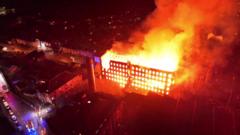
The local news cycle follows a predictable, exhausting script every time an abandoned textile mill or Victorian warehouse goes up in flames. First comes the dramatic drone footage of orange plumes gutting a roof. Then comes the "community heartbreak" montage. Finally, the police announce an arrest for arson, and the preservationists start screaming about lost heritage.
They are mourning a corpse that should have been buried forty years ago.
The arrest of a suspect in a "major fire" at a historic mill isn't a tragedy. It is a predictable symptom of a failed urban policy that prioritizes the aesthetics of the 19th century over the economic survival of the 21st. We treat these crumbling brick husks like sacred relics, while in reality, they are massive, uninsurable liabilities that suck the air out of local development.
If we want to stop the arson, we need to stop the obsession with "preservation at all costs."
The Arsonist is Just the Finishing Move
When a mill burns, the public points at the person with the match. I look at the zoning board and the heritage committees.
For decades, these buildings sit empty. They are magnets for vagrancy, drug use, and eventually, fire. Why are they empty? Because "historic status" is a financial death sentence. I have consulted on projects where the cost of bringing a 100,000-square-foot mill up to modern fire code—installing wet-pipe systems, remediating asbestos, and fixing structural rot—exceeds the cost of building two brand-new, energy-efficient complexes.
Investors aren't stupid. They run the numbers. When the numbers don't work because a committee insists on "original window panes" or "period-accurate brickwork," the building sits. It decays. It becomes a tinderbox.
The fire isn't the problem. The stagnation is the problem.
The Preservation Trap
We are told these buildings "tell a story."
The story they tell is one of industrial decline and labor exploitation. Most of these "historic" sites were built as cheaply as possible in 1880 to house dangerous machinery. They weren't designed to last 150 years. They were designed to be functional shells. By forcing developers to keep them, we aren't "honoring history"—we are fetishizing old bricks.
- The Lead and Asbestos Factor: These buildings are toxic. Stripping them is a biological hazard.
- The Layout Problem: Huge floor plates with massive support pillars make for terrible modern apartments or offices. You end up with dark, cavernous spaces that nobody wants to rent.
- The Insurance Void: Try getting a reasonable premium on a timber-framed warehouse with a failing roof. You can't.
When a building is legally un-renovatable and commercially un-insurable, it becomes a target. Whether it's "insurance lightning" or a bored teenager, the fire is an inevitability of neglect, not a freak accident.
Stop Asking "Who Did It" and Start Asking "Why It Was There"
The "People Also Ask" sections of Google are filled with questions like “How can we protect our historic landmarks?”
The answer is brutal: You can’t protect something that has no purpose.
A building that does not generate tax revenue or provide housing is not a landmark. It is a barricade. It stops the neighborhood from evolving. In every town with a "historic" mill district, you see the same pattern: a five-block radius of blight. Small businesses won't open next to a five-story pile of rotting wood and broken glass.
We need to lower the barrier for demolition.
If a developer cannot present a viable, funded plan for adaptive reuse within five years of a building going vacant, the historic protections should vanish. Period. The "sentimental value" of a building does not pay for the fire trucks that have to show up when it eventually, inevitably, catches fire.
The True Cost of a "Historic" Fire
When these fires happen, the cost isn't just the loss of the building.
- Public Safety: We risk the lives of firefighters to save a shell that was already slated for the wrecking ball of time.
- Opportunity Cost: That land could have been 200 units of affordable housing. Instead, it’s a pile of charred rubble that will take another decade to clear due to environmental litigation.
- Infrastructure Stress: Old mills are often in areas with aging water mains. Fighting these "major fires" often depletes local pressure and damages the grid.
I've seen city councils cry over the loss of a facade while ignoring the fact that the same facade has been depressing property values for three generations. It’s a performance. It’s NIMBYism wrapped in a "heritage" cloak.
The Counter-Intuitive Path to Growth
If you want to save the "soul" of a city, you don't do it with old bricks. You do it by making it a place where people can actually afford to live and work.
The obsession with preservation creates an artificial scarcity of land. By forcing developers to jump through the "Historic Tax Credit" hoops, we ensure that only the most expensive, luxury-tier projects ever get built. You don't get "affordable housing" in a renovated 1890s silk mill. You get $3,000-a-month lofts for people who like the aesthetic of the working class without ever having to be part of it.
If we allowed those mills to be demolished the moment they became a liability, we could build high-density, high-efficiency, safe housing.
Why My Approach Sucks (For Some)
Let’s be honest: my stance is unpopular. It’s cold.
If you follow my logic, you lose the "character" of the skyline. You lose the visual connection to the industrial revolution. You lose the "Instagrammable" rust-belt chic.
But you gain a city that breathes. You gain a neighborhood that doesn't have a "fire season." You gain a tax base that can actually fund the schools.
The arrest of an arsonist is a distraction. The real crime is the legislation that kept that building standing long enough to become a hazard. We are so afraid of losing our past that we are literally letting it burn down around us.
Stop mourning the mills. Grab a sledgehammer. Build something that doesn't require a police investigation to finally clear the lot.


