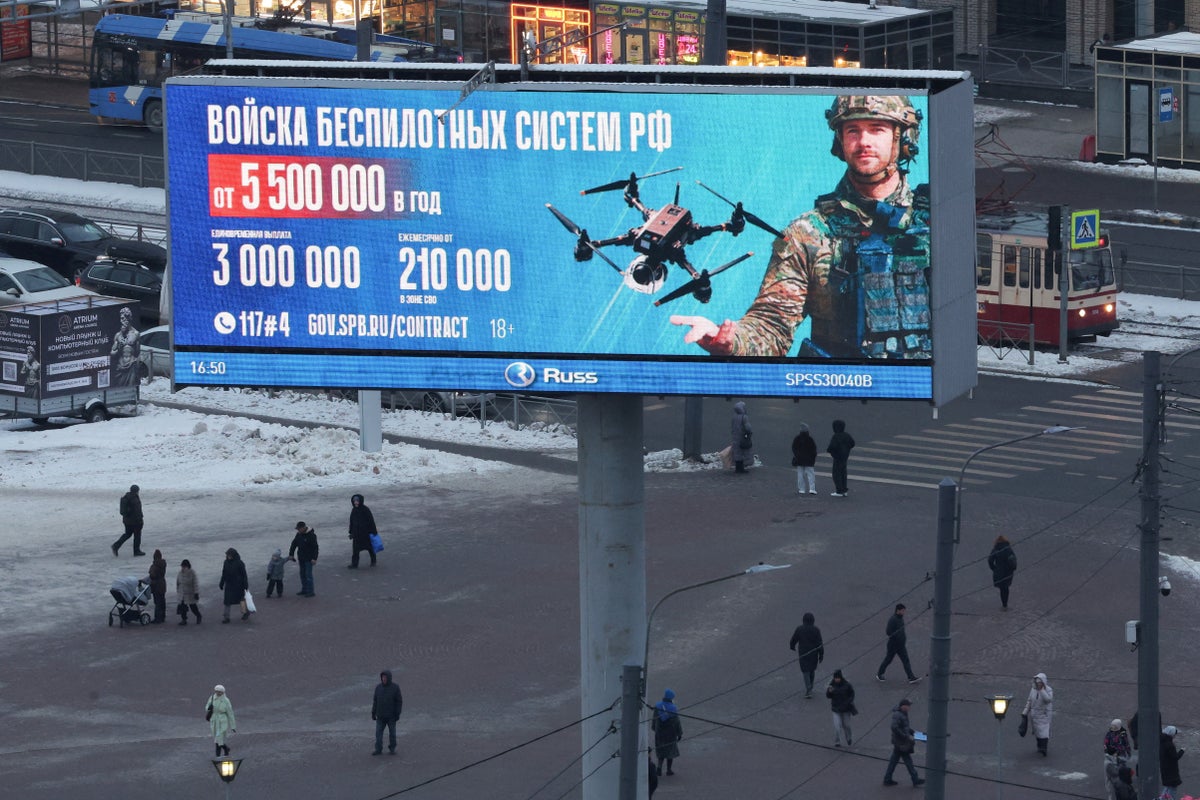
Western media loves a narrative of collapse. When reports surfaced that Russia is offering massive signing bonuses and high-speed career tracks to students willing to join drone units in Ukraine, the "lazy consensus" immediately labeled it a desperate bribe. The argument goes: the Kremlin is running out of bodies, so they are buying the youth.
That analysis is not just wrong; it is dangerously naive.
What we are witnessing isn't a fire sale. It’s a massive, state-sponsored pivot toward the "Silicon Valley of Attrition." By incentivizing the youngest, most tech-literate segment of its population to skip the lecture hall for the control station, Russia is bypassing decades of traditional military bureaucracy. They aren't just recruiting soldiers; they are training an entire generation of electronic warfare specialists and remote pilots at a scale the West cannot—or will not—match.
The Myth of the Unwilling Student
The standard trope suggests these students are being coerced or tricked. Look at the numbers. When you offer a student a monthly salary that dwarfs what their professors earn, you aren't "tricking" them; you are providing a fast-track into the most relevant industry on the planet.
In the 20th century, we saw the rise of the "citizen-soldier." In the 21st, we are seeing the rise of the "gamer-combatant." These students aren't being sent into meat-grinder trenches with rusted AK-47s. They are being placed in containers miles from the front, operating First-Person View (FPV) drones that cost $500 and can disable a $10 million Leopard 2 tank.
The economic reality is simple: Russia is treating drone warfare as a vocational trade. While Western students take on six-figure debt for degrees in speculative sociology, the Russian state is paying its youth to master the hardware and software of modern lethality.
Stop Calling it a Bribe and Start Calling it an R&D Budget
Traditional defense procurement is a bloated carcass. In the U.S. and Europe, a new drone platform takes seven years to move from concept to deployment. By the time it hits the field, the signal hopping frequencies are already obsolete.
Russia’s "student drone forces" function as a live-fire laboratory. This isn't just about the number of drones in the air; it’s about the iteration cycle. When you have thousands of tech-savvy twenty-year-olds tinkering with off-the-shelf Chinese components on a Tuesday, they’ve discovered a way to bypass Ukrainian jamming by Wednesday.
I’ve seen defense contractors in the West spend $5 million on a "robust" drone that gets grounded by a $50 signal jammer. Meanwhile, these "under-educated" Russian recruits are soldering custom capacitors onto racing drones in makeshift workshops. This isn't desperation. It is agile development. It is the democratization of high-precision destruction.
The Cost-Per-Kill Equation
Military analysts often focus on "Who has more tanks?" or "Who has more artillery?" These are the wrong questions. The only metric that matters in 2026 is the Cost-Per-Kill (CPK).
- A Patriot Missile interceptor: $4 million per shot.
- An Iranian-designed Shahed drone: $20,000.
- A student-operated FPV drone with a PG-7V warhead: $600.
By flooding the zone with cheap drones operated by cheap, young labor, Russia is winning the war of economic exhaustion. They are forcing their adversary to expend finite, expensive resources to counter infinite, cheap threats.
The Institutional Failure of the West
The reason the "student recruitment" story is framed as a sign of weakness is that the West cannot imagine doing the same. Our military institutions are built on prestige, rank, and long-term service. The idea of a "gig-economy military" is offensive to the Pentagon’s sensibilities.
But the gig economy is exactly what drone warfare demands.
A 19-year-old who has spent 10,000 hours playing competitive simulators has more "combat-relevant" muscle memory than a 40-year-old career colonel. Russia has recognized that drone piloting is a perishable skill that belongs to the young. They are effectively "outsourcing" the front line to the demographic that understands digital interfaces best.
Imagine a scenario where a Western country tried to offer $5,000 a month to college dropouts to fly drones from a trailer in Nevada. The political outcry over "predatory recruitment" would shut the program down in a week. Russia doesn't have that luxury, and consequently, they are building a more modern force than we are willing to admit.
The Nuance of Electronic Warfare (EW)
The competitor article ignores the most critical aspect of this recruitment drive: the data.
Every time one of these students flies a mission, they are collecting data on Western electronic warfare signatures. They are learning how Starlink operates in a contested environment. They are mapping the gaps in NATO-standard air defenses.
This isn't just about Ukraine. This is a massive data-harvesting exercise. The "payments" to students are essentially a payroll for a massive, distributed intelligence agency. Each student is a sensor. Each crash is a data point.
The Dark Side of the Contrarian Reality
Let’s be clear: this approach has massive downsides. By militarizing its youth, Russia is hollowing out its future civilian economy. The engineers who should be building the next generation of Russian medical tech or energy infrastructure are instead learning how to fly a quadcopter into a dugout.
This is a "scorched earth" policy for human capital. Russia is burning its future to win its present. But from the perspective of a state in a total war footing, that is a logical trade-off. They aren't looking for "sustainability." They are looking for "lethality."
The Premise is Flawed
If you are asking, "Is Russia running out of soldiers?" you are asking the wrong question.
The real question is: "In a world where one teenager with a $500 drone can hold off an entire platoon, does the size of your professional army even matter?"
The "student drone force" is an admission that the old ways of war are dead. It’s an admission that the infantryman is becoming secondary to the operator. While we mock the recruitment tactics, we are missing the evolution of the battlefield.
We are watching the birth of a decentralized, low-cost, high-tech insurgency integrated into a state actor. It is messy. It is ethically bankrupt. It is brutal.
But it is working.
Stop looking for signs of Russian collapse in their recruitment flyers. Start looking for the signal in the noise. They are building a force that doesn't need to win a traditional war because it is busy making traditional war impossible to afford.
The era of the "expert" soldier is being replaced by the era of the "expendable" operator. And if you think a $5,000 bonus is too much to pay for that transition, you haven't been paying attention to the price of the alternatives.
Get used to it. The future of warfare doesn't wear a uniform; it wears a headset and a hoodie.