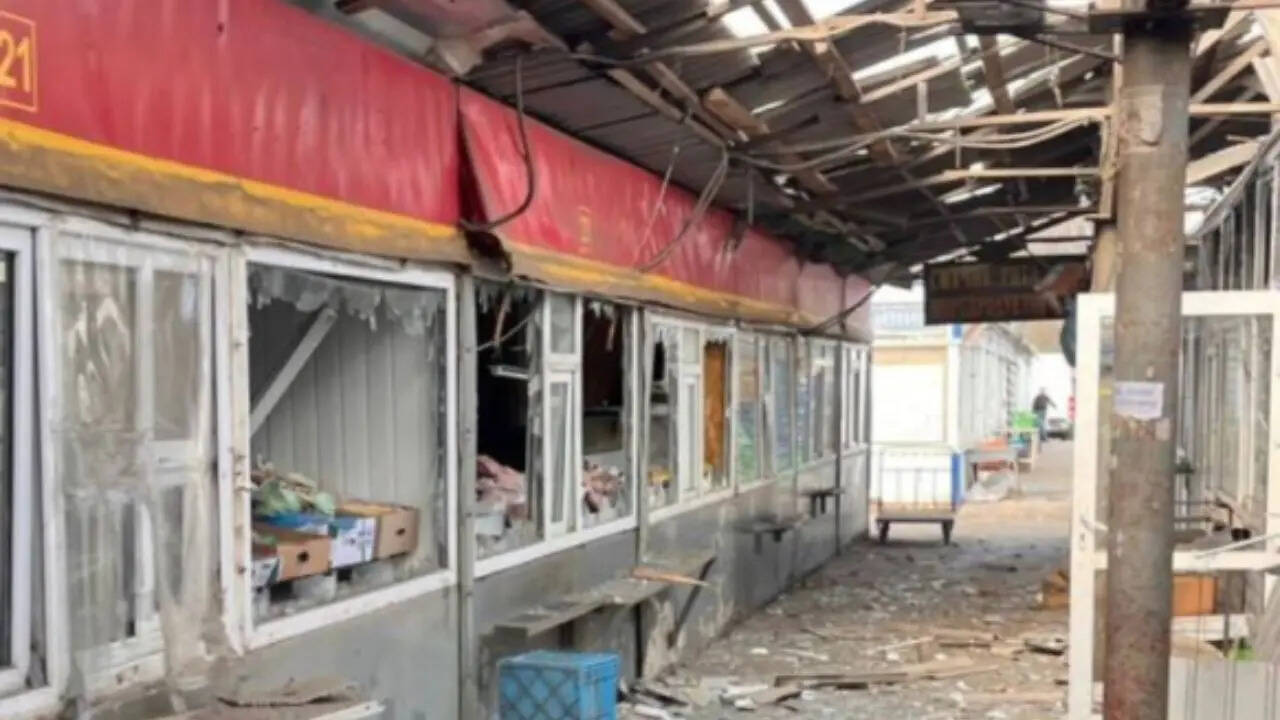
The Saturday morning rush at a local market should be about finding the best produce or catching up with neighbors. In Nikopol, it became a scene of absolute carnage. At roughly 9:50 am on April 4, 2026, Russian forces deployed FPV drones directly into a crowded marketplace. The result was immediate and devastating: five people dead and at least 19 others wounded, including a 14-year-old girl now fighting for her life in critical condition.
I've watched this conflict evolve for years, and what we're seeing now isn't just "collateral damage." It's a shift in tactics. While the world often focuses on massive nighttime missile barrages, the reality on the ground in frontline cities like Nikopol is a persistent, terrifying hunt by low-cost drones against civilian soft targets in broad daylight. For a different perspective, read: this related article.
The Nikopol market strike and the cost of proximity
Nikopol isn't just any city. It sits right on the edge of the Dnipro River, staring directly at Russian-occupied territory on the opposite bank. Because of this geography, the city is a constant target for everything from heavy artillery to these nimble, lethal drones.
The April 4 attack wasn't an isolated incident but part of a massive surge. Overnight, Ukraine’s Air Force reported a staggering 286 drones launched across the country. While air defenses managed to intercept about 260 of those—mostly the long-range Shahed types—it's the tactical drones, like the ones that hit the Nikopol market, that are becoming harder to stop. They fly low, they're fast, and they're being used to "clean up" targets while people are most active. Further coverage on this matter has been shared by BBC News.
Here’s the breakdown of the casualties from the Nikopol strike:
- Total Dead: 5 (three women and two men).
- Total Injured: 19 (some reports suggest this could rise to 22 as more people seek help for shrapnel wounds).
- Critical Cases: A 14-year-old girl and two elderly men are currently in intensive care with blast injuries and severe burns.
A calculated shift to daylight terror
You might wonder why Russia is ramping up daytime attacks now. It's about psychological attrition. When you strike at night, people are in their homes or shelters. When you strike a market at 10:00 am, you're hitting the very fabric of "normal" life. It's a message that nowhere is safe, even during the busiest hours of the day.
Ukrainian officials aren't mincing words. The Prosecutor General’s Office has already labeled the Nikopol market hit a war crime. But beyond the legal terminology, there’s a practical reality: the sheer volume of drones. Launching nearly 300 drones in a single 24-hour window, as we just saw, is designed to saturate and exhaust defense systems.
The broader context of the April 4 escalation
Nikopol wasn't the only city under fire this weekend. The "Easter Escalation," as some are calling it, has spread the violence across several regions:
- Sumy: An overnight drone strike hit a high-rise apartment building, injuring 11 people, including a teenager.
- Kharkiv: This city endured 37 strikes in a single day recently, with the latest Saturday morning attacks injuring another five civilians.
- Kramatorsk: Six people were killed just 24 hours prior to the Nikopol strike.
Honestly, it feels like we’re entering a phase where the frequency of these "small" drone strikes is doing as much cumulative damage as the big ballistic missile hits. For the people in Dnipropetrovsk Oblast, it means living in a state of permanent "moderate" or "critical" danger.
What this means for the frontline
If you're following the maps, the proximity of Nikopol to the Zaporizhzhia Nuclear Power Plant and the occupied territories makes it a strategic anvil. By keeping the civilian population in a state of constant flight or fear, the Russian military hopes to complicate Ukrainian logistics and tie down air defense assets that could be used at the actual front.
It’s a brutal logic. While the Kremlin claims to target "military-industrial complexes," there is no military value in a trade pavilion or a produce stall. The destruction of trade pavilions and stores in Nikopol is purely about economic and social disruption.
If you want to help or stay informed, don't just look at the casualty counts. Look at where the strikes are happening. Supporting organizations that provide mobile medical units to these frontline cities is the most direct way to impact survival rates. Places like Nikopol need more than just "thoughts and prayers"—they need advanced shrapnel kits and trauma surgeons who can handle the influx of blast injuries that these daylight drone strikes are now causing with horrific regularity.
Watch the skies, stay in touch with local alerts if you're in the region, and never assume a "quiet" morning at the market is a safe one.