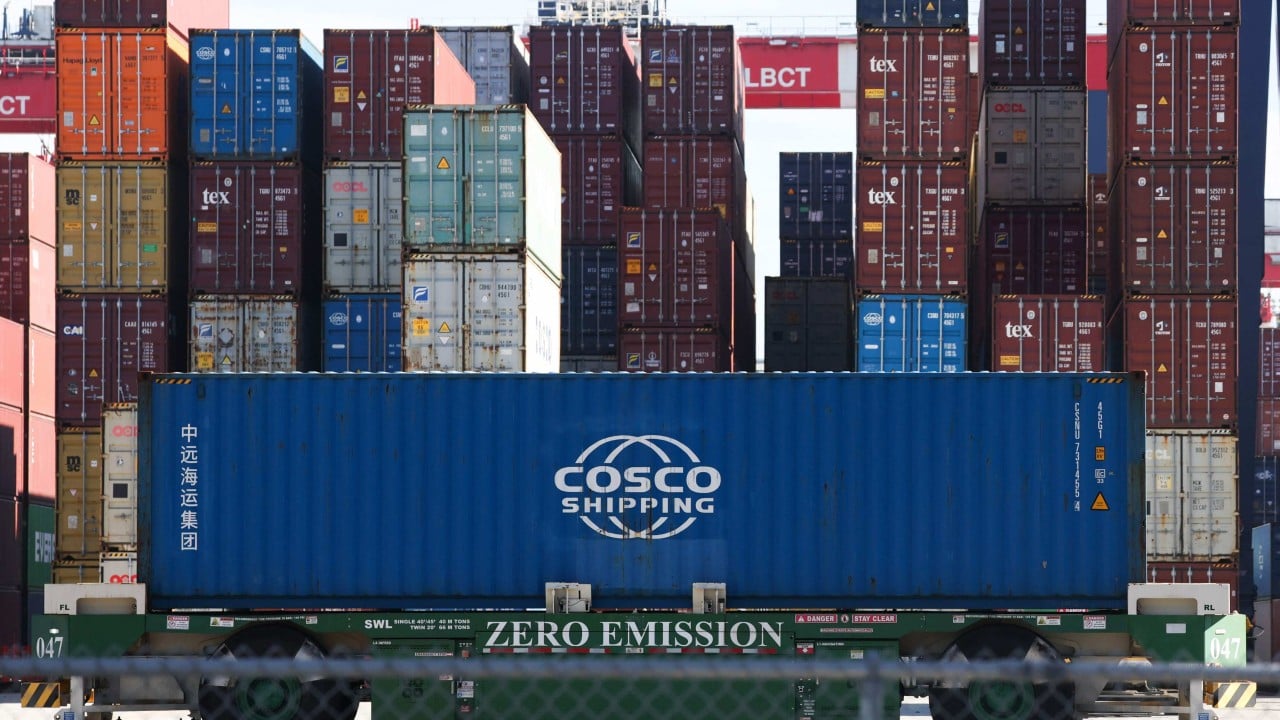
A single container ship is a city made of iron. It is a floating stack of dreams, containing everything from the silicon chips in your pocket to the coffee beans in your cupboard. When these giants stop moving, the world’s heartbeat skips.
Lately, that heartbeat has been erratic.
In the boardrooms of COSCO Shipping Ports, the air isn’t filled with panic. It is filled with the dry, calculated hum of spreadsheets. While the Middle East flickers with the heat of conflict and the Red Sea becomes a gauntlet of drone strikes and diverted hulls, the world’s largest port operator is leaning back. They are looking at the map of the world and seeing something the rest of us miss. They see resilience where we see a crisis.
The View from the Bridge
Consider a captain named Elias. He isn't real, but his predicament is. Elias stands on the bridge of a vessel roughly the size of the Empire State Building laid on its side. Normally, his path from Asia to Europe is a straight shot through the Suez Canal—a mathematical certainty. Now, that certainty is gone. He looks at the radar, thinking about the Bab el-Mandeb strait, wondering if the horizon holds a merchant’s profit or a missile’s arc.
For Elias, the conflict is a visceral, immediate threat. For COSCO, it is a variable in a very long game.
The company recently went on the record to state that the impact of the Red Sea tensions on their bottom line remains "limited." To the average person watching the news, this sounds like corporate delusion. How can a war in one of the world’s most vital maritime arteries not bleed a shipping giant dry? The answer lies in the invisible architecture of global trade.
Shipping isn't just about moving Point A to Point B. It is about the "Hub and Spoke."
The Greek Fortress
To understand why COSCO isn't sweating, you have to look at Piraeus. This ancient Greek port was once the gateway for triremes and philosophers. Today, it is the crown jewel of China’s "Belt and Road" in Europe. COSCO doesn't just visit Piraeus; they own the concession to run it.
When the Red Sea becomes a "no-go" zone, ships take the long way around the Cape of Good Hope. This adds ten days. it adds millions in fuel. It creates a massive logistical knot. But eventually, those ships still have to dock. They still have to unload. Whether a ship arrives on Tuesday via Suez or three weeks later via Africa, the cranes at Piraeus are still waiting. The rent is still paid. The cargo still moves.
This is the "moat" around COSCO’s business. They aren't just the bus drivers of the ocean; they own the bus stations.
The company’s recent financial reports reflect this strange immunity. While revenue dipped slightly in certain sectors, the overall volume handled across their global portfolio of dozens of terminals remained remarkably steady. They handled over 100 million TEUs (twenty-foot equivalent units) last year. Think about that number. One hundred million metal boxes, each a brick in the wall of global civilization.
The Math of Human Necessity
We often mistake "shipping" for a luxury of the modern age. We think of it as the reason our cheap plastic toys arrive on time. It is deeper than that. Shipping is the nervous system of our species.
When the Iran-aligned Houthi rebels began targeting ships, the world expected a total collapse of the supply chain. We remembered the "Ever Given" getting stuck in the Suez and the toilet paper shortages that followed. We braced for impact.
But the "limited" impact COSCO describes is a testament to human adaptability. Or, perhaps, human desperation.
If the Red Sea is closed, we don't stop buying. We just wait longer. This delay creates a "vessel squeeze." Because ships are taking longer journeys, there are fewer ships available at any given time to start new journeys. In the twisted logic of maritime economics, a shortage of ships often leads to higher freight rates.
So, while the port operator might see a slight delay in arrival times, the shipping lines—the sisters of these port operators—often find themselves making more money per box because the capacity is tight. It is a grim irony. Conflict creates scarcity, and scarcity creates value.
The Ghost of the Strait
There is a quiet tension in the phrase "limited impact." It suggests a threshold.
If you sit in a café in Algeciras or Valencia—other ports where COSCO holds significant sway—you won't see men in suits worrying about the day-to-day fluctuations of the stock market. You see the dockworkers. You see the truckers.
These are the people for whom the "human element" isn't a buzzword. For a crane operator in Piraeus, the Red Sea conflict isn't a geopolitical shift; it’s a shift in his overtime schedule. It’s the difference between a quiet Tuesday and a chaotic Sunday when three diverted ships arrive at once, screaming to be unloaded.
The invisible stakes are found in the price of a gallon of milk in a suburban grocery store three months from now. COSCO’s confidence is a signal that the "big pipes" of the world are still flowing, even if the water is taking a detour.
Beyond the Horizon
Why does this matter to you?
It matters because we live in an era of "perma-crisis." If it isn't a pandemic, it’s a canal blockage. If it isn't a blockage, it’s a regional war. We have become accustomed to the idea that the world is fragile.
COSCO’s stance offers a different narrative. It suggests that the systems we have built are more "liquid" than we realize. They are designed to absorb shocks. They are built to route around damage, much like the internet itself.
But there is a cost to this resilience. The "limited" impact on a balance sheet doesn't account for the carbon footprint of thousands of ships burning extra fuel to circumnavigate a continent. It doesn't account for the psychological toll on sailors who are effectively trapped on their vessels for extra weeks, separated from their families by a war they didn't start.
The company’s management is focused on "lean operations" and "cost control." These are the shield and sword of the corporate world. By tightening their belts and diversifying their port holdings—stretching from China to the Mediterranean to South America—they have insured themselves against the volatility of any single geographic point.
They have turned the world into a giant game of Tetris. If one line doesn't fit, they simply move the pieces until it does.
The Irony of Stability
There is a profound silence in the middle of a container terminal. Despite the massive machinery, the scale of the operation swallows sound. You realize, standing there, that you are looking at the true face of power in the 21st century.
Power isn't just about who has the most drones or the most territory. It is about who controls the flow.
COSCO Shipping Ports is signaling to the world that the flow is safe. They are telling investors that the "Red Sea Ghost"—the fear of a total maritime shutdown—is just that: a ghost. It haunts the headlines, but it doesn't break the steel.
As we move deeper into this decade, the definition of "stability" is changing. It no longer means the absence of conflict. It means the ability to thrive within conflict. It means building a business model that treats a missile strike in a distant strait as a minor logistical detour rather than an existential threat.
The cranes keep moving. They dip their long necks, pluck a box from a deck, and swing it onto the land.
Somewhere in the Atlantic, a ship that should have been in the Mediterranean by now is fighting a ten-meter swell off the coast of South Africa. The crew is tired. The salt is thick on the windows. But the cargo is safe. The ports are open. The ledger is balanced.
The world is still connected, not by a shared peace, but by a shared, stubborn refusal to let the boxes stop moving.
We are all passengers on this iron city. We are all waiting for our dreams to clear customs. And for now, the gates of Piraeus remain wide, indifferent to the smoke on the southern horizon.
Would you like me to analyze the specific port volume data from COSCO’s latest quarterly report to see which regions are picking up the slack?