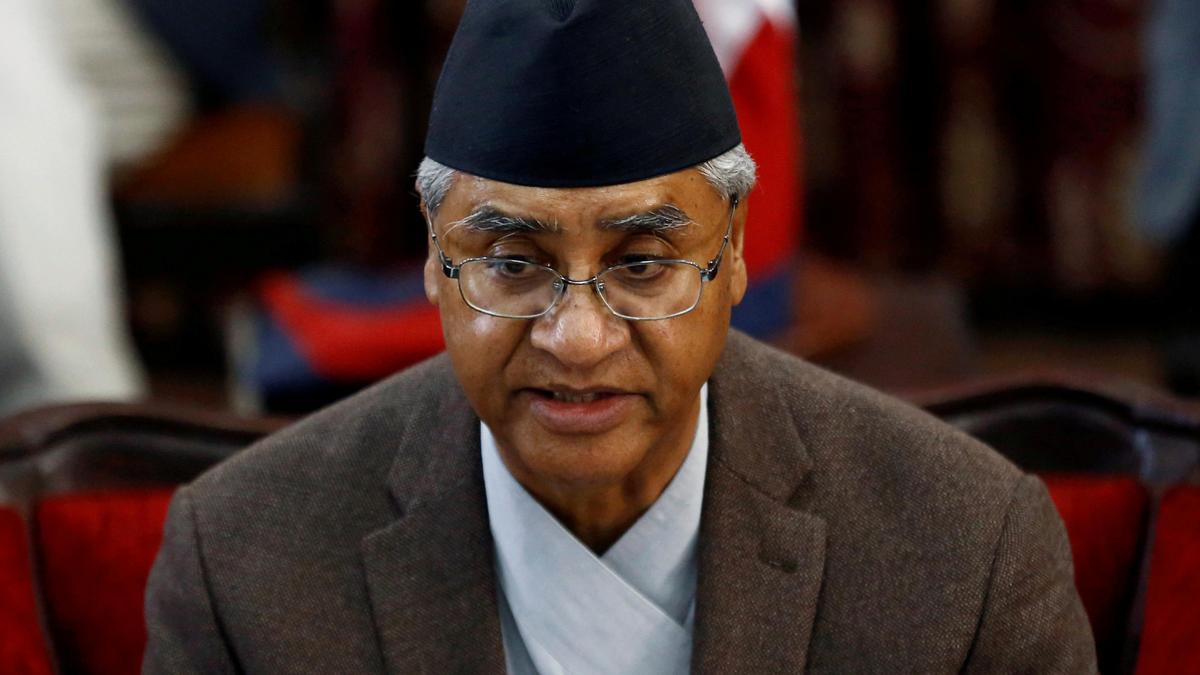
Nepal has issued an arrest warrant for five-time Prime Minister Sher Bahadur Deuba and his wife, former Foreign Minister Arzu Rana Deuba, marking a seismic shift in the country's struggle against institutional graft. The Kathmandu District Court authorized the warrants this week following a high-stakes request from the Department of Money Laundering Investigation. Currently in Singapore for what they describe as medical treatment, the couple now faces the prospect of an Interpol Red Notice, an indignity once unthinkable for the architects of Nepal’s democratic transition.
This is not a routine legal procedure. It is the culmination of a volcanic public reckoning that erupted in September 2025, when a youth-led uprising—dubbed the Gen Z protests—overran the streets of Kathmandu.
The Ashes of Singha Durbar
The catalyst for the current probe is as visceral as it is damaging. During the height of the September unrest, protesters breached the private residences of several top-tier politicians. At the Deuba residence, and those of other former leaders, witnesses and viral social media footage claimed to show something staggering: bundles of cash, some partially charred, scattered among the wreckage.
While Deuba has dismissed these videos as AI-generated fabrications, forensic analysis tells a different story. Government investigators confirmed that fragments recovered from the sites were indeed genuine currency. This discovery stripped away the thin veil of "procedural errors" that usually protects the political class, forcing the Department of Money Laundering Investigation to treat the matter as a criminal acquisition of wealth.
For decades, the Deuba name was synonymous with the Nepali Congress and the very survival of the state. He navigated five separate terms as Prime Minister, surviving civil wars and royal coups. But the sheer longevity that once signaled stability now looks like a long-running monopoly on state resources.
A Rap Artist and a Revolution
The political environment has fundamentally changed since the election of Balendra "Balen" Shah. A 35-year-old rapper and structural engineer who swept into power on a wave of anti-establishment fervor, Shah represents a generation that has no memory of the "heroic" era of the 1990s democracy movement. To them, the old guard—Deuba, KP Sharma Oli, and Pushpa Kamal Dahal—are not liberators, but obstacles.
The current administration is systematically dismantling the protectionist networks that once shielded former leaders. The arrest of former Energy Minister Deepak Khadka and the broadening investigations into KP Sharma Oli and Dahal suggest that the Deuba warrant is the first tile in a collapsing domino set.
The Singapore Standoff
Sher Bahadur Deuba remains defiant. In a statement released from abroad, he characterized the investigation as "false propaganda," asserting that his life is an open book. He pointed to his role in establishing the Commission for the Investigation of Abuse of Authority (CIAA) in the early 1990s as proof of his commitment to transparency.
There is a bitter irony in that defense. The very institutions Deuba helped build to catch mid-level bureaucrats are now being turned against him by a new generation of investigators who are less susceptible to the traditional "phone-call politics" of Kathmandu.
The immediate challenge for the Nepali government is the physical apprehension of the couple. By staying in Singapore, the Deubas have effectively placed themselves in a legal gray zone. Nepal’s Ministry of Home Affairs is now preparing the paperwork for Interpol, a move designed to freeze their international mobility and force a return.
Why This Time is Different
Skeptics in Kathmandu have seen "anti-corruption drives" before. Usually, they are used by one faction to settle scores with another before being quietly shelved. However, the 2025 uprising changed the stakes. The protesters didn’t just demand resignations; they demanded the return of "looted" wealth.
The investigation has moved beyond simple bribery allegations. It is now a comprehensive audit of immovable assets, foreign bank accounts, and family-linked businesses. The Department of Money Laundering Investigation has already frozen all assets registered to the Deuba family.
This isn't just about one man or one party. It is an audit of the entire post-1990 political order. If the prosecution of a five-time Prime Minister succeeds, the unspoken agreement that protected the "Big Three" leaders for thirty years is dead.
Nepal is no longer a country where a revolutionary past grants a lifetime of immunity. The charred remains of currency found in the homes of the powerful have become the ultimate symbol of a broken trust that can no longer be mended with speeches or political reshuffling. The warrant is out, the assets are frozen, and the "open book" of Deuba’s career is being read by a very different audience than he ever intended.
The clock is ticking on the Singapore medical stay.