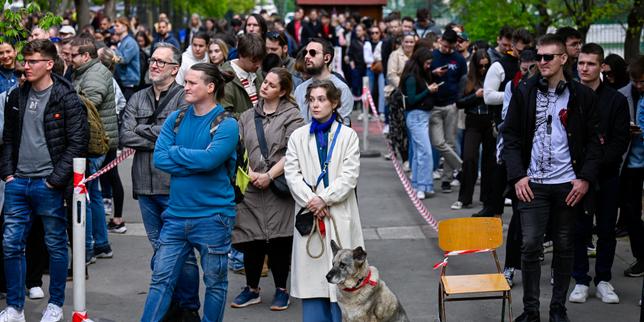
The record-breaking turnout reported across Hungary at mid-day isn't a sign of a healthy, relaxed democracy. It is the sound of a fever breaking. By noon, the sheer volume of voters hitting the polls suggested that the apathy which usually protects incumbents has vanished, replaced by a desperate, high-stakes mobilization from both the Fidesz powerhouse and a newly galvanized opposition. While state media frames the surge as a victory for civic engagement, the reality on the ground in Budapest and the rural heartlands tells a story of a nation pushed to a psychological breaking point.
The End of the Quiet Majority
For over a decade, Viktor Orban’s grip on power rested on a simple calculation. He didn't need everyone to love him; he just needed his core base to show up while everyone else stayed home, exhausted by a fragmented opposition. That calculation has failed. The numbers flowing out of the National Election Office indicate that the "quiet majority" has decided to speak. Meanwhile, you can explore similar stories here: The Mechanics of Political Displacement Analytical Breakdown of the Tisza Party Surge.
High turnout typically favors the challenger in Hungarian politics. When the numbers spike, it usually means the urban centers—traditionally more critical of the government—are flooding the booths. However, Fidesz has spent the last year building a sophisticated, data-driven mobilization engine that targets every small village with surgical precision. They aren't just waiting for voters; they are fetching them. This isn't just an election. It is a total mobilization of two different Hungaries that no longer share a common reality.
The Peter Magyar Factor
The sudden rise of Peter Magyar, a former insider who turned on the system, has acted as a chemical catalyst in a stagnant solution. Before Magyar, the opposition was a collection of familiar faces that many voters found uninspiring or compromised. Magyar changed the physics of the race. He speaks the language of the regime because he was part of it. He knows where the bodies are buried, and he has spent the campaign season digging them up. To explore the complete picture, we recommend the recent analysis by Associated Press.
His presence on the ballot transformed a predictable landslide into a street fight. He didn't just pull voters from the left; he started chipping away at the edges of the Fidesz base—the disillusioned conservatives who still believe in European integration but are tired of the systemic cronyism. This internal fracture is why we see such frantic activity at the polling stations. Fidesz is terrified of losing its aura of invincibility, and the opposition finally smells blood.
Economic Pain Behind the Patriotic Rhetoric
While the billboards across the country scream about "sovereignty" and "stopping Brussels," the average Hungarian is voting on the price of bread and fuel. Hungary has endured some of the highest inflation rates in the European Union over the last two years. The government’s attempt to shield the public through price caps and subsidies worked for a while, but the bill has finally come due.
The Rural Squeeze
In the villages, the loyalty to Orban remains strong, but it is becoming transactional. The "Public Works" schemes and the social safety nets provided by local Fidesz-aligned mayors are the only things keeping many families afloat. This creates a powerful incentive to vote for the status quo, even as living standards stagnate.
- Utility Costs: Despite the famous "overhead reduction" program, many households are seeing energy bills they cannot afford.
- Healthcare Collapse: Outside of Budapest, the state of public hospitals has become a primary grievance, with wait times for basic procedures stretching into years.
- Education Strike: The ongoing friction with teachers has moved from the classroom to the kitchen table, as parents realize the state is failing to prepare their children for a modern economy.
The Infrastructure of Influence
To understand why the results expected tonight are so unpredictable, one must look at how the information reached the voters. The Hungarian media environment is an echo chamber. Nearly all regional newspapers and television stations are under the control of the Central European Press and Media Foundation (KESMA), a massive conglomerate loyal to the Prime Minister.
This means that for a large portion of the electorate, the "record turnout" is being framed as a defense of the nation against foreign interference. They aren't voting against an opposition party; they are voting against a perceived existential threat. This psychological warfare makes the high turnout even more volatile. When people believe they are fighting for their survival, they don't just vote—they recruit everyone they know.
The Shadow of the European Union
Brussels is watching these mid-day numbers with a mixture of hope and anxiety. Hungary remains the primary obstacle to a unified EU foreign policy, particularly regarding Ukraine. A weakened Orban would mean a more compliant Hungary, but a resurgent Orban, backed by a massive popular mandate, would feel empowered to escalate his "veto diplomacy."
The freezing of billions in EU funds was meant to bring the government to heel. Instead, it provided a convenient villain for the state’s propaganda machine. The narrative that "foreign powers are trying to starve Hungarians" has been incredibly effective in rural districts. The irony is that the very funds being withheld are the ones needed to fix the crumbling infrastructure that is driving the urban opposition’s anger. It is a perfect, self-sustaining cycle of grievance.
Digital Warfare and the Data Gap
While the physical polling stations are crowded, the real battle happened on mobile screens over the last forty-eight hours. Both sides have utilized massive databases to track supporters. Fidesz has the "Kubatov lists"—a legendary database of voter preferences that allows them to know exactly who hasn't voted by 2:00 PM and send a volunteer to their door.
The opposition, led by Magyar’s movement, has countered with a massive, grassroots social media blitz. They have bypassed the traditional media blackout by going directly to Facebook and TikTok, reaching a demographic that hasn't watched a state news broadcast in a decade. This digital divide is reflected in the geographic split of the turnout. The cities are hyper-informed and angry; the countryside is hyper-mobilized and defensive.
The Geopolitical Stakes
This isn't just about who sits in the parliament in Budapest. It is about the eastern flank of NATO and the future of the Visegrad Four. For years, Hungary has played a balancing act between East and West, courting Chinese investment and Russian energy while cashing EU checks. That era of "strategic ambiguity" is reaching its limit.
The high turnout suggests that the Hungarian public senses the gravity of the moment. They know that this election will decide whether Hungary remains a bridge between worlds or becomes a fortified outpost on the edge of a new Iron Curtain. The results expected tonight will not just be a headcount; they will be a directive on Hungary's place in the world for the next decade.
The Credibility of the Count
With such high stakes, the focus will inevitably shift to the integrity of the counting process. Thousands of independent poll watchers have been deployed across the country, many for the first time. Their presence is a direct response to fears of electoral fraud, particularly in the reporting of "phantom" voters from across the borders.
The "voter tourism" phenomenon—where people are registered at addresses they don't live in to swing local races—has been a recurring theme in Hungarian elections. This time, the sheer volume of legitimate voters might make such tactics irrelevant, or it might make the margins so thin that every single disputed ballot becomes a potential flashpoint for civil unrest.
The Night Ahead
As the polls prepare to close, the atmosphere in Budapest is one of exhaustion and anticipation. The mid-day records have set the stage for a long night of counting. If the numbers hold, we are looking at the most significant electoral event in Central Europe since the fall of the Berlin Wall.
The Orban administration has survived many challenges, but it has never faced a surge of this magnitude coupled with an internal defection as high-profile as Peter Magyar's. The machine is running at full capacity, burning through resources and political capital to maintain its grip. But machines can overheat. When a population is this activated, the old tactics of containment and distraction no longer work. The only thing left is the raw math of the ballot box.
The results will begin to trickle in after the sun sets, but the shift in the national psyche has already happened. Hungary is no longer a country of passive observers. By showing up in these numbers, the people have reclaimed the narrative from the spin doctors and the pollsters. Whether the outcome is a confirmation of the current path or a sharp detour, the era of predictable, stagnant politics in Hungary is officially over. The pressure inside the system is simply too high for it to return to the way it was.
Go to the official National Election Office website and look at the district-by-district breakdown of the 6:00 PM turnout figures. If the gap between the capital and the rural counties has narrowed to less than five percent, the incumbent has successfully defended his territory. If the gap has widened, the political map of Hungary is about to be redrawn in real-time.