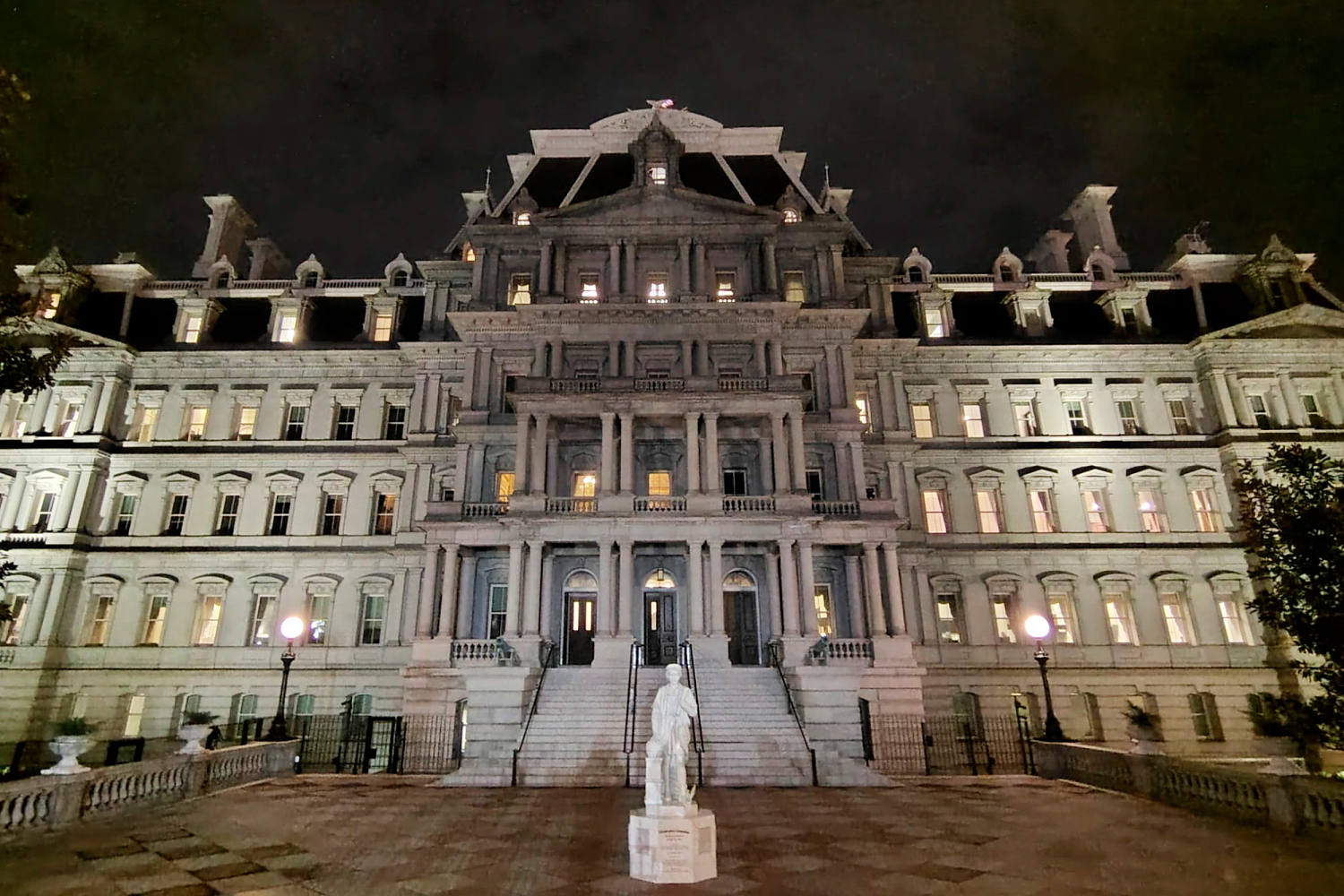
The relocation of a Christopher Columbus statue to the vicinity of the White House is not a localized aesthetic choice but a high-leverage exercise in symbolic geography. By positioning a historically contentious figure within the immediate orbit of the Executive Branch, the administration utilizes the physical environment to codify a specific historical narrative, effectively turning federal land into a medium for cultural signaling. This maneuver functions through three primary mechanisms: the seizure of the "National Front Yard" as a messaging platform, the deliberate activation of historical friction to consolidate a base of support, and the use of permanent bronze-and-stone assets to create "policy-by-proxy" that outlasts legislative cycles.
The Spatial Mechanics of Presidential Influence
Traditional political strategy focuses on digital and broadcast channels; however, spatial strategy operates on the principle of permanence and proximity. In the context of Washington D.C., the distance between a monument and the Oval Office is inversely proportional to its perceived endorsement by the state. For a deeper dive into similar topics, we recommend: this related article.
Placing a Columbus statue near the White House disrupts the existing commemorative density of the area. Most monuments in this high-value zone are reserved for figures who represent a consensus of American civic virtue. By introducing Columbus—a figure currently at the center of a re-evaluation regarding colonial history—the administration forces a "re-contextualization" of the surrounding space.
The logistical reality of this placement involves the National Park Service (NPS) and the Commission of Fine Arts (CFA). When a President bypasses or accelerates these standard bureaucratic channels, it signals an expansion of executive prerogative. The statue becomes more than a tribute; it acts as a marker of administrative territory, asserting that the current leadership maintains the sole authority to define who belongs in the American pantheon. For additional details on the matter, in-depth analysis is available at Reuters.
The Cost Function of Symbolic Friction
Every political action carries a "friction cost"—the amount of social and political capital expended to achieve a result. In many cases, leaders seek to minimize friction to pass legislation. However, in the strategy of cultural signaling, friction is the intended product.
- Narrative Polarization: The statue acts as a lightning rod. By choosing a figure that triggers an immediate, predictable opposition from specific demographics, the administration creates a binary choice for the public. You are either with the "protectors of history" or the "iconoclasts."
- Zero-Sum Commemoration: History is a finite resource in terms of public space and attention. Occupying a physical square foot with a statue of Columbus inherently prevents that space from being used for a monument that might represent a different, perhaps more modern, set of values.
- Media Multiplier Effect: The actual cost of moving a statue is negligible compared to the billions of dollars in "earned media" generated by the ensuing controversy. This is a high-efficiency trade: small capital outlay for massive narrative dominance.
Categorizing the Columbus Archetype
To understand why Columbus is the specific tool chosen for this strategy, one must analyze the "Columbus Archetype" through a clinical lens. He is no longer viewed as a historical individual in the political arena; he is a composite variable representing three distinct themes:
- Western Tradition: He serves as the foundational "Point Alpha" for the European-derived state.
- Defiance of Revisionism: Because modern academic circles have largely moved toward a critical view of his legacy, his physical elevation serves as a direct counter-offensive against what the administration characterizes as "erasure."
- Institutional Continuity: Using federal resources to protect and promote the statue reinforces the idea that the state is the ultimate arbiter of historical truth.
The Mechanism of Policy by Proxy
Legislative wins are fragile. They can be repealed, defunded, or overturned by courts. Physical monuments, however, are notoriously difficult to remove once they are integrated into the federal landscape. This is "Policy by Proxy." By placing the statue, the administration is effectively passing a cultural law that requires no Congressional approval and possesses a much longer half-life than an Executive Order.
The removal process for a federally recognized monument involves an arduous multi-year sequence of environmental impact studies, historical preservation reviews, and public comment periods. Even a subsequent administration hostile to the statue would find the "unwinding" process to be a significant drain on their political bandwidth. Thus, the placement is a strategic "poison pill" designed to force future incumbents to choose between a costly removal battle or tacit acceptance of the statue’s presence.
Identifying the Strategic Bottleneck
The primary limitation of this strategy is the "Saturation Point." As more monuments are used for immediate political signaling, the unique value of the National Mall and its surroundings begins to depreciate. If every square is filled with figures chosen for their ability to provoke the opposition, the area loses its status as a site of national unity and becomes a fragmented patchwork of partisan claims.
Furthermore, this approach relies on the "Defense of Order" logic. The administration positions itself as the defender of statues against "mobs," but this creates a dependency. The strategy only works as long as there is an active threat of protest or vandalism. Without the friction, the statue reverts to being a static object of little political utility.
Strategic Forecast: The Monumentalization of Executive Power
Expect this event to serve as a pilot program for a broader "National Garden of American Heroes" or similar initiatives. The goal is to saturate the federal district with physical reminders of a specific ideological framework before the next election cycle. This is not about the 15th century; it is about the 21st-century control of public perception.
For analysts and strategists, the move signals a shift from "persuasion-based" politics to "assertion-based" politics. The statue is a physical manifestation of a refusal to negotiate on cultural terms. The strategic play for opposing forces is not to engage in the debate over Columbus’s character—which plays directly into the administration's friction-seeking model—but to target the procedural and bureaucratic mechanisms of the NPS and CFA, shifting the conflict from the emotive (history) to the structural (land-use law and executive overreach). Any effort to counter this move must focus on the "Chain of Custody" for federal land, challenging the unilateral nature of the placement rather than the aesthetic or historical merit of the bronze itself.