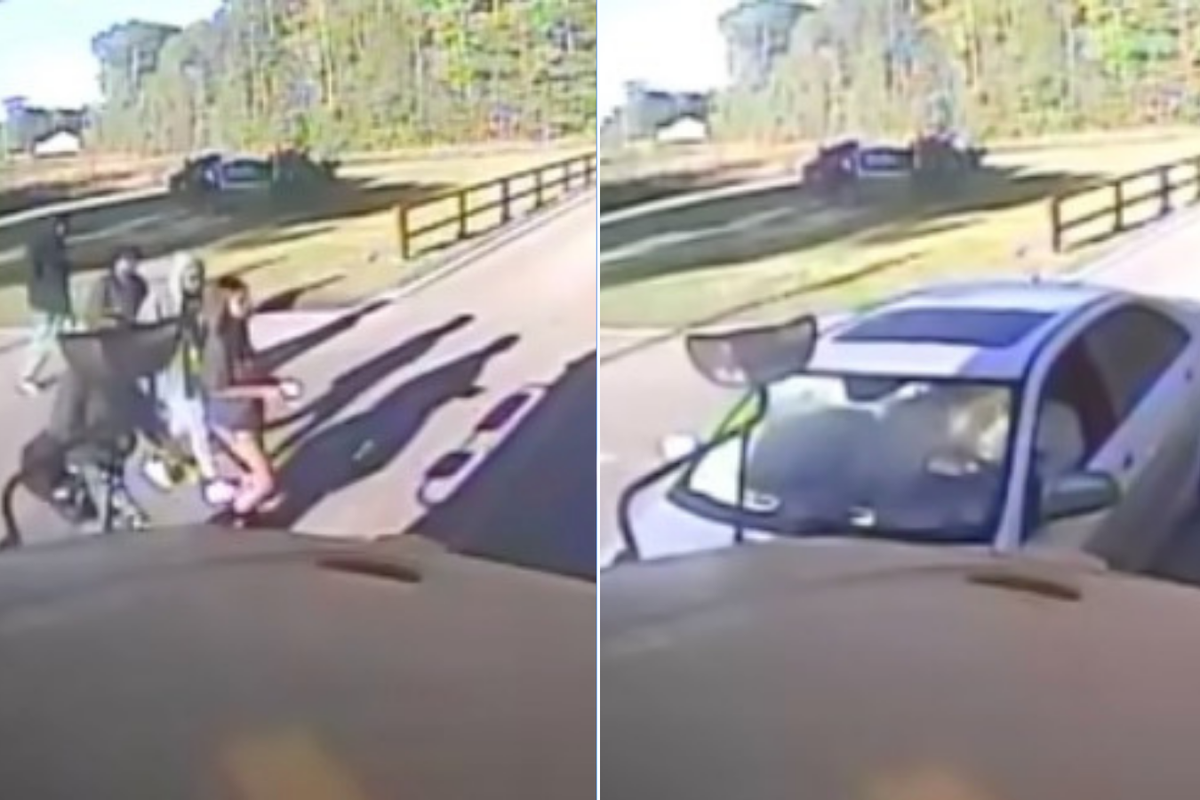
The headlines are already bleeding. They tell a story of a monster in a sedan, a hit-and-run coward plowing into a school bus in Mississippi while children were crossing. We retreat into the same tired ritual: thoughts, prayers, and a manhunt for one "bad apple."
We want a villain to put in handcuffs because it makes us feel like the system works. It doesn’t.
If you think the problem here is just a single reckless driver, you’re part of the collective blindness that keeps these tragedies on a loop. The Mississippi crash isn't an anomaly. It is the logical, mathematical outcome of a transport infrastructure designed for high-velocity throughput rather than human life. We’ve built a world where we expect a yellow paint job and a flashing "stop" arm to counteract 4,000 pounds of kinetic energy driven by a distracted or malicious human.
It's a suicide pact masquerading as a commute.
The Myth of the "Safe" School Bus
We are told school buses are the safest vehicles on the road. Statistically, that’s true—if you’re sitting inside the yellow cage. But the moment those kids step off the bus, they enter a "kill zone" that we’ve spent seventy years perfecting.
The competitor articles focus on the "hit-and-run" aspect because it’s easy to hate a runner. It’s much harder to look at the Stroad (Street-Road hybrid) where this happened and admit that the design itself invited the speed.
Most suburban and rural routes in Mississippi and across the South are built with wide lanes and massive "clear zones." This sends a psychological signal to the driver: Go fast. When you design a road like a drag strip, don't act shocked when people treat it like one. The driver who fled is a criminal, yes, but the engineers who built a 50 mph thoroughfare with mid-block pedestrian crossings are the silent accomplices.
Stop Arm Cameras Are a Revenue Scam, Not a Safety Solution
The immediate "solution" proposed by politicians after every bus crash is more cameras.
"Put cameras on the stop arms! Fine the violators!"
This is a classic pivot. It’s an attempt to monetize danger rather than prevent it. A camera captures a license plate after a child has been struck or narrowly missed. It does nothing to physically stop a vehicle from entering the loading zone.
I’ve seen municipal budgets grow fat on stop-arm violations while the actual rate of "near-misses" remains stagnant. If we actually cared about those kids in Mississippi, we wouldn't be looking for a way to mail a $300 ticket to the driver’s house three weeks later. We’d be talking about physical barriers.
Imagine a scenario where school buses were equipped with retractable bollards or high-visibility physical gates that blocked the entire width of the asphalt. It sounds "too expensive" or "too slow," right? That’s the quiet admission: we value the flow of traffic more than the lives of the students. We choose the efficiency of the commute over the physics of protection.
The Liability of the "Human Element"
We live in the era of the distracted driver. Between smartphones, massive infotainment screens, and the general erosion of the "social contract," the human behind the wheel is the most unreliable component in the transport chain.
Yet, our entire strategy for protecting children crossing the road relies on that unreliable component paying attention. We rely on a driver seeing a yellow bus, recognizing the lights, and choosing to depress the brake pedal.
In any other high-stakes industry—aviation, nuclear power, surgery—we use "fail-safes." We design systems where a single human error cannot lead to a catastrophic failure. On our roads, we do the opposite. We create a system that requires 100% human compliance 100% of the time. When a driver in Mississippi fails that test, we call it an "accident."
It wasn't an accident. It was a system failure.
Why "Awareness Campaigns" Are a Waste of Breath
Every year, the National Association of State Directors of Pupil Transportation Services (NASDPTS) conducts surveys on illegal school bus passing. They find tens of thousands of violations in a single day.
The response? "Yellow Bus Safety Week." More posters. More social media posts telling people "Don't pass the bus."
This is the peak of "lazy consensus" thinking. It assumes that drivers pass buses because they forgot it was illegal. It ignores the reality of "road rage," "hurry culture," and the sheer density of vehicles on the road. You cannot educate your way out of a physics problem.
If you want to stop drivers from plowing into buses, you have to make it physically impossible or psychologically terrifying to do so. This means:
- Narrowing the lanes at designated bus stops to force deceleration.
- Raised crosswalks (speed tables) at every major student pick-up point.
- Automated emergency braking (AEB) mandates for all new vehicles that recognize school bus signals and force the car to a halt.
But we won't do that. We’ll just keep hunting for the driver of that one sedan in Mississippi, pretending that catching him fixes the hole in the hull.
The Hard Truth About Rural Infrastructure
Mississippi has some of the highest traffic fatality rates in the country. This isn't because Mississippians are "worse" drivers; it's because the infrastructure is often aging, poorly lit, and designed for a pre-digital age.
When a bus stops on a two-lane highway with a 55 mph speed limit, you are asking for a miracle. You are asking a driver coming over a crest at 60 mph to perceive, react, and stop a multi-ton vehicle in a distance that the laws of physics barely allow.
The "hit-and-run" driver is a coward for leaving the scene, but the real crime is that we still have kids crossing high-speed rural highways on foot in 2026.
The Actionable Pivot
If you're a parent, stop asking for more "awareness." Start demanding "hard" infrastructure.
- Demand that the school district audits every stop for sight-line distance.
- Demand that the city installs physical chicanes at high-volume bus stops.
- Stop accepting "the driver was distracted" as a valid excuse.
We have the technology to make it impossible for a car to hit a child. We have geo-fencing. We have V2X (Vehicle-to-Everything) communication that can alert every car within a half-mile radius that a bus is unloading.
We don't use it because it’s "unproven" or "intrusive."
The driver in Mississippi didn't just plow into a bus. He plowed into a society that has decided that a five-minute delay in a commute is a greater tragedy than a child in the ICU.
Until we change the asphalt, the blood will keep hitting it.
The driver is the symptom. The road is the disease. Stop looking at the mugshot and start looking at the map.


