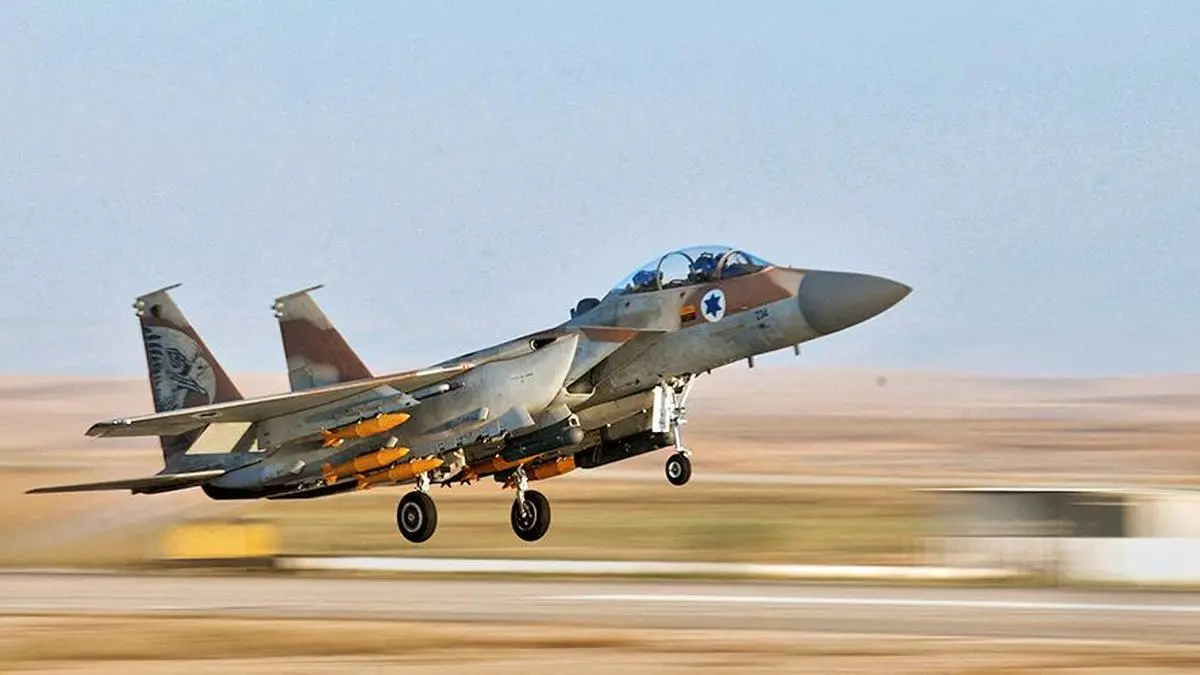
The coffee in Isfahan is usually thick, sweet, and shared over long conversations that meander like the Zayandeh River. But in the pre-dawn hours of a Friday, that rhythm broke. It didn't break with a shout. It broke with a low, rhythmic hum that seemed to vibrate in the marrow of one's bones before it ever reached the ears.
For the people living in the shadow of the Zagros Mountains, the silence of the night is a physical presence. When that silence is perforated by the clinical, metallic shriek of air defense batteries, the world shrinks. It shrinks to the size of a window pane, a basement door, or the grip of a hand.
The Israeli Air Force had arrived.
This was not a chaotic brawl. It was a surgical incision performed at Mach speed. While official bulletins from the IDF would later describe a "completed wave of strikes," those four words mask a terrifyingly complex symphony of physics, geography, and raw political will. To understand what happened in Isfahan, you have to look past the grainy satellite photos and the sterile casualty reports. You have to look at the invisible lines being redrawn in the sand and the sky.
The Anatomy of a Shadow
Isfahan is not just a city of turquoise domes and ancient bridges. It is the heart of a specialized nervous system. It houses the Khatam al-Anbiya Air Base and, more critically, facilities central to a nuclear program that has kept the world’s diplomats awake for decades.
When a strike package is launched from a base in the Negev, it isn't just a flight of F-35 "Adir" stealth fighters. It is a billion-dollar gamble. Imagine driving a car through a dark forest where the trees have eyes and the floor is made of glass. One wrong vibration, one slip of the electronic mask, and the "stealth" vanishes. The pilot becomes a target in a cage of radar waves.
The IDF operates with a philosophy of "Mabam"—the war between wars. It is a doctrine of precision. In this specific wave, the goal wasn't to level a city block or cause mass casualties. The goal was to send a message written in fire: We can touch you whenever we want.
The technical reality of this is staggering. The aircraft must traverse hundreds of miles of hostile or neutral airspace, refuel in silence, and deploy munitions that can "see" their target through layers of concrete and electronic jamming. These are not gravity bombs. They are thinking machines.
A Tale of Two Cities
Consider a hypothetical shopkeeper in Isfahan. We'll call him Reza. He sells carpets near the Naqsh-e Jahan Square. For Reza, the geopolitical standoff between Jerusalem and Tehran is usually an abstraction—something heard on a crackling radio or seen in a state-sponsored mural.
At 4:00 AM, the abstraction ended.
The sound of the S-300 surface-to-air missiles launching is a sound like the earth being unzipped. It is a violent, percussive roar. For Reza, standing on his balcony, the flashes in the distance weren't just "strikes on military infrastructure." They were the sudden realization that the walls of his world are thinner than he thought.
Simultaneously, in an underground command center in Tel Aviv, a young officer stares at a screen. To her, Isfahan is a series of data points. Blue icons representing friendly assets, red icons representing threats. She doesn't see the carpets or the turquoise domes. She sees the "kill chain"—the process of finding, fixing, tracking, and targeting.
When the "target destroyed" notification flickers, she feels a rush of relief, not because of the destruction, but because it means the pilots—her friends, her brothers—are turning their noses back toward the sea.
This is the disconnect of modern warfare. It is fought in the pixels and the ether, but it is felt in the shaking floorboards of a bedroom in central Iran.
The Invisible Stakes
Why Isfahan? Why now?
The "why" is buried in the geography of the facility itself. Isfahan sits at a crossroads. It is a hub for the production of uranium metal and the assembly of the very drones that have become a staple of modern conflict. By striking here, the IAF didn't just break hardware; they broke a sense of invulnerability.
There is a psychological weight to an aerial breach. For years, the narrative was one of "strategic depth." The idea was that Iran was too big, its facilities too buried, and its defenses too layered for a conventional strike to succeed without a full-scale regional war.
The wave of strikes proved that depth is a localized illusion.
But the real story isn't the damage to the radar at the airbase. The real story is the restraint. If you have the capability to fly into the most guarded airspace in the Middle East and hit a specific target with surgical precision, you also have the capability to hit everything else.
The strikes were a comma, not a period.
The Physics of the Aftermath
In the hours following the attack, the air over Isfahan didn't smell like smoke. It smelled like ozone and dust. The state media was quick to downplay the event, calling the sounds "suspicious objects" being intercepted. This is a common dance in the region—a strategic ambiguity designed to prevent the need for immediate, escalatory retaliation.
If you admit you were hit hard, you have to hit back harder. If you claim you swatted away a few "micro-drones," you can go back to sleep.
But the scientists at the Isfahan nuclear site know better. They understand the mathematics of the strike. They know that the munitions used were likely designed to disable specific components—transformers, cooling systems, or radar arrays—without causing a catastrophic leak or a civilian massacre.
It is a terrifyingly polite way to threaten someone.
Consider the complexity of the munitions themselves. Modern standoff missiles like the "Blue Sparrow" or the "Rampage" are designed to mimic the radar signature of other objects, or to stay so low and fast that by the time a defender sees them, the kinetic energy is already through the door.
The IAF doesn't just use explosions; it uses geometry.
The Human Cost of High-Tech Silence
We often talk about these events as if they are chess games played by giants. We use words like "escalation ladder" and "deterrence." But for the people on the ground, those words are meaningless.
There is a specific kind of exhaustion that comes from living in a state of "almost war." It is a low-grade fever of the soul. In Isfahan, the morning after the strikes, the markets opened as usual. The tea was poured. The carpets were swept. But the conversation had changed.
The "Wave" of strikes was over in minutes, but its wake will last for years. It proved that the sky is no longer a ceiling; it’s a door. And that door is unlocked.
The pilots are back in their hangars now. The ground crews are washing the salt air off the fuselages. In Isfahan, the sun has risen over the mountains, casting long shadows across the airbase and the nuclear facility.
The silence has returned to the Zagros Mountains. But it’s a different kind of silence now. It’s the silence of a room where someone has just whispered a secret that changes everything.
The world looks the same, but the air feels heavier. The thick, sweet coffee doesn't taste quite the same when you spent the night wondering if the roof was about to disappear.
The sky is clear, blue, and vast. But everyone is looking up. Everyone is waiting for the next hum. Everyone is wondering if the next wave will be a message, or the end of the conversation entirely.
The mountains remain. The domes remain. But the illusion of distance is dead. Isfahan is no longer a world away; it is exactly one flight path away.
And the engines never really stop cooling.