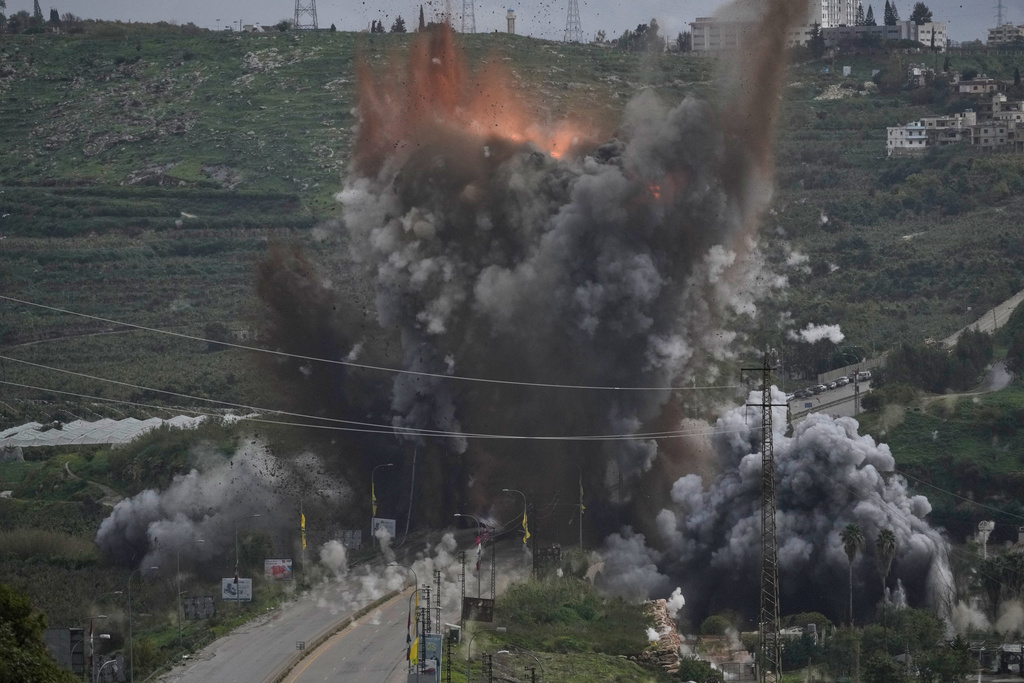
The vibration starts in the soles of your feet before it reaches your ears. In Tehran, it isn’t the sound of a city waking up; it is the low-frequency thrum of an escalating shadow war finally stepping into the light. When the sky over the Iranian capital fractured into shards of orange and steel-gray last night, it wasn’t just a localized military engagement. It was a tremor felt in gas stations in Ohio, in boardroom meetings in Tokyo, and in the cramped cabins of oil tankers drifting through the Strait of Hormuz.
Precision strikes. That is the antiseptic term used in briefings. But for the people on the ground, there is nothing precise about the terror of a midnight sky ignited by outgoing interceptors and incoming munitions. Israel’s decision to target Iranian military infrastructure marks a point of no return. We are no longer talking about the "possibility" of regional conflict. We are watching the gears of a global economic engine grind against the grit of high-stakes brinkmanship.
The Narrow Throat of the World
Consider a map. Look at that tiny, hook-shaped sliver of water between the Persian Gulf and the Gulf of Oman. The Strait of Hormuz is barely twenty-one miles wide at its narrowest point. It is the jugular vein of the global energy market.
Every single day, roughly $20.5$ million barrels of oil pass through that passage. To put that into perspective, that is about one-fifth of the world’s total liquid petroleum consumption. Now, imagine a hand tightening around that throat.
In the wake of the strikes, Tehran has dusted off its most potent rhetorical weapon: the threat to shutter the Strait. It is a move often dismissed as a bluff by Western analysts, a "suicide pill" that would wreck Iran’s own economy. But desperation changes the calculus. When a nation feels its back is against the wall, the "irrational" becomes the only remaining card to play. If that gate closes, the ripple effect doesn't just raise the price of a gallon of premium. It resets the global cost of living overnight.
The Invisible Stakes of a Broken Supply Chain
Think of a supply chain not as a list of logistics, but as a fragile, interconnected web. It is a series of handshakes between producers, refiners, and consumers. Those strikes in Tehran were a serrated knife across that web.
The immediate reaction is always the same: a spike in the price of Brent Crude. Traders in London and New York look at the ticker and see red. But what about the downstream reality?
A ship-owner named Elias—let’s call him that for the sake of the story—is currently sitting in a darkened office in Piraeus, Greece. He manages a fleet of Aframax tankers. For Elias, the news of the strikes isn't about geopolitics; it's about insurance premiums. Every time an anti-ship missile battery moves or a drone swarm is launched, the cost of insuring a hull doubles. Then it triples.
Eventually, it becomes too expensive to sail.
When Elias decides the risk is too high, the oil stays in the ground. Or it sits on the water, stagnant. This is the invisible tax of conflict. It is the cost we all pay for the perception of danger. It starts with the price of a flight to visit family and ends with the cost of a head of lettuce that was trucked across a continent using fuel that was once part of that $20.5$ million barrel daily flow.
The Sound of the Siren and the Silence of the Market
In the streets of Tehran, the sirens aren't a metaphor. They are a physical weight. After years of a cold war carried out in the shadows—through cyberattacks on water plants and assassinations in broad daylight—the shift to direct, kinetic strikes is a gut-punch.
The human cost is often buried under the weight of "strategic objectives." We talk about radars, air defenses, and missile sites. We forget about the shopkeepers who won't open their doors tomorrow. We forget about the families huddling in apartment basements, wondering if the next sound is a sonic boom or something much worse.
The psychological impact of these strikes is a weapon in itself. It’s designed to project vulnerability. By hitting the heart of the capital, Israel isn't just degrading military capacity; it is stripping away the illusion of sanctuary.
But every action has an equal and opposite reaction. In this theater, the reaction is the threat of the blockade. For Iran, the Strait of Hormuz is the "Ultimate Equalizer." If they can't sell their oil, if their infrastructure is being dismantled piece by piece, they can ensure the rest of the world feels the sting.
A Calculated Fragility
There is a strange, mathematical coldness to these escalations. Analysts talk about "proportionality" and "escalation ladders." It’s as if we are playing a game of chess where the board is on fire.
If the Strait is blocked, even partially, the math is brutal.
$$Price_{new} = Price_{old} \times (1 + \text{Geopolitical Risk Premium})$$
But the Geopolitical Risk Premium isn't just a number. It is the sound of a closing door. It is the realization that the era of cheap, reliable energy is a historical anomaly, not a birthright.
The strikes on Tehran were not an isolated event. They are part of a cascading failure of the post-Cold War order. For decades, the "Open Seas" were a given. The U.S. Fifth Fleet acted as the world’s most expensive security guard for the global economy. Now, that guard is being challenged.
The drones used in the attack on Tehran are relatively inexpensive. A million-dollar missile to take out a billion-dollar facility. The ROI of modern warfare is horrifyingly efficient. And if Iran responds by mining the Strait, the cost to clear those mines—both in terms of time and money—is astronomical.
Beyond the Ticker Tape
We are often told to look at the markets for the truth. But the markets are reactive, not prophetic. They reflect the fear of the moment, not the reality of the decade.
The reality is that we are witnessing the birth of a new kind of friction. It’s a world where the lines between "military" and "economic" targets have completely blurred. When an oil refinery is hit, it isn't just a blow to the military; it's a blow to the civilian population’s ability to stay warm, to cook, to survive.
Consider the "Strait of Hormuz" as more than a geographic location. It is a symbol of our collective dependence. We have built a civilization on the assumption that the oil will always flow through that twenty-one-mile gap. We have bet everything on the stability of a region that has known very little of it.
The strikes in Tehran have pulled back the curtain on that bet. They have shown us that the "jugular vein" is incredibly easy to cut.
The Weight of the Morning
The sun will rise over the Persian Gulf tomorrow. It will catch the glint of the water and the steel of the tankers. Some will keep moving. Others will drop anchor, waiting for word from their headquarters.
The world waits with them.
We find ourselves in a moment where a single pilot’s decision, or a single missile commander’s order, can change the trajectory of the global economy for a generation. It is a terrifying level of centralization of power.
The "Red Sky over Tehran" is a warning. It is a signal that the old rules—the ones that kept the tankers moving even during the darkest days of the 1980s "Tanker War"—are being rewritten in real-time.
Is it a bluff? Is the threat to shut the Strait just a desperate plea for relevance?
Maybe.
But as the smoke clears over the military compounds on the outskirts of Tehran, the world has to ask itself a much harder question. How much is a gamble worth when the stake is everything?
The vibration in the soles of our feet hasn't stopped. It’s just moving toward the water.