The sea off the coast of Dubai usually moves with a heavy, oily rhythm. It is a merchant’s highway, a liquid artery pumping the lifeblood of the global economy through the narrow throat of the Persian Gulf. Most nights, the horizon is a steady string of amber lights—tankers, freighters, and supply boats waiting their turn to dock or depart. But on a Tuesday that began like any other, that rhythm broke.
Panic has a specific sound on a ship. It isn't just the sirens. It is the frantic, metal-on-metal thud of boots on a steel deck and the crackle of a radio transmission that carries the unmistakable tremor of a human voice realizing that the floor beneath them is no longer safe.
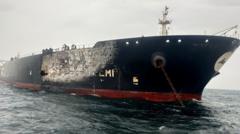
When the BW Rhine, a Singapore-flagged tanker, was struck, the impact wasn't just a physical collision. It was a puncture wound in the illusion of maritime security. We often view the global supply chain as a digital abstraction—tracking numbers on a screen, "out for delivery" notifications, or price fluctuations at a gas pump. We forget that it is actually composed of millions of tons of steel floating on a dark, unforgiving expanse of salt water, manned by crews who are often the last to know they’ve become pawns in a geopolitical chess match.
The Anatomy of an Impact
Imagine standing on the bridge of a vessel three football fields long. You are carrying roughly 60,000 tons of gasoline. To your left, the gleaming skyline of Dubai rises like a glass mirage. To your right, the vast, open water. The air is thick with humidity and the smell of brine.
Suddenly, an external source—later identified as an explosive-laden boat or a mine—hits the hull.
The sound is a dull, chest-thumping roar. The ship doesn't just rock; it groans. In that moment, the crew isn't thinking about the price of Brent Crude or the tensions between regional powers. They are thinking about the fire. Fire on a gasoline tanker is a mathematical certainty of catastrophe if not contained within seconds.
The BW Rhine suffered damage to one of its starboard ballast tanks. For the uninitiated, ballast tanks are the unsung heroes of naval architecture. They hold water to keep the ship stable. Because the explosion hit the ballast tank instead of the cargo hold, a massacre was avoided. It was a matter of inches. Had the hull breached a few meters further back, the Gulf would have seen a localized inferno that would have choked the coastline for weeks.
The Invisible War in the Shallows
The world looked at the smoke rising from the water and asked who did it. The answer, as is often the case in the "gray zone" of modern conflict, is shrouded in deniability. We live in an era where war is no longer declared with trumpets and documents. Instead, it is waged through "unattributed incidents."
A mine here. A drone there. A "technical failure" that suspiciously mimics a cyberattack.
These events are designed to be just loud enough to send a message, but quiet enough to avoid a full-scale retaliatory strike. The message in the Dubai hit was clear: nobody is untouchable. Not even in the busiest, most heavily monitored waters in the world.
Consider the logistical nightmare of this specific geography. The Strait of Hormuz is a bottleneck. Nearly a fifth of the world's oil passes through this strip of water. If you want to rattle the cages of every central bank on the planet, you don't need to invade a country. You just need to make the insurance premiums for a tanker so high that it becomes unprofitable to sail.
Shipping companies operate on razor-thin margins and immense risks. When a ship is hit off Dubai, the "war risk" insurance surcharges spike instantly. This is the hidden tax on every gallon of fuel you buy. You aren't just paying for the extraction and the refining; you are paying for the fear felt by a captain in the middle of the night.
The Human Cost of High Stakes
We rarely talk about the sailors.
On the BW Rhine, there were 22 seafarers. They come from places like Manila, Mumbai, and Odessa. They spend months away from their families, living in a world of grey paint and industrial noise, so that the rest of the world can keep its lights on. When an explosion rips through the hull, they are the ones who have to grab the extinguishers. They are the ones who have to decide whether to lower the lifeboats into a sea that might be covered in burning fuel.
In the aftermath of the Dubai incident, the official reports focused on the "structural integrity" of the vessel and the "minimal impact on the environment." These are comforting phrases. They suggest that the systems worked. But systems are just barriers we build to protect people.
The psychological toll on maritime workers is the silent crisis of our century. After an attack, the crew doesn't just go home. They often stay with the ship. they have to sail it to a dry dock. They have to pass through the same waters where they were almost killed, watching the radar screen for small, fast-moving blips that shouldn't be there. Every floating log or piece of debris becomes a potential mine. Every fishing dhow becomes a potential suicide boat.
The Fragility of the Flow
The incident near Dubai wasn't an isolated mishap. It was a symptom of a world that has grown too comfortable with its own complexity. We have built a global civilization that relies on the "just-in-time" delivery of everything. We assume that the physical world will always be as reliable as the internet.
But the physical world is heavy. It is slow. It is vulnerable to a few pounds of high explosives strapped to a remote-controlled skiff.
The technology used to protect these ships is staggering. We have satellite arrays that can track a vessel's position to within a few centimeters. We have thermal imaging that can see a human body in total darkness from miles away. Yet, all that sophistication can be bypassed by a tactic that is essentially medieval: hitting a hole in a wooden or metal hull.
This is the Great Disconnect. We spend billions on cybersecurity and digital infrastructure, but we leave the physical gates of our energy supply guarded by luck and the bravery of underpaid merchant marines.
The fire on the BW Rhine was extinguished relatively quickly. The 22 crew members survived. The gasoline didn't spill into the turquoise waters of the United Arab Emirates. On paper, it was a "minor incident."
But there is no such thing as a minor explosion on an oil tanker.
The real damage isn't the charred steel or the twisted rebar of the ballast tank. The damage is the realization that the horizon isn't just a scenic view from a luxury hotel in Dubai. It is a frontline. It is a place where the comfort of the modern world meets the brutal reality of power politics.
As the sun rose the morning after the hit, the smoke cleared. The skyscrapers of the city still glittered, reflecting a gold that seemed permanent and unshakable. Below them, however, the water remained dark. The tankers continued to move, one after another, like beads on a string. They moved because they had to. They moved because the world demands they move.
But for those who were on the water that night, the ocean had changed. It was no longer a highway. It was a reminder of how easily the things we take for granted can be turned into ash. The next time you see the price of a commodity shift by a fraction of a percent, or hear a brief news clip about a "vessel in distress" in a far-off sea, remember the sound of boots on a steel deck.
The world is held together by a very thin hull.