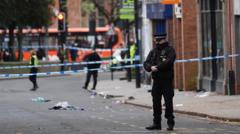
The night air in Derby usually carries the faint, metallic scent of the nearby railway works, a hum of industry that settles into a quiet lull by the time the streetlights flicker to life. On a Saturday, that silence is replaced by the rhythmic thumping of bass from open car windows and the high-pitched chatter of people who believe the evening is only just beginning. It is a predictable choreography of urban life.
Then, the rhythm broke.
Seven people were standing on the pavement—a mix of friends, strangers, and passersby—acting out the universal human ritual of heading home or moving to the next venue. They were in the vicinity of Curzon Street, a stretch of tarmac that serves as one of the city’s many arteries. In a single, violent heartbeat, the boundary between the safe haven of the sidewalk and the danger of the road vanished.
A car didn't just pass by. It mounted the curb.
The sound of such an event is something witnesses never truly forget. It isn't just the screech of tires or the thud of metal against stone; it is the collective gasp of a crowd realizing that the physical laws of their world have just been violated. Seven individuals were struck. Seven lives were instantly tethered to a singular, traumatic moment that would ripple outward to families, hospitals, and eventually, the cold interior of a courtroom.
The Anatomy of an Aftermath
Emergency services are trained to handle chaos, but there is a specific, heavy energy to a scene where the victims are many and the culprit is a machine. Paramedics moved through the blue-light haze, triaging the wounded. Some injuries were described as serious, others less so, though "minor" is a relative term when you have been tossed like a ragdoll by two tons of steel.
While the medical teams worked to stabilize the broken bodies, the police began the grim task of reconstruction. This is where the story shifts from a tragedy of physics to a matter of law.
Officers quickly identified a suspect. A 25-year-old man from Derby was arrested at the scene. He was later charged with seven counts of causing serious injury by dangerous driving, driving while disqualified, and driving without insurance. It is a dry list of offenses that, when read aloud in a court of law, feels woefully inadequate to describe the terror of those seven people who had simply been standing on a pavement.
The Invisible Stakes of a Disqualified Driver
There is a particular kind of violation that occurs when a driver who has already been banned from the road chooses to get behind the wheel. It isn't just a failure of judgment; it is a profound betrayal of the social contract.
Consider the hypothetical, yet statistically grounded, reality of a pedestrian's mindset. When you step onto a sidewalk, you are trusting the invisible lines of the law. You trust that the driver coming toward you has passed a test, carries insurance, and, most importantly, is legally permitted to be there.
A disqualified driver who ignores their ban is someone who has decided that their own convenience outweighs the safety of an entire community. This isn't just about a car hitting people; it is about the collapse of a system designed to protect us. The 25-year-old man in the Derby case, now facing the full weight of the Crown Prosecution Service, represents the ultimate breakdown of that trust.
The legal machinery is now in motion. He appeared before Southern Derbyshire Magistrates' Court, his name recorded for the public record, his future now a matter for a judge and jury. The courtrooms in Derby are often quiet, echoing places where the weight of a single night can be measured in years of potential prison time.
The Geography of a Single Second
Curzon Street is not a particularly dangerous road by any traditional metric. It isn't a high-speed motorway or a blind mountain pass. It is a street like any other, where the margin for error is measured in centimeters.
When a car mounts a curb, it is usually the result of a catastrophic failure—either mechanical, which is rare, or human, which is almost always the cause. For seven people, that one second of failure resulted in a lifetime of consequences. The "minor" injuries mentioned in the initial reports may heal in weeks, but the psychological impact of being hunted by a vehicle on what was supposed to be a safe path lingers for decades.
Wait.
Think about what it feels like to simply walk down a street tonight. You will pass dozens of cars. You will assume they will stay between the white lines. You will assume the person in the driver’s seat has the right to be there.
The Derby incident is a stark, cold reminder that the line between a routine Saturday night and a life-altering tragedy is incredibly thin. It is held together by the thin thread of the law, a thread that was snapped on a Derby pavement.
The man charged with these offenses remains in the system, a figure at the center of a legal storm. But the real story lives in the seven people who were just trying to go home, who now carry the memory of headlights and the sound of a curb being conquered.
The road didn't lose its way that night. A human did.
Seven people were standing on the pavement.
Six of them will never look at a passing car the same way again. One of them may never walk the same way again. And all of them are now part of a narrative they never asked to join, victims of a choice made by someone who believed the rules of the road were mere suggestions.