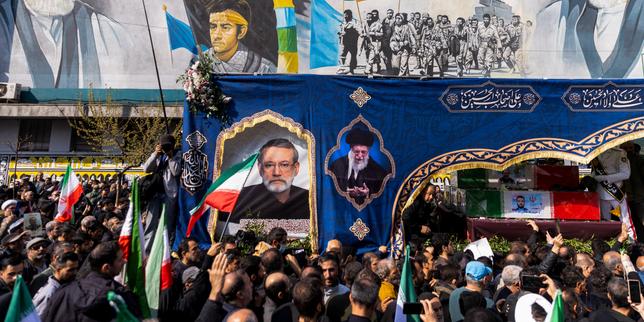
The internal power structure of the Islamic Republic of Iran has undergone a fundamental phase shift, moving from a multi-polar clerical bureaucracy to a mono-polar military-theocratic complex. While external observers often focus on the rhetoric of the Supreme Leader or the tactical movements of the presidency, the operational reality is defined by the total integration of the Islamic Revolutionary Guard Corps (IRGC) into the state’s decision-making marrow. This is not merely a change in personnel; it is a structural evolution that prioritizes the export of the "Islamic Revolution" as a survival mechanism for the regime. To understand the current Iranian strategy, one must analyze the convergence of ideological absolutism and paramilitary pragmatism.
The Dual-Track Power Architecture
The Iranian state operates on a parallel system designed to prevent a traditional coup while ensuring ideological purity. This architecture consists of the "Formal State" (the Presidency, Parliament, and regular army) and the "Revolutionary State" (the Supreme Leader, the Guardian Council, and the IRGC). In the current era, the Revolutionary State has effectively cannibalized the Formal State.
The Displacement of the Clerical Elite
Historically, the Iranian Revolution was guided by high-ranking jurists (marja-e taqlid) who debated the nuances of Velayat-e Faqih (Guardianship of the Jurist). However, a clear trend has emerged: the intellectual and traditionalist clergy are being sidelined in favor of "political clerics" who function as commissars for the military wing. This displacement creates a feedback loop where policy is no longer tempered by theological caution but is driven by the IRGC’s requirement for continuous regional expansion.
Institutional Capture by the IRGC
The IRGC is no longer a mere military branch. It has evolved into a conglomerate with three distinct but overlapping functions:
- Kinetic Operations: Managing the "Axis of Resistance" across Lebanon, Syria, Iraq, and Yemen.
- Economic Hegemony: Controlling an estimated 30% to 50% of the Iranian economy through Bonyads (charitable foundations) and front companies, particularly in engineering, telecommunications, and energy.
- Political Oversight: Placing former commanders in high-ranking civilian roles, ensuring that the legislative agenda aligns with military expansionism.
The Strategic Logic of Revolutionary Export
The directive to spread the revolution outside Iran's borders is often dismissed as pure fanaticism. In reality, it follows a cold, calculated cost-benefit analysis. The regime views domestic stability as being inextricably linked to regional instability.
The Doctrine of Forward Defense
Iranian military strategists utilize a "Forward Defense" framework. By cultivating proxies like Hezbollah or the Houthis, Iran shifts the theater of conflict away from the Iranian plateau. If a conflict occurs in Beirut or Baghdad, the infrastructure of Tehran remains untouched. This strategy leverages asymmetrical warfare to offset Iran’s lack of a modern air force or conventional navy. The cost of maintaining a proxy is a fraction of the cost required to maintain a standing high-tech army capable of peer-to-peer conflict.
The Identity Crisis and the "External Enemy"
Totalitarian systems require an existential threat to justify internal repression. As the domestic population—particularly the youth—becomes increasingly secular and disillusioned with the economic failures of the theocracy, the state doubles down on its role as the "Vanguard of Islam." The export of the revolution serves as a legitimizing narrative. If the regime can claim it is leading a global struggle against "Arrogance" (the West) and "Zionism," it can frame domestic dissent as treason or foreign sabotage.
The Three Pillars of the New Iranian Leadership
The current leadership cohort, which Christian Jambet and other scholars identify as "soldiers of the revolution," operates under three non-negotiable pillars.
1. Ideological Inflexibility
Unlike the "Reformist" or "Pragmatist" factions of the 1990s and early 2000s, the current ruling class views compromise as a precursor to collapse. They point to the downfall of the Soviet Union or the Arab Spring as evidence that loosening the grip leads to total institutional failure. For these leaders, the revolution is not a historical event but a continuous process that must be aggressively defended.
2. Strategic Depth via Non-State Actors
Iran has mastered the art of "state-building within a state." By providing social services, military training, and political backing to Shia populations abroad, they create dependencies that are nearly impossible to decouple.
- Lebanon: Hezbollah is the blueprint, acting as a sovereign entity within the Lebanese state.
- Iraq: The Popular Mobilization Forces (PMF) have been integrated into the state security apparatus while maintaining loyalty to Tehran.
- Yemen: The Houthis provide Iran with a strategic chokepoint at the Bab el-Mandeb strait, giving Tehran leverage over global maritime trade.
3. Economic Autarky and the Resistance Economy
The leadership has pivoted toward a "Resistance Economy," focusing on self-sufficiency and "circumvention logistics." This involves building clandestine financial networks to bypass international sanctions. The goal is to make the Iranian economy "sanction-proof" by trading with non-aligned powers and utilizing decentralized finance. This economic stance supports the military's autonomy, as the IRGC manages its own revenue streams independent of the national budget.
The Friction Points of the Military-Theocratic Model
While the consolidation of power under the IRGC provides short-term stability, it creates structural vulnerabilities that threaten the long-term viability of the state.
The Succession Crisis
The health and eventual passing of the current Supreme Leader, Ali Khamenei, represents the single greatest point of failure for the regime. The IRGC will likely seek to install a figurehead who will not interfere with their operational autonomy. However, the lack of a charismatic or theologically heavyweight successor could lead to a fragmentation of the ruling elite or a direct transition to a military dictatorship, stripping away the religious "mask" that provides the regime’s remaining shred of legitimacy.
The Demographics of Dissent
There is a widening chasm between the aging leadership and a population where over 60% are under the age of 30. This younger demographic is digitally connected and largely indifferent to the revolutionary fervor of 1979. The regime’s reliance on the "Morality Police" and the Basij militia to maintain order is an admission that they have lost the battle for the hearts and minds of the citizenry. The cost of internal surveillance is rising, diverting resources from the very regional projects the leadership deems essential.
Quantifying the Geopolitical Impact
The shift toward a "soldier-led" Iran changes the calculus for regional and global powers. Diplomacy becomes an exercise in futility when the civilian diplomats (the Ministry of Foreign Affairs) have no authority over the military actors (the Quds Force).
- The Nuclear Variable: For the military-theocratic elite, a nuclear deterrent is the ultimate insurance policy. It guarantees that the export of the revolution can continue without the fear of a "regime change" invasion from the West.
- Regional Re-alignment: The rise of the IRGC has forced an unprecedented alignment between Sunni Arab states and Israel. This "security architecture of necessity" is a direct response to Iran’s territorial and ideological encroachment.
The Iranian leadership is currently locked in a "sunk cost" fallacy. Having invested billions of dollars and decades of effort into the "Axis of Resistance," they cannot pivot toward normalization without dismantling the very structures that keep them in power. The transition from a revolutionary state to a stable regional power would require the IRGC to relinquish its economic and political empire—an outcome they will fight to prevent at any cost.
The immediate strategic imperative for external actors is to recognize that the Iranian presidency is a decorative office. Real power resides in the intersections of the IRGC command and the Office of the Supreme Leader. Engagement strategies that do not account for the IRGC's requirement for permanent revolution are destined to fail. The focus must shift from negotiating with the "Formal State" to containing the "Revolutionary State" through the systematic degradation of its proxy networks and the disruption of its illicit economic lifelines.