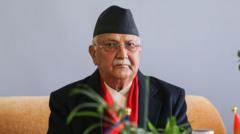
The arrest of a former head of government for actions taken during a period of civil unrest is rarely a simple act of criminal justice; it is a recalibration of a state's internal power dynamics. In the case of Nepal’s recent detention of an ex-Prime Minister following a fatal protest crackdown, the event serves as a critical data point for understanding the transition from "sovereign immunity" to "legal accountability" in volatile democracies. This shift is not driven by moral suddenness but by a specific set of structural pressures: the erosion of the former leader's patronage networks, the emergence of a more independent judiciary, and the strategic utility of prosecution for the current administration.
Understanding this event requires looking past the immediate headlines of "justice served" to analyze the three-variable equation that governs political arrests in transitional states: the Legal Precedent Variable, the Security Sector Alignment, and the Political Risk-Reward Ratio.
The Architecture of Responsibility: Command and Liability
To evaluate the arrest, one must first define the concept of Command Responsibility. In high-stakes protest environments, fatalities generally result from a breakdown in one of three areas: the Rules of Engagement (ROE), the communication chain between the executive and the Ministry of Home Affairs, or the individual discipline of field units.
The Chain of Command Model
The prosecution’s logic rests on a linear transmission of authority. If an executive issues a directive to "restore order at any cost," that directive removes the discretionary buffer typically held by police commanders. In this structural framework, the arrest signals that the state is moving toward a Top-Down Liability Model.
- The Executive Mandate: The Prime Minister or Cabinet issues high-level objectives.
- The Operational Filter: The Ministry of Home Affairs translates these into specific deployments.
- The Tactical Execution: Police and paramilitary forces engage with civilians.
When a "fatal crackdown" occurs, the legal inquiry seeks to identify whether the lethality was an unauthorized deviation by the tactical layer or an inevitable outcome of the executive mandate. By arresting the former Prime Minister, the current judicial apparatus is asserting that the executive mandate contained "intentional negligence" or "explicit provocation."
The Political Risk-Reward Ratio
Governments do not arrest their predecessors without calculating the potential for systemic blowback. The decision to move from investigation to incarceration is governed by the Institutional Strength Index. If the state’s institutions (the courts and the police) are perceived as weak, the arrest of a former leader can trigger a "Cycle of Retribution" where every change in power results in the imprisonment of the previous faction.
Variables of State Stability
- Patronage Decay: A leader is most vulnerable when their ability to distribute resources or protection to loyalists has vanished. The arrest suggests that the former PM's influence within the security apparatus has reached a terminal low.
- Judicial Independence vs. Judicial Capture: One must distinguish whether the court is acting as a neutral arbiter of constitutional law or as a tool for the current regime to "clear the field" for the next election cycle.
- Public Sentiment as a Catalyst: In Nepal, the memory of the protest victims serves as a potent form of political capital. The current administration leverages this "Moral Liquidity" to justify a move that might otherwise be seen as a political purge.
The Cost Function of Civil Unrest
The "fatal crackdown" mentioned in the reference represents a failure of the state’s Crisis Management Protocol. When analyzing such events, we must quantify the cost of state violence. Beyond the tragic loss of human life, there is a quantifiable degradation of state legitimacy.
$$L = \frac{V \times I}{P}$$
In this simplified heuristic, Legitimacy (L) is inversely proportional to the Perceived Political Motivation (P) behind the use of force, where V represents the Volume of force used and I represents the Impact (casualties/arrests).
When the state uses lethal force against its own citizens, it incurs a "Legitimacy Debt." The arrest of the person perceived to be at the helm of that force is an attempt to "repay" that debt to the public. However, if the prosecution fails or is seen as a sham, the debt remains, often leading to further cycles of unrest.
Tactical Realities of the Arrest
The timing and method of the arrest provide insight into the government’s confidence. High-profile arrests in Nepal often involve a "Soft Detention" phase where the individual is held in a government bungalow or hospital rather than a standard correctional facility. This indicates a Controlled Escalation Strategy.
- Step 1: The Investigation Launch. Using a commission of inquiry to establish a factual baseline that is difficult for the opposition to ignore.
- Step 2: The Travel Ban. Restricting the subject’s movement to prevent "flight risk," which doubles as a test of the subject's remaining support.
- Step 3: The Custodial Detention. Moving the subject into physical custody to demonstrate the absolute authority of the current legal system.
This sequence is designed to minimize the risk of a counter-protest. By the time the actual arrest happens, the subject’s political momentum has often been systematically bled out through months of legal maneuvering.
The Bottleneck of Evidence
The primary challenge in prosecuting a former head of state for a protest crackdown is the Documentation Gap. High-level orders for the use of force are rarely written; they are often relayed via secure verbal channels or through "implied intent."
To secure a conviction, the prosecution must move beyond the "He said, she said" of political theater and find the Paper Trail of Complicity:
- Minutes of National Security Council Meetings: Did the PM ignore warnings from intelligence agencies about the potential for fatalities?
- Communication Logs: Is there evidence of direct communication between the PM’s office and the operational commanders in the field during the hours the fatalities occurred?
- Budgetary Allocations: Was there a sudden surge in the procurement of "lethal crowd control" materials immediately preceding the event?
Without these components, the arrest remains a symbolic gesture rather than a legal finality.
Strategic Forecast
The arrest of Nepal's former Prime Minister will serve as a stress test for the country's 2015 Constitution. If the case proceeds through a transparent, evidence-based trial, it will set a precedent that the executive branch is subordinate to the law, potentially stabilizing the country's long-term democratic trajectory.
However, the risk of Polarization Acceleration is high. If the former leader's base perceives the arrest as a weaponization of the judiciary, the resulting friction could stall essential legislative functions.
The strategic play for the current administration is to move the proceedings into a specialized "Truth and Reconciliation" or "Human Rights" court framework. This shift moves the narrative from a "Political Rivalry" to a "National Healing" process. For international observers and investors, the key metric to watch is not the arrest itself, but the Due Process Transparency. A messy, opaque trial will signal high sovereign risk; a clinical, documented prosecution will signal that Nepal is maturing into a rules-based state.
The immediate objective for any political stakeholder in this environment is the securing of the "Middle Ground" electorate—those who may have supported the former PM's policies but are alienated by the state-sponsored violence. The prosecution must tailor its narrative to this demographic, framing the arrest not as a hit on a party leader, but as a defense of the citizen's right to life.