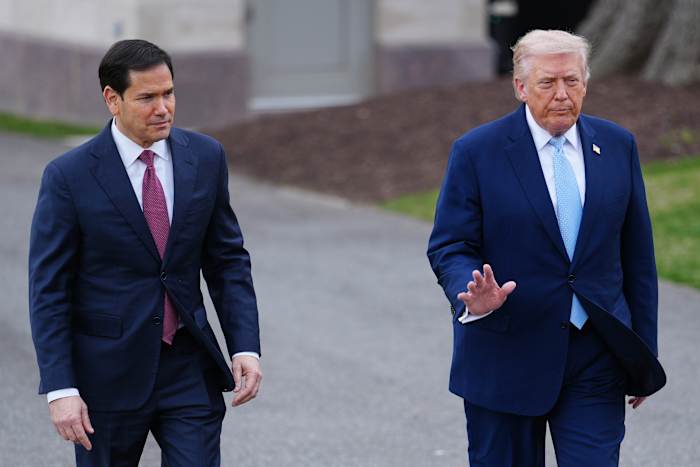
The headlines are predictable. The usual suspects in the legacy press are painting Marco Rubio’s trip to France as a warmongering crusade, a desperate attempt to "sell" a conflict to a weary, sophisticated Europe. They characterize the G7 as the adults in the room, holding back a reckless American impulse to ignite the Middle East.
They are wrong. Also making waves in this space: The Kinetic Deficit Dynamics of Pakistan Afghanistan Cross Border Conflict.
The "skeptical allies" narrative is a comfort blanket for a European leadership that has spent two decades outsourcing its security to the Pentagon while underwriting its energy and trade through the very regimes that want to see the West dismantled. Rubio isn't going to France to sell a war; he’s going there to audit a bankruptcy. The bankruptcy of European foreign policy.
The Myth of the Strategic Pivot
The lazy consensus suggests that diplomacy with Tehran is a delicate clock that Washington keeps trying to smash with a hammer. This perspective assumes that the Iranian regime is a rational, Westphalian state acting out of a sense of wounded pride or security concerns. Additional details into this topic are covered by The Guardian.
I’ve spent years analyzing the flow of dual-use technology and the way sanctions are bypassed through shell companies in Dubai and Ankara. The reality? Tehran isn’t looking for a seat at the table. They want the table.
When Rubio sits down with his counterparts in Biarritz or Paris, he isn’t pitching a "Maximum Pressure" campaign because he enjoys the optics of escalation. He’s doing it because the alternative—the "Strategic Patience" model—has failed every measurable metric. Under the JCPOA and its subsequent shadows, Iranian proxy networks expanded, their ballistic missile range increased, and their enrichment capability reached levels that make "peaceful use" a scientific punchline.
Europe Is Playing a Dangerous Game of Arbitrage
European skepticism isn't rooted in a superior moral objection to war. It’s rooted in commercial arbitrage.
France, Germany, and Italy have spent years trying to maintain "special channels" for trade. They want to be the ones who sell the cars and the infrastructure while the U.S. pays for the carrier groups that keep the shipping lanes open. It’s a classic free-rider problem. By opposing American pressure, they hope to preserve a status quo where they get the profits and Washington gets the bill for the instability.
Let’s look at the data. European exports to the region didn't just happen in a vacuum. They required a stable maritime environment. Yet, when the IRGC (Islamic Revolutionary Guard Corps) begins seizing tankers or harassing commercial traffic, who does the G7 call? They don't call the French Navy to lead the charge; they look for the U.S. Fifth Fleet.
Rubio’s job is to point out this hypocrisy. You cannot claim to be a partner in global security while simultaneously funding the entities that destabilize it through lopsided trade agreements and "de-escalation" rhetoric that serves as a tactical pause for the adversary.
The Nuclear Physics of Denial
There is a technical illiteracy in the way the media covers these diplomatic missions. They treat 60% enrichment as a "concerning development" rather than what it is: a terminal point.
$$U^{235} \text{ enrichment is not a linear process in terms of effort.}$$
To move from natural uranium (0.7%) to 5% (reactor grade) takes about 75% of the total work required to reach weapons-grade (90%). To move from 60% to 90% is a weekend's work for a sophisticated centrifuge cascade.
The G7 allies know this. Their scientists tell them this. But their politicians ignore it because admitting it means the "diplomatic path" they’ve been selling to their voters is actually a dead end. Rubio is the one holding the map, pointing out that the road ended five miles back and they are currently driving off a cliff.
Stop Asking "Will There Be War?"
The question "Is Rubio selling a war?" is the wrong question. It’s a distraction designed to make the speaker look like a pacifist.
The real question is: "Is the current state of deterrence functional?"
The answer is a resounding no. Deterrence is not a static state; it is a psychological calculation of cost. If the G7 remains fractured, the cost of aggression for Tehran remains low. By signaling "skepticism" and "disagreement" with Washington, the European allies are actually making kinetic conflict more likely. They are signaling to the IRGC that the West is divided, that there is no unified red line, and that they can continue to push the envelope without facing a collective response.
I’ve watched diplomatic missions fail because the participants were more concerned with the dinner menu than the underlying mechanics of power. If Rubio plays this right, he won’t be asking for their permission to act. He will be showing them the cost of their own inaction.
The "Middle Way" is a Mirage
People often ask: "Isn't there a middle ground between total war and total appeasement?"
In this specific geopolitical context, the middle ground is just a slower version of the worst-case scenario. It’s the "boiling frog" strategy. You allow the enrichment to continue, you allow the proxies to entrench themselves in Lebanon, Syria, and Yemen, and you hope that somehow, magically, the regime decides to stop being a revolutionary entity.
History doesn't work that way. Revolutions don't "mellow" when they are winning. They export.
Rubio's trip is an attempt to force the G7 to choose:
- Unified Economic Asphyxiation: A total, airtight sanctions regime that forces a fundamental internal rethink in Tehran.
- Continued Fragmentation: Which leads, inevitably, to a nuclear-armed regional power and a massive, uncontrolled regional war that will make the current energy crisis look like a minor inconvenience.
The Hard Truth About French Diplomacy
President Macron loves the role of the "Grand Mediator." It plays well in Paris. It suggests France is a global power capable of bridging the gap between the "cowboys" in Washington and the "mullahs" in Tehran.
But mediation only works when both parties want a deal. When one party uses the negotiation period to install more advanced centrifuges, "mediation" is just another word for "complicity."
Rubio isn't there to be part of Macron's PR machine. He’s there to disrupt the narrative that France is a neutral observer. France is a stakeholder. If the Middle East goes up in flames, the refugee waves don't hit Florida; they hit Marseille. The energy shocks don't just hurt the NYSE; they tank the Euro.
The Risk of Being Right
The contrarian take isn't that Rubio is a hero. The risk of his approach is that it forces a confrontation that the West is currently ill-prepared to handle because we’ve spent thirty years hollowing out our industrial bases and debating domestic trivia.
However, ignoring the problem doesn't make it go away. It just makes the eventual explosion larger.
I’ve seen this movie before. In 2014, everyone laughed at the idea of a major land war in Europe. The "skeptics" said Russia was integrated into the global economy and wouldn't dare. They were wrong. They were wrong because they projected their own rational, profit-driven logic onto a leadership that valued ideology and territory over GDP.
The G7 is making the same mistake again. They think Tehran wants a better credit rating. Tehran wants a hegemony.
Stop Betting Against Reality
If you’re waiting for the G7 to "convince" Rubio to tone it down, you’re missing the point. The mission isn't to find a consensus; it’s to shatter a false one.
The "skepticism" of the allies isn't a sign of wisdom. It’s a symptom of paralysis. They are afraid of the consequences of action, so they choose the certainty of decay.
Rubio’s trip is the first step in demanding that the "Great Powers" actually act like they have power. It’s time to stop treating the Iranian nuclear program like a math problem that can be solved with enough "dialogue" and start treating it like the existential threat to the global order that it is.
The G7 doesn't need to be "sold" a war. They need to be sold a reality check.
Force the hand. Close the loopholes. Stop the trade. Or get out of the way and let the adults handle the security of the hemisphere.
The clock isn't ticking; it’s already struck midnight.
Explain how the "SNAPBACK" mechanism in the original nuclear deal is technically flawed and why Rubio's push for a new framework is the only way to fix the loophole.