The sky over Ohio doesn't usually hold onto memories. It is a vast, indifferent canvas of slate gray and pale blue, crisscrossed by the invisible highways of commercial jets and the occasional wandering Cessna. But on a Tuesday that felt too quiet for the weight it was about to carry, a single pilot decided that the air itself should remember.
He wasn't flying for cargo. He wasn't flying for a paycheck. He was flying to etch three names into the atmosphere before the wind could take them.
Twenty-one years ago, the ground gave way in a place far from the rolling hills of the Midwest. In the dusty heat of Iraq, a KC-135 Stratotanker—a flying gas station, essential but unglamorous—fell from the sky. On board were three men from the Ohio Air National Guard’s 121st Air Refueling Wing. They were neighbors, fathers, and sons. Master Sgt. Robert J. Walters, 33; Tech. Sgt. Kelly M. Bolor, 37; and Tech. Sgt. Richard A. Rivera, 34.
They died in a crash that left a hole in the dirt of a foreign land and a much larger, permanent hole in the hearts of a community in Columbus.
Time has a way of smoothing over the jagged edges of grief until the world forgets to look. We move on. We buy groceries. We complain about the traffic. But for those who fly, the bond is different. It is a brotherhood of thin air. And for one pilot, the twenty-first anniversary of that loss required more than a moment of silence. It required a physical act of defiance against forgetting.
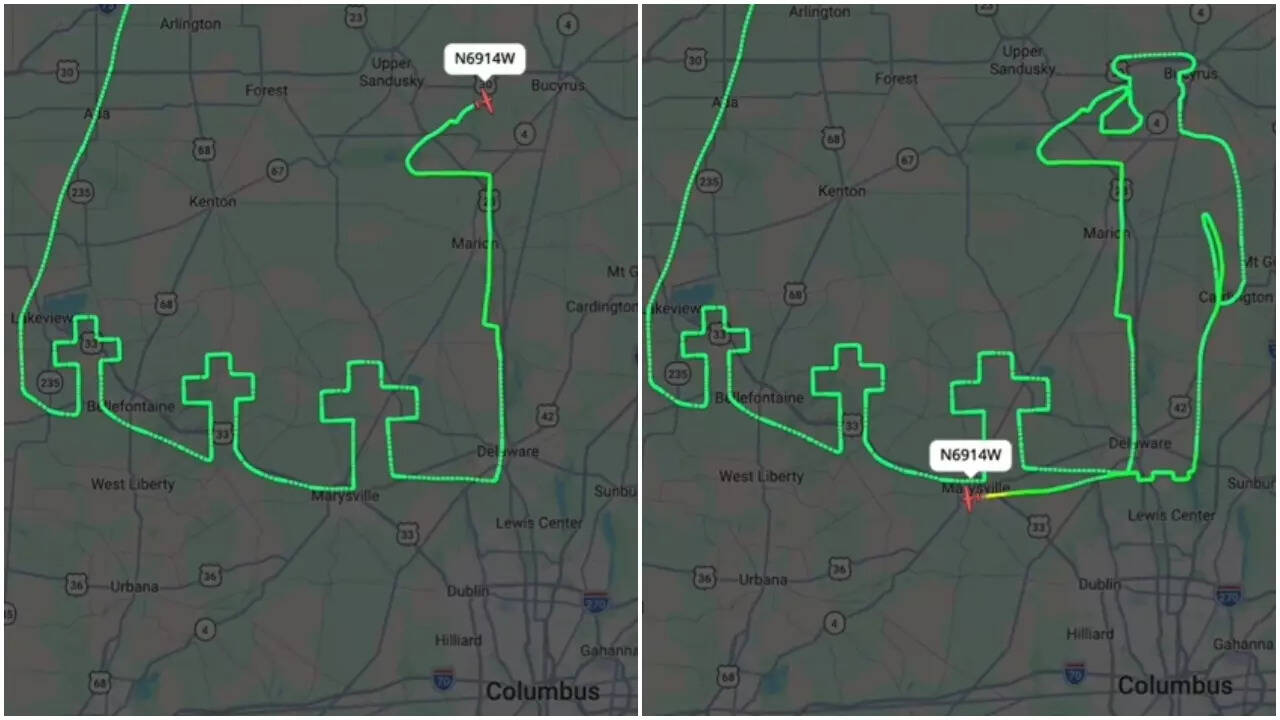
He took to the cockpit of a small, nimble aircraft. His mission was a flight path so precise it bordered on the mathematical, yet so emotional it felt like a prayer. Using GPS tracking technology, he began to draw.
Think of the concentration required. At thousands of feet up, there are no lines on the pavement to follow. There is only the instrument panel and the steady hand on the yoke. One degree off and the tribute becomes a smudge. Too much speed and the curves lose their grace. He flew a series of tight, grueling circles and sharp, intentional banks.
From the ground, if you looked up, you might have seen a tiny speck of silver catching the sun. You wouldn't have known that above your head, a man was laboring to write a message to the dead.
The digital footprint he left behind on flight-tracking software revealed the truth. When the data points were connected, a symbol emerged over the Ohio landscape: a giant, soaring "121." It was the number of their wing. It was followed by a heart, a simple, universal shape that took miles of airspace to complete.
It was a skyward embrace.
This wasn't just a stunt for the internet to double-tap. It was an exercise in the invisible stakes of memory. When we lose people in the line of duty, we often talk about them in the past tense. We build stone monuments that eventually grow moss and blend into the park scenery. But there is something visceral about a tribute made of motion and momentum. It exists in the present. It requires the burning of fuel and the beating of a heart to manifest.
The pilot’s path didn't just mark a number. It traced the geography of a wound that hasn't fully healed.
Consider the families of Walters, Bolor, and Rivera. For them, every anniversary is a mountain they have to climb again. They wake up to the same sun that rose over Iraq two decades ago, but the house is quieter. There is a specific kind of loneliness in being the survivor of a hero; the world celebrates the sacrifice, but you are the one left with the empty chair at Thanksgiving.
When that pilot banked his wings over the Ohio farmland, he was telling those families that the air they breathe is still heavy with the legacy of the men they lost. He was reclaiming the sky—the very element that took them—and forcing it to honor them instead.
Precision. That is the word that haunts the cockpit.
In a KC-135, precision is life. To refuel a fighter jet mid-air, you are bringing two massive pieces of machinery together at hundreds of miles per hour, tethered by a single boom. It is a dance of inches. One mistake, one mechanical failure, and the dance ends in fire. The men of the 121st knew this every time they strapped in. They lived in the margins of error.
By using that same high-stakes precision to draw a heart in the clouds, the tribute pilot mirrored the discipline of the fallen. He used the tools of their trade to sign their names across the heavens.
We often struggle to find ways to bridge the gap between our comfortable lives and the sacrifices made on our behalf. We post a flag emoji. We say "thank you for your service" in a checkout line. These things aren't wrong, but they are easy. What happened in the sky over Ohio wasn't easy. It was a deliberate, time-consuming, and technical labor of love. It was an acknowledgment that some debts can never be paid, only remembered.
As the plane finally leveled off and headed back to the hangar, the digital lines on the radar screens remained, a ghost of the flight. The heart was miles wide. The "121" stretched across counties.
Eventually, the pilot landed. He tucked the plane away. The engine ticked as it cooled in the evening air. To anyone passing by the airfield, it was just another day at the hangar. But for a few hours, the sky had been forced to speak.
The wind eventually dispersed the actual air the plane moved through. The clouds shifted, and the sun went down. But the record of that flight remains. It serves as a reminder that even when the metal is gone and the smoke has cleared, the path we take matters.
We are all flying through an indifferent world, trying to leave some kind of mark before our fuel runs low. Most of us leave small, messy scribbles. But on a Tuesday in Ohio, a pilot showed us what it looks like to turn a tragedy into a trajectory. He reminded us that while we cannot bring the fallen back to earth, we can meet them halfway in the light.
The sky is empty again. But it feels different now. It feels like a place where promises are kept.