The radiator in the surgical assessment unit isn't clicking. It’s dead. Outside, a biting January wind whips across the ambulance bay, carrying the scent of damp pavement and exhaust. Inside, the air is thick with something far more heavy than the winter chill. It is the weight of an absence.
Usually, the sound of a hospital is a frantic, overlapping symphony of bleeping monitors, squeaking rubber soles, and the low-frequency hum of junior doctors debating blood results in the hallway. Today, the silence is physical. It presses against your eardrums.
Six days. One hundred and forty-four hours.
That is the length of the longest strike in the history of the National Health Service. To the spreadsheet-wielders in Whitehall, it is a data point—a projected loss of nearly 200,000 appointments and surgeries. To a patient named Elias (let’s call him that for the sake of the story we are living through), it is the difference between a hip that works and a life lived in a chair. To the doctors on the picket line, it is a desperate, final scream for air from a profession that feels like it’s drowning.
The strike officially began at 7:00 AM on a Tuesday. By noon, the ripple effects weren't just visible; they were visceral.
The Arithmetic of Exhaustion
We have been told that this is about a 35% pay restoration. That number sounds massive, greedy even, when stripped of context. But numbers are bloodless things. They don't tell you about the junior doctor who has spent thirty-six hours on their feet, fueled by a lukewarm KitKat and the fear of making a fatal dosing error. They don't mention that a first-year medic earns roughly £15 per hour—less than the person who cleans the operating theater floor, and certainly less than the barista who serves them the caffeine required to stay awake through a night shift in A&E.
Think of it as a structural failure. When a bridge collapses, we look at the rust. When a healthcare system shutters for six days, we have to look at the erosion of the people who hold it up. Since 2008, the real-world value of a junior doctor’s paycheck has shriveled. It’s not just about the money; it’s about the message the money sends. It says: You are a replaceable cog in a failing machine.
But these cogs have names. They have student loans that dwarf mortgages. They have burnout that feels like a permanent fog.
The Patient in the Middle
Elias sat in his living room in Manchester, watching the news. His surgery was supposed to be tomorrow. He had prepared for this for months. He’d bought the raised toilet seat, the long-handled grabber, the hope that by spring he would walk his granddaughter to the park.
The phone rang at 4:15 PM on Monday. A polite, weary voice from the hospital administration gave him the news. "Postponed." No new date. Just a void.
He isn't angry at the doctors. He’s tired. He represents the millions of Britons caught in a pincer movement between a government that won't budge and a workforce that can't continue. This isn't just a labor dispute. It is a slow-motion car crash where the passengers are the ones paying for the fuel.
The government argues that the doctors’ demands are "unaffordable." They point to the inflationary pressure of a double-digit pay rise. They speak in the language of fiscal responsibility. Meanwhile, the British Medical Association (BMA) speaks in the language of survival. If the pay doesn’t rise, the doctors leave. They go to Australia. They go to New Zealand. They go to private tech firms where their brains are valued and their sleep is protected.
The NHS isn't just losing six days of work. It is losing a generation of expertise.
The Ghost Shift
Walk into any major hospital during this walkout and you will see the "consultant cover." These are the senior doctors, the ones who usually oversee the big picture, now back on the front lines doing the grunt work. They are cannulating patients, writing discharge summaries, and checking obs.
It is a stop-gap. A finger in a dyke that is already crumbling.
The atmosphere is surreal. In the Emergency Departments, the wait times haven't necessarily skyrocketed—because the public has been warned to stay away unless they are literally dying. The "Disruption" mentioned in the headlines isn't always a riot in the waiting room. Sometimes it’s just the quiet tragedy of a cancer diagnosis that has to wait another week because the specialist who would have read the scan is currently covering a ward for a striking junior.
Delays aren't just inconveniences. In medicine, time is tissue. Time is a tumor growing by millimeters. Time is a heart muscle weakening.
The Weight of the Picket
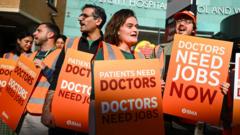
Outside the hospital gates, the "junior" doctors—a misnomer for anyone from a fresh graduate to a registrar with a decade of experience—stand in their puffer jackets. They hold signs that use humor to mask a deep, abiding bitterness. “I’d rather be at work, but I can’t afford the parking.”
They are greeted by the honks of passing cars, but the public's patience is a finite resource. Everyone supports the NHS until their own mother is the one waiting ten hours in the back of an ambulance. The tension is palpable. The doctors know they are being vilified in some corners of the press as militants holding the country to ransom.
But talk to one of them. Really listen.
One registrar, let’s call her Sarah, described the moment she decided to vote for the strike. It wasn't when she saw her bank balance. It was when she realized she had stopped caring. She found herself looking at a patient not as a person, but as a "bed-blocker." She realized she was becoming the cold, clinical shadow of the healer she wanted to be.
"I'm striking so I can afford to stay a doctor," she said. Her breath hitched in the cold air. "If I don't strike, I'll just quit. Which is worse for the patients?"
The Invisible Stakes
What is the cost of a six-day strike?
If you look at the Department of Health and Social Care’s ledger, the cost is measured in millions of pounds of lost productivity and the expense of hiring temporary staff.
But how do you measure the cost of trust?
The social contract of the NHS is built on a simple premise: the people will pay, and the system will provide. For the first time in nearly eighty years, that contract is being shredded. We are seeing the "normalization of the abnormal." We are getting used to the idea that the hospital might just be... closed.
This strike is a fever. In the human body, a fever is a defense mechanism. It is the body raising its temperature to kill off an infection. It’s painful, it’s exhausting, and it makes the patient feel miserable. But the fever isn't the disease. The disease is the underlying infection that the body is trying to fight.
The infection in this case is a decade of underfunding, a recruitment crisis that has left 100,000 vacancies across the NHS, and a management style that treats human beings like units of production.
The Turning Tide
The sun sets early in January. By 4:30 PM, the picket lines thin out as the night shifts—the skeleton crews who ensure life-and-limb safety—take over. The strikers go home to cold flats, while the ministers go home to heated debates about the next day’s talking points.
There is no "win" here. Even if the government gives in tomorrow, the scars will remain. The relationship between the medics and the state has been poisoned.
We often talk about the NHS as a "national religion." If that’s true, then these six days are a schism. It is the moment the priesthood walked out of the temple because the roof was falling in and the tithes weren't even covering the candles.
The real tragedy of the six-day strike isn't the headlines or the political posturing. It’s the silence of the wards. It’s the empty operating theaters where life-changing work should be happening. It’s the doctor sitting in her car, crying before she goes into her shift because she knows she’s going to have to apologize to twenty different people for things that aren't her fault.
As the wind picks up, shaking the plastic banners tied to the hospital railings, you realize that the disruption isn't coming. It’s already here. It’s been here for years, hidden in the shadows of the waiting lists and the hollowed-out eyes of the staff. The strike didn't create the crisis; it just turned the lights on so we couldn't look away anymore.
The sixth day will come and go. The junior doctors will return to their wards. The consultants will go back to their clinics. Elias will wait for another phone call. But the hospital will never be quite as warm as it used to be.
The radiator is still clicking, but the heat is gone.