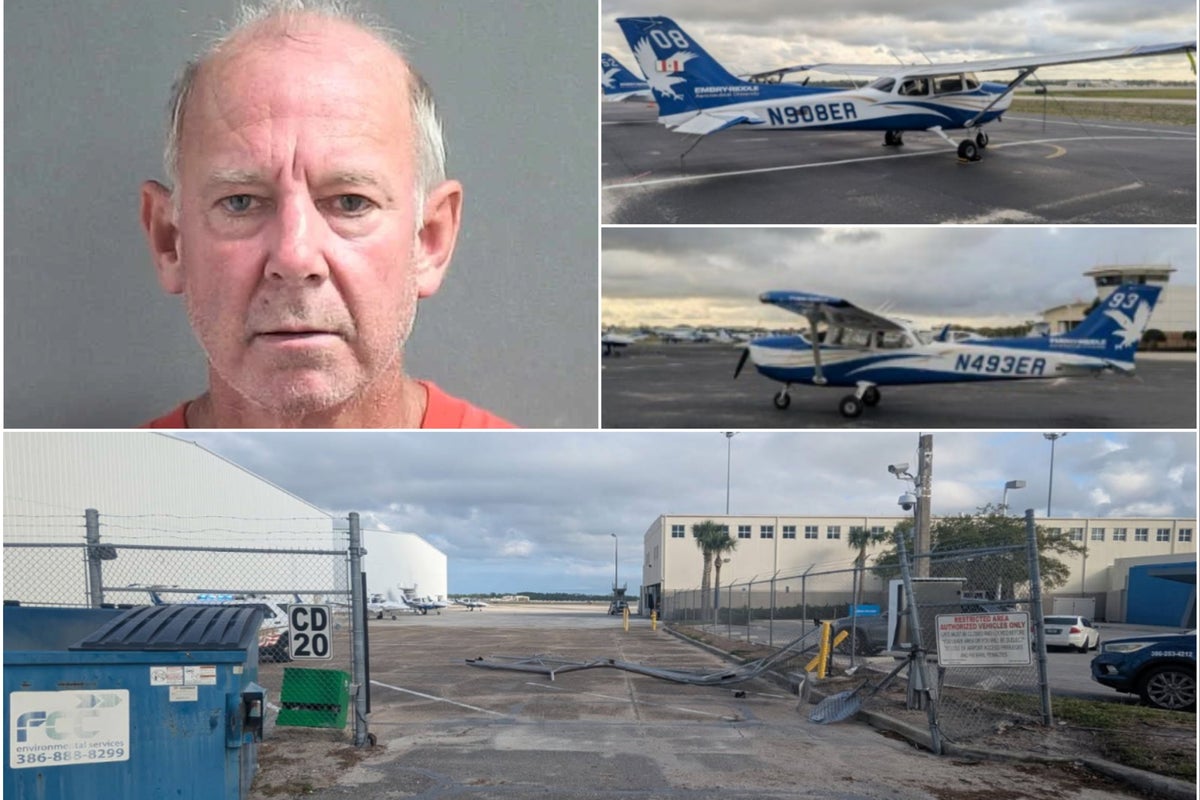
The probability of a successful aircraft theft by an untrained, intoxicated individual is mathematically near zero, yet the frequency of such attempts reveals systemic vulnerabilities in General Aviation (GA) infrastructure. When a subject enters a restricted airfield with the intent to "visit family," the incident is typically dismissed as a localized crime report. However, viewing this through the lens of Security Stack Failure reveals a breakdown across three specific operational layers: physical perimeter integrity, cockpit access protocols, and the human-machine interface threshold.
The incident involving an unauthorized individual attempting to commandeer a Cessna 150 at a Florida municipal airport serves as a diagnostic case study for these vulnerabilities. To understand why this happens, we must deconstruct the event using a Threat-Asset-Vulnerability (TAV) framework.
The Perimeter Permeability Coefficient
Small and regional airports operate under a different regulatory burden than major international hubs. While Category X airports utilize multi-modal biometric and electronic surveillance, GA airports often rely on "passive deterrence." This creates a Perimeter Permeability Coefficient where the cost of security is weighed against the utility of open access for private pilots.
The failure in this specific instance began with a breach of the physical barrier. In many regional facilities, fencing follows the Minimum Standards for Commercial Aeronautical Activities, which may only require a chain-link fence of six to eight feet. For an individual whose cognitive inhibitions are lowered by chemical substances—ethanol in this case—the perceived risk of scaling such a barrier is outweighed by the immediate internal impulse.
- Detection Latency: The time between the breach and the arrival of law enforcement determines the success of the intercept. In this case, the subject moved from the fence line to the cockpit without triggering an immediate kinetic response.
- Environmental Noise: High-activity areas during transition hours provide cover for unauthorized movement.
- Lighting Deficits: Shadows in hangar rows create "dead zones" where infrared or standard CCTV cannot maintain a continuous line of sight.
The Cockpit Access Paradox
Once the perimeter is compromised, the second line of defense is the aircraft itself. Unlike modern automobiles, which utilize encrypted key fobs and immobilizers, many older GA aircraft like the Cessna 150 utilize mechanical locks that are often decades old.
The Mechanical-Digital Gap in aviation security is a significant bottleneck. A 1970s-era airframe was designed for an era of low-threat social trust. The ignition system is often a simple four-position rotary switch (Off, Right, Left, Both, Start). If the aircraft is not secured with an external gust lock or a heavy-duty throttle lock, the only barrier to engine ignition is a physical key that shares a common profile with thousands of other units from the same era.
The subject's attempt to start the engine failed not because of a security "hack," but because of the Operational Complexity Threshold. Starting a carbureted Lycoming O-200 engine requires a specific sequence of actions:
- Master Switch Activation: Powering the electrical bus.
- Fuel Selector Verification: Ensuring the gravity-fed or pump-assisted lines are open.
- Mixture Calibration: Setting the fuel-to-air ratio (Full Rich for start).
- Primer Application: Manually injecting fuel into the cylinders.
- Magneto Engagement: The final step that the subject in the Florida case likely failed to execute correctly under the influence of alcohol.
Chemical Impairment and the Cognitive Load of Flight
The subject’s stated motivation—to fly a stolen plane to visit a relative—highlights a total collapse of Risk-Benefit Analysis. Under the influence of alcohol, the brain's prefrontal cortex, responsible for executive function and impulse control, is bypassed. This leads to what psychologists call "Alcohol Myopia," where the individual focuses only on the most salient cues (the plane and the destination) while ignoring the complex intermediate steps (pre-flight checks, air traffic control, fuel management, and physical piloting).
Flight is a high-cognitive-load activity. It requires the management of $V_x$ (best angle of climb) and $V_y$ (best rate of climb) speeds, alongside constant spatial orientation. An intoxicated person attempting to pilot a craft faces a Cognitive Saturation Point almost immediately. Even if the subject had successfully started the engine, the transition from taxiing to rotation (takeoff) involves a transition from two-dimensional movement to three-dimensional physics.
The Physics of the Failed Departure
The Cessna 150 has a maximum takeoff weight (MTOW) of approximately 1,600 lbs. If the subject had managed to reach the runway, the following physical variables would have likely resulted in a hull loss:
- Torque and P-Factor: The propeller rotates clockwise (from the pilot's perspective), creating a left-turning tendency. Without precise right-rudder input, the aircraft would have veered off the runway long before reaching rotation speed ($V_r$).
- The Ground Effect Trap: A novice might get the plane off the ground briefly due to "ground effect"—a cushion of air close to the surface—only to stall and crash once they climb out of that cushion without sufficient airspeed.
The Economic Burden of GA Security Gaps
While the Florida incident ended without a flight, the economic impact is non-trivial. The cost of a security breach is a function of:
$$C_{total} = C_{response} + C_{inspection} + C_{opportunity}$$
Where:
- $C_{response}$ is the deployment of local and federal assets (FBI, TSA, Local Police).
- $C_{inspection}$ is the mandatory airworthiness check required after an unauthorized person handles aircraft controls (checking for "sabotage" or accidental damage to sensitive linkages).
- $C_{opportunity}$ is the revenue lost from airport downtime or restricted movement during the investigation.
The "broken windows" theory applies to airfields. If an individual can easily reach the flight line, it signals a systemic failure that can be exploited by more sophisticated actors. The federal involvement in this case (FBI and TSA) is not an overreaction to a "drunk man," but a mandatory audit of the security protocols that allowed the breach to occur.
Institutional Friction and Reporting
A significant friction point in preventing these incidents is the reporting structure. Many GA airports are "non-towered," meaning there is no active controller watching the field 24/7. Monitoring falls to FBO (Fixed Base Operator) staff or local law enforcement patrols.
The gap in coverage exists because the Marginal Cost of Security for a 100-aircraft rural airport is often higher than the perceived Value of the Risk. Until a major incident occurs, these facilities remain in a state of "Security Debt," where they are borrowing against the low probability of a threat to save on the high cost of automated surveillance.
To mitigate this, airports are increasingly looking toward Computer Vision (CV) Integration. By layering AI-driven motion detection over existing CCTV feeds, a system can distinguish between a pilot walking to their hangar at 3:00 AM and an intruder scaling a fence. This reduces the human labor cost while decreasing the Time-to-Detect.
Structural Hardening Recommendations
The current reliance on "lock and key" is insufficient for a modern threat environment, even when the threat is an intoxicated civilian. To elevate the security posture of General Aviation, the following hard-point upgrades are necessary:
- Electronic Ignition Interlocks: Migrating from mechanical keys to RFID or encrypted digital starts would render unauthorized engine starts nearly impossible without specialized tools.
- Geofenced Perimeter Alarms: Replacing static fences with active fiber-optic vibration sensors that alert local dispatch the moment a fence is touched.
- Standardized Hangar Security: Moving away from "padlock" culture toward integrated access control systems that log every entry and exit.
The Florida incident is a symptom of a larger, systemic complacency regarding the "small plane" sector. While the absurdity of the story makes for a compelling headline, the underlying data suggests that we are currently relying on the complexity of the machine to protect it, rather than the integrity of the facility. As flight systems become more automated and easier to operate, the "barrier to entry" for theft will decrease, making the hardening of the physical perimeter the only viable long-term strategy for airfield management.
Deploying a multi-layered infrared sensor array at all "secondary" access points should be the immediate priority for regional airport authorities. This move shifts the defensive strategy from reactive—arresting a subject in the cockpit—to proactive—intercepting the subject at the fence line.
.png?width=1200&auto=webp&trim=0%2C0%2C0%2C0)
.png?width=1200&auto=webp&trim=0%2C200%2C0%2C0)