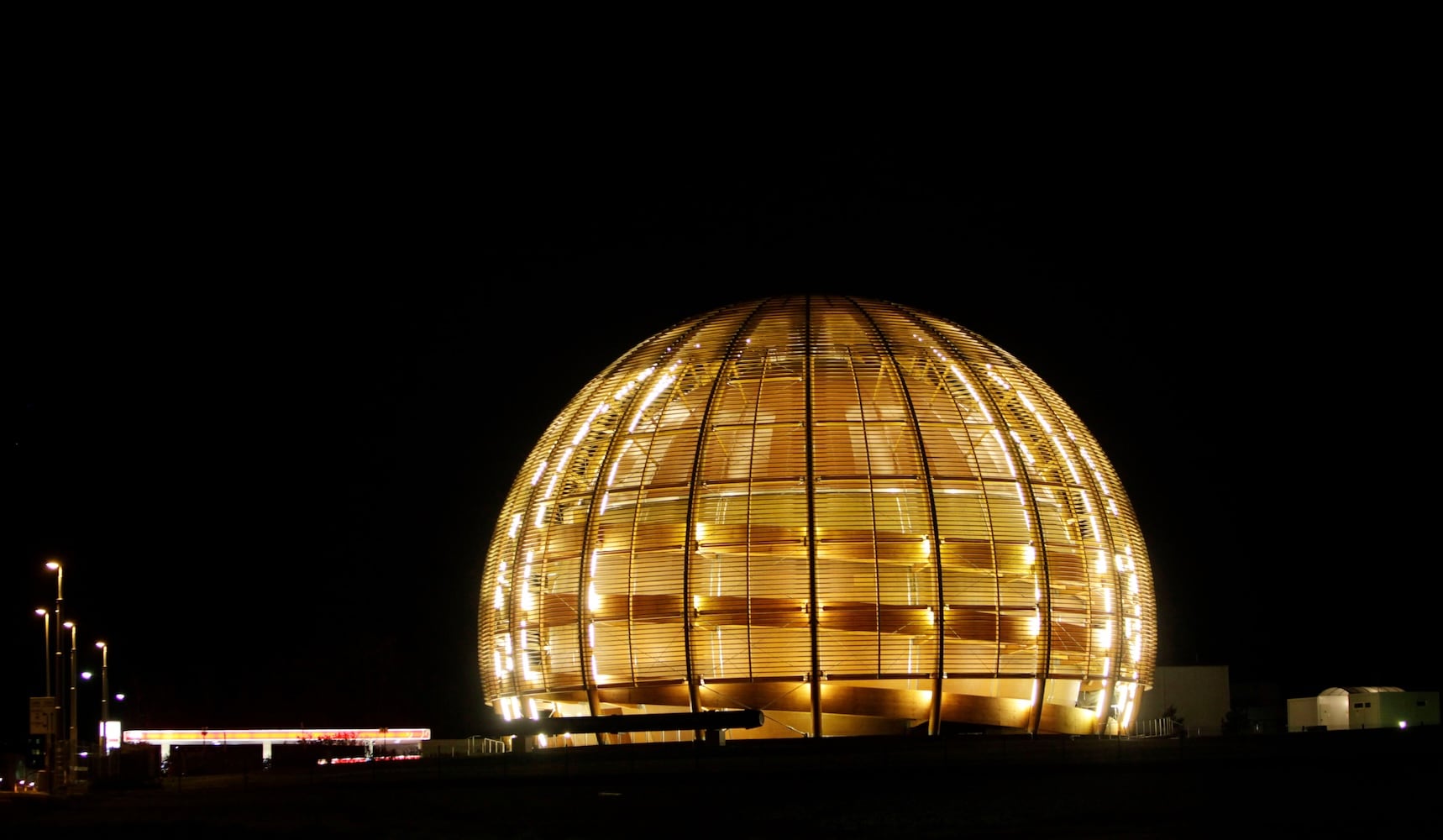
The portability of antimatter represents the transition of high-energy physics from stationary laboratory observation to mobile, distributed experimentation. While the production of antiprotons at the European Organization for Nuclear Research (CERN) is a mature process, the spatial tethering of research to the Antiproton Decelerator (AD) has historically bottlenecked the broader scientific utility of these particles. The BASE-STEP (Baryon Antibaryon Symmetry Experiment - Short-term Transportable Antiproton Container) project effectively decouples production from analysis, introducing a specialized logistical pipeline for the most volatile substance in the known universe.
The Physical Constraints of Antimatter Stability
Antimatter is not merely difficult to store; it is fundamentally incompatible with the baryonic matter that constitutes every storage vessel, atmosphere, and human operator. The primary technical hurdle is the elimination of annihilation events. When an antiproton encounters a proton, they annihilate, converting their rest mass into energy—primarily pionic radiation and gamma rays—according to the mass-energy equivalence formula $E=mc^2$.
To prevent this, the BASE-STEP apparatus must maintain three specific environmental constants:
- Ultra-High Vacuum (UHV): The storage chamber must reach pressures lower than $10^{-15}$ mbar. This reduces the probability of an antiproton colliding with a residual gas molecule. At these levels, the vacuum is more "empty" than interstellar space, extending the lifetime of the stored particles from microseconds to months.
- Cryogenic Thermal Regulation: The system utilizes liquid helium to cool the environment to approximately 4.2 Kelvin. Lowering the kinetic energy of the antiprotons is necessary for electromagnetic trapping. High-energy particles are too "hot" to be contained by feasible magnetic field strengths; cooling them allows for a deeper potential well in the trap.
- Electromagnetic Confinement: Since physical walls are unusable, the antiprotons are suspended using a Penning trap. This device uses a strong homogeneous axial magnetic field to provide radial confinement and a quadrupole electric field to provide axial confinement.
The BASE-STEP Transport Architecture
The transition from a stationary Penning trap to a mobile one requires a redesign of the support infrastructure. A stationary trap relies on the laboratory’s power grid, massive superconducting magnets, and a continuous supply of cryogens. BASE-STEP miniaturizes this into a 1.9-meter-long, 1-ton unit capable of being loaded onto a standard truck.
The logistical architecture is defined by the Redundancy-Criticality Ratio. Because a power failure or a vacuum leak results in the immediate loss of the "cargo" and a burst of radiation, the transport unit must function as an autonomous life-support system for subatomic particles.
The Magnet System
The core of the transport unit is a superconducting magnet. Unlike conventional electromagnets, once a superconducting magnet is "charged" and kept at cryogenic temperatures, the current flows indefinitely without an external power source. This creates a permanent magnetic bottle. The challenge in transport is maintaining the "quench" safety margin. If the magnet warms up or experiences a physical jar, it can lose superconductivity, rapidly venting its stored energy and boiling off the liquid helium.
The Power Buffer
While the magnet is self-sustaining, the vacuum pumps and electronic control systems are not. The transport unit incorporates a battery array designed to provide a minimum of 24 hours of autonomous operation. This buffer accounts for transit time between CERN’s AD hall and the receiving facility, with a safety margin for traffic or mechanical vehicle failure.
The Value Chain of Distributed Antimatter
The strategic impetus for moving antimatter 600 meters across the CERN site—and eventually to external facilities—is the elimination of magnetic interference. The Antiproton Decelerator is a high-EMI (Electromagnetic Interference) environment. The heavy machinery, pulsing magnets of the synchrotron, and industrial power draw create magnetic "noise" that limits the precision of measurements.
By transporting antiprotons to a dedicated "quiet" laboratory, researchers can improve the precision of Penning trap mass spectrometry by several orders of magnitude. This enables a more rigorous testing of the Charge, Parity, and Time Reversal (CPT) symmetry. CPT symmetry dictates that the laws of physics should be identical if particles are replaced with antiparticles, spatial coordinates are inverted, and time is reversed. Any measurable difference between the mass, charge, or magnetic moment of a proton and an antiproton would signal a breakdown in the Standard Model of particle physics.
Systematic Risks in Mobile Antimatter Operations
The deployment of BASE-STEP introduces variables that are absent in a controlled laboratory setting. Strategic risk management must account for:
- Vibrational Decoupling: Road transport introduces stochastic vibrations. Even with dampening systems, these vibrations can translate to the Penning trap, potentially heating the antiprotons and causing them to escape the magnetic well.
- Thermal Gradients: The exterior of the transport container is subject to ambient weather conditions, while the interior must remain near absolute zero. The insulation vacuum—distinct from the storage vacuum—must remain intact despite the physical stresses of motion.
- The Detection Threshold: Because the quantity of antimatter being moved is infinitesimal (roughly $10^{13}$ antiprotons), it does not pose a "bomb" risk. A total loss of containment would result in an energy release roughly equivalent to the calories in a small snack. However, the loss of the data and the years of effort required to capture those particles represents a significant sunk-cost risk.
Scaling the Logistics of Exotic Matter
The current iteration of BASE-STEP is a proof-of-concept for intra-site movement. The logical progression involves inter-site transport. This shifts the bottleneck from physics to regulation and infrastructure.
If antimatter is to be moved between sovereign borders or over long distances, the transport units must be standardized. This creates a requirement for "Antimatter-Ready" receiving facilities. Much like the cold chain in pharmaceuticals requires specialized refrigeration at every node, antimatter research requires a network of compatible electromagnetic "docks" where the BASE-STEP unit can be integrated into the local experiment’s vacuum and power systems without dropping the trap's potential.
The economic model of antimatter research is also shifted. Currently, researchers must compete for beam time at the few facilities capable of producing antiprotons (CERN and Fermilab). A mobile storage solution allows for a "decoupling of production and consumption." A central facility can produce and "bottle" antiprotons, which are then shipped to university labs worldwide. This democratizes high-energy physics, moving it from a centralized model to a hub-and-spoke distribution model.
The immediate priority for the BASE-STEP team is the refinement of the transition efficiency—the percentage of antiprotons successfully transferred from the AD beamline into the mobile trap. Current losses during the "catch" phase are the primary inefficiency. Optimization of the deceleration pulse and the catching electrodes will determine the viability of this logistical model. Once the transition efficiency exceeds 90%, the focus will shift to the temporal stability of the mobile trap, aiming for storage durations exceeding 100 days.
Integrating laser-cooling technology into the mobile unit represents the next technological jump. By using lasers to further reduce the temperature of the trapped antiprotons to the millikelvin range, the stability of the "cargo" increases, making longer transport routes feasible. This would effectively turn antimatter into a standard laboratory reagent, albeit one with the most complex supply chain in existence.