Japan’s energy security rests on a fragile maritime bridge that is currently facing a dual-threat environment: escalating geopolitical instability in the Middle East and a systemic decline in domestic heavy industrial capacity. The proposition of Japan reviving its own Liquefied Natural Gas (LNG) carrier construction is not a matter of simple industrial policy; it is a defensive maneuver against the "Suez-Strait Bottleneck" and the predatory pricing power held by South Korean and Chinese shipyards. While the technological barrier to entry is high, the cost of inaction is a complete loss of sovereign control over the primary fuel source powering the Japanese grid.
The Triad of Maritime Vulnerability
The current crisis involving Iranian energy and the broader instability in the Persian Gulf exposes three critical failure points in the Japanese energy procurement model.
- Logistical Inflexibility: Japan relies on long-term supply contracts and specialized vessels. When regional conflicts—specifically those involving Iran and the Strait of Hormuz—threaten these routes, the lack of a captive, domestically produced fleet means Japan cannot rapidly pivot its transport capacity to alternative Atlantic or Arctic routes without paying a "spot market" premium for vessel charters.
- Technological Atrophy: Over the last two decades, Japanese shipbuilders have ceded the high-value LNG market to South Korea’s "Big Three" (HD Hyundai, Samsung Heavy Industries, and Hanwha Ocean). This has created a monopsony where Japanese energy firms like JERA or Tokyo Gas are price-takers for the very assets required to deliver their product.
- Geopolitical De-risking: As Iran-linked tensions increase the insurance premiums (War Risk Surcharges) for transit, the value proposition of owning a fleet designed for high-efficiency, non-traditional routes (such as the Northern Sea Route) becomes a strategic necessity rather than a luxury.
The Cost Function of High-Complexity Shipbuilding
Building an LNG carrier is fundamentally different from constructing a bulk carrier or a standard tanker. The difficulty is defined by the Cryogenic Containment Requirement. Natural gas must be cooled to approximately -162°C to reach its liquid state, reducing its volume by a factor of 600.
The economic barriers for Japan to re-enter this market are governed by the following variables:
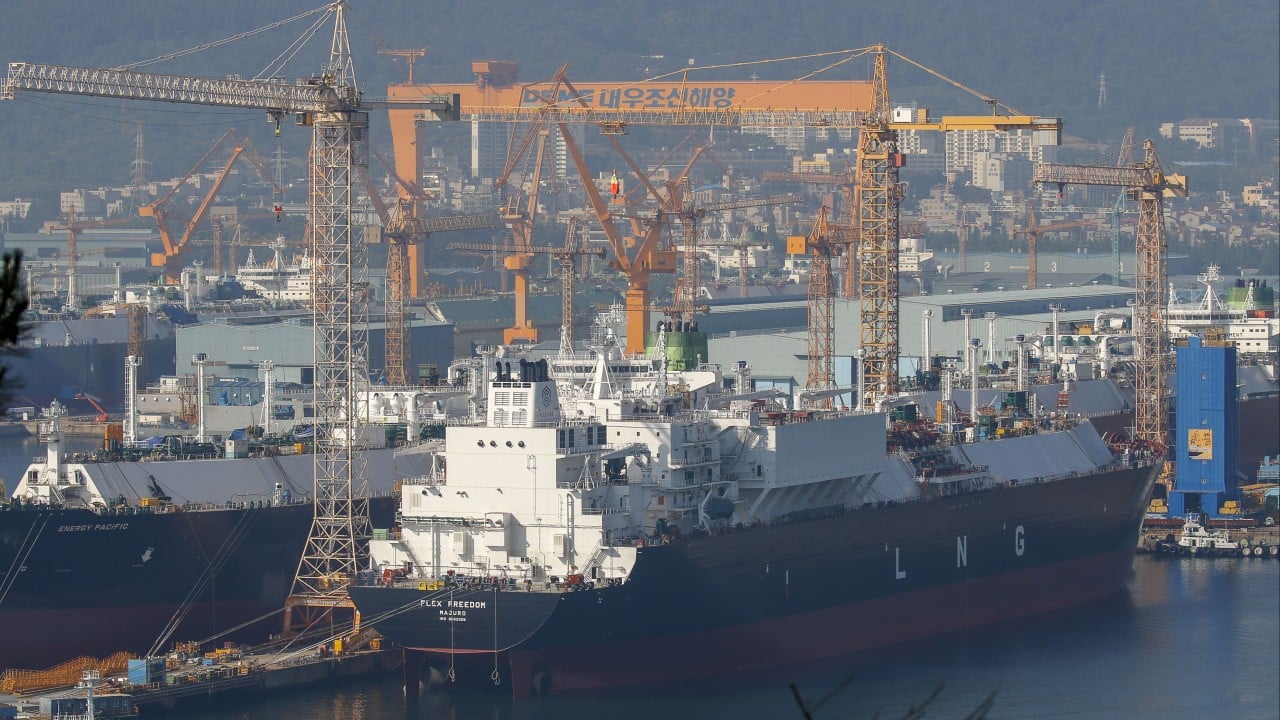
- Invar and Membrane Systems: The dominant technology, GTT’s No. 96 or Mark III membrane systems, requires high-precision welding of Invar (a nickel-iron alloy with a low coefficient of thermal expansion). Japan’s labor shortage in the specialized welding sector creates a massive upward pressure on the "Cost per Deadweight Ton."
- Boil-Off Rate (BOR) Optimization: Modern carriers must maintain a BOR of less than 0.085% per day. Achieving this requires advanced insulation thickness and reliquefaction plants that Japanese yards have not integrated at scale for nearly a decade.
- Scale Economies vs. Specialized Design: South Korean yards thrive on "Series Construction," building 10-20 identical hulls to amortize engineering costs. Japan’s domestic needs are often for "Specially Purpose" vessels—smaller drafts for specific Japanese ports or reinforced hulls for ice-breaking. This lack of standardization makes Japanese-built ships 20-30% more expensive than their Korean counterparts.
The Strategic Logic of Sovereign Shipbuilding
The argument for Japan mulling its own LNG carriers is not based on achieving price parity with China; it is based on the Value of Certainty. In a scenario where the Strait of Hormuz is closed or Iranian energy exports are completely sanctioned, the global demand for LNG carriers will skyrocket.
If Japan does not possess the internal capability to manufacture these vessels, it faces a multi-year lead time at foreign yards. By the time a foreign yard can deliver a ship, the energy crisis may have already caused irreversible damage to the Japanese industrial base.
The "Sovereign Vessel Function" can be expressed as:
$$V_s = (C_m - C_d) + P_{risk}$$
Where:
- $V_s$ is the Strategic Value of domestic production.
- $C_m$ is the Market Cost of a foreign vessel.
- $C_d$ is the Domestic Cost.
- $P_{risk}$ is the quantified Risk Premium of being unable to secure a vessel during a global shortage.
When $P_{risk}$ is high—as it is during an Iran-centric energy crisis—the total value of domestic production turns positive even if $C_d$ significantly exceeds $C_m$.
Structural Barriers to Re-Industrialization
The primary obstacle is not lack of capital, but the Structural Rigidity of the Japanese Supply Chain.
The "Second Limitation" is the fragmentation of the Japanese shipbuilding industry. Unlike the consolidated South Korean giants, Japanese yards are often smaller and siloed. To compete, they must move toward a Consortium Model. Mitsubishi Shipbuilding, Nihon Shipyard (a joint venture between Imabari and JMU), and Kawasaki Heavy Industries must synchronize their R&D to share the burden of developing next-generation propulsion, such as Ammonia-ready or Hydrogen-hybrid engines.
The "Third Limitation" involves the labor force. The average age of a master welder in Nagasaki or Imabari is trending upward, while the transfer of tacit knowledge—the "know-how" of managing cryogenic stresses—is stalling. Without a state-backed program to subsidize the training of a new generation of cryogenic engineers, the hardware (the shipyard) will remain idle regardless of the order book.
Energy Diversification and the Iranian Variable
The Iranian energy crisis acts as a catalyst because it disrupts the "Fixed Path" of Japanese energy. Historically, Japan viewed LNG as a bridge fuel. However, if the bridge is constantly threatened by regional hegemons, the bridge itself must be reinforced.
Building domestic LNG carriers allows Japan to:
- Access the Arctic: Investing in ice-classed LNG carriers allows Japan to tap into Yamal or North American Arctic gas, bypassing the Middle East entirely.
- Stabilize the Balance of Payments: Paying domestic yards for ships keeps capital within the Japanese economy, offsetting the massive trade deficit caused by high energy prices.
- Hedge Against Currency Volatility: Vessel contracts are typically denominated in USD. Domestic production allows for more complex yen-denominated financing structures, reducing the impact of a weak Yen on long-term capital expenditures.
The Technological Pivot: Beyond Traditional LNG
The strategic play is not to build "yesterday’s" LNG carrier. If Japan is to re-enter the market, it must leapfrog current designs. This involves focusing on Multi-Fuel Flexibility.
The next generation of vessels must be capable of transporting not just LNG, but also Liquefied CO2 (LCO2) for Carbon Capture and Storage (CCS) projects, or Ammonia for co-firing in coal plants. By building a "Multi-Liquid Gas Carrier" platform, Japan can solve its immediate LNG transport problem while simultaneously building the infrastructure for its 2050 Carbon Neutrality goal.
This creates a "Dual-Use" industrial base. The same shipyard capacity that builds LNG carriers during an Iran-induced energy crisis can be pivoted to build Ammonia carriers as the energy transition matures. This modularity reduces the risk of these yards becoming stranded assets.
The Final Strategic Calculation
Japan’s move to build its own LNG carriers is a recognition that the "Market" cannot solve security problems. The invisible hand of the market will always favor the cheapest ship, which currently comes from a competitor. However, the "Visible Hand" of the state must favor the most secure ship.
The immediate tactical requirement is the formation of a National Maritime Task Force consisting of the Ministry of Economy, Trade and Industry (METI), major shipping lines (NYK, MOL, K-Line), and the primary shipbuilders. This task force must move beyond "mulling" and initiate a subsidized "Lead Ship" program.
This program should focus on three specific milestones:
- Standardization of the "Japan-Max" Hull: A design optimized for Japanese port constraints and high-efficiency reliquefaction.
- Digital Twin Integration: Using IoT sensors to reduce crew requirements, addressing the maritime labor shortage.
- Strategic Steel Reservation: Securing domestic supplies of high-nickel steel to insulate shipbuilders from global commodity price spikes.
The window for this re-industrialization is narrow. As South Korea and China move toward autonomous shipping and even larger scale-economies, Japan’s opportunity to reclaim a share of the cryogenic transport market is tied directly to the duration of the current energy instability. The crisis in Iran is the signal; the shipbuilding program is the response. Failure to act now ensures that Japan will remain a hostage to both the geography of the Middle East and the industrial capacity of its neighbors.