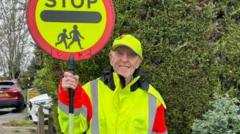
The asphalt on a Tuesday morning in Nuneaton doesn’t usually hold much poetry. It is a gray, utilitarian stretch of road, damp with the persistent English mist and loud with the impatient thrum of diesel engines. But for nearly three decades, this specific patch of ground has been a sanctuary. At the center of it stands a man whose bones are older than the neighborhood's modern history, clutching a pole topped with a luminous yellow disc.
Terry Tooms is ninety-one. For twenty-eight years, he has been the human barrier between the heavy kinetic energy of morning traffic and the fragile, bouncing lives of schoolchildren. To the passing driver, he is a "lollipop man," a quaint relic of a civic duty that feels increasingly out of step with a high-speed, automated world. To the community, he has been the clock by which they set their lives.
He didn’t start this job to make history. He started it because, after a lifetime of labor, a man needs a reason to put on his boots in the morning. What began as a way to stay busy became a twenty-eight-year vigil. Think about that span of time. A child who Terry safely crossed during his first week on the job is now a thirty-five-year-old adult, perhaps sitting in one of those idling cars, watching the same man guide their own child across the blacktop.
The stakes are invisible until they aren’t. We take for granted the safety of a crosswalk, treating it as a painted legal fiction. But in reality, a school crossing is a theater of high-stakes physics. You have two-ton masses of steel moving at thirty miles per hour, operated by humans who are often distracted, caffeinated, or running late. On the curb, you have three-foot-tall bundles of energy who haven't yet mastered the concept of momentum or mortality. Terry Tooms was the bridge between those two worlds. He was the friction that slowed the world down.
Retirement at ninety-one isn't a typical career move. Most people have surrendered to the armchair or the garden long before they hit their ninth decade. But Terry’s hands, though weathered and perhaps a bit stiff in the winter chill, never wavered when he raised that sign. There is a specific kind of authority that comes with age. When a man of ninety-one steps into the road, the world stops. It’s not just the law; it’s a reflexive, ancestral respect for a guardian who has seen more of life than most of the drivers combined.
The equipment is simple. A high-vis jacket that has seen a thousand rainstorms. A hat to keep the frost off. The pole. But the real tool of the trade is the eye contact. Terry’s job was never just about the sign. It was about catching the eye of the man in the silver SUV and making sure he saw the toddler with the oversized backpack. It was about the brief nod to the tired mother, a silent signal that says: I have them. They are safe for these twenty feet.
Consider the sensory reality of twenty-eight years on a British roadside. The smell of exhaust and wet pavement. The bite of January wind that whistles through the gaps in a coat. The relentless, cheerful "Good morning, Terry!" shouted by hundreds of voices over the decades. He has stood there through five Prime Ministers, several economic crashes, and a global pandemic. While the world outside Nuneaton spiraled into digital chaos and political upheaval, Terry remained a constant.
He is part of a vanishing breed of public servants. In an era where we look toward "smart" intersections and automated sensors to keep us safe, there is no technological substitute for a grandfatherly figure who knows the names of the local dogs and which kid is likely to bolt if they see a butterfly. You can’t program twenty-eight years of neighborhood intuition into an algorithm.
The final patrol wasn't marked by a brass band or a government motorcade. It was marked by the people. They came because Terry represents something we are terrified of losing: the idea that we are responsible for one another. When he stepped into the road for that last time, he wasn't just clearing a path for a few kids. He was closing a chapter on a lifetime of quiet, unglamorous heroism.
There is a weight to that yellow sign. It’s not heavy in terms of pounds, but it carries the responsibility of thousands of safe arrivals. Every day Terry went home, his "success" was measured by the fact that nothing happened. No accidents. No close calls. Just a boring, perfectly safe morning. In the world of public safety, "boring" is the highest possible achievement. Terry Tooms has been spectacularly boring for nearly three decades.
As he hung up the jacket, the street didn't change. The cars still hissed over the wet tar. The school bells still rang. But there is a sudden, sharp emptiness on that corner. The air feels a little less guarded.
He walked away from the curb not as a man who was tired, but as a man who had finished his watch. The jacket is folded. The sign is stowed. In the quiet of his home, far from the roar of the morning commute, Terry Tooms can finally let the world look after itself. But for those who crossed with him, the road will always feel a little longer, and the morning a little colder, without the old man in the yellow coat holding back the tide.
He didn't just cross children; he held time still.
The morning sun finally broke through the clouds, hitting the empty spot on the pavement where he used to stand. It looked like any other piece of road. But it wasn't. It was the site of twenty-eight years of kept promises.



:max_bytes(150000):strip_icc()/sq-0aff8b108dee456fafa106076608f3b2.jpg)