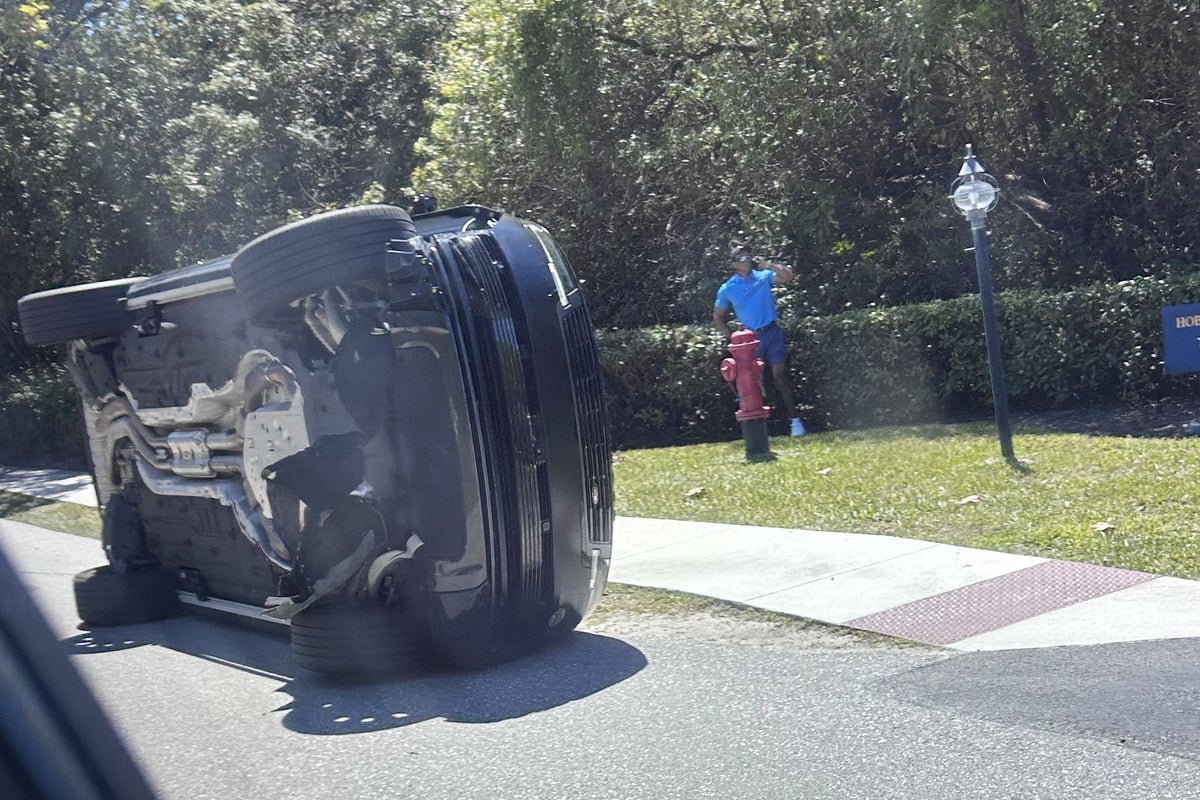
The survival of a high-speed vehicular rollover is not a matter of luck but a function of energy management and structural preservation. When Tiger Woods' Genesis GV80 left the roadway in Rolling Hills Estates, the event initiated a complex sequence of energy transfers where the vehicle's safety systems were forced to counteract the massive kinetic energy generated by a 6,000-pound SUV traveling at speeds significantly exceeding the 45 mph limit. The fundamental physics of this crash provide a blueprint for understanding modern automotive safety engineering and the specific variables that dictate the margin between a fatal outcome and a survivable trauma.
The Mechanics of Kinetic Energy and Impact Forces
To analyze the severity of the crash, one must first quantify the energy involved. Kinetic energy is defined by the formula $E_k = \frac{1}{2}mv^2$. Because velocity is squared, a vehicle traveling at 80 mph carries nearly four times the destructive energy of a vehicle traveling at 40 mph.
In this specific incident, the vehicle crossed a center median, struck a curb, and hit a tree before rolling multiple times. Each of these interactions acted as a "load case" for the vehicle's chassis. The primary objective of the GV80's design was to manage the deceleration pulse—the rate at which the vehicle loses its velocity. If a vehicle stops instantly against a rigid object, the G-forces exerted on the internal organs are typically unsurvivable. By hitting "soft" targets like brush and then rolling, the vehicle dissipated its energy over a longer duration and distance, reducing the peak force experienced by the occupant.
The Safety Cell vs. The Crumple Zone
The survival of the driver was predicated on the maintenance of the "survival space," also known as the safety cell. Modern luxury SUVs utilize ultra-high-strength steel (UHSS) and hot-stamped components to ensure that while the front and rear of the car deform (the crumple zones), the passenger compartment remains rigid.
- Front-End Deformation: The initial impact with the curb and vegetation utilized the front longitudinal members to absorb the first wave of energy.
- Structural Integrity: Despite the rollover, the A and B-pillars of the vehicle did not collapse. This prevented the roof from intruding into the cabin, a common cause of cervical spine injuries in older vehicle models.
- Internal Restraint Systems: The deployment of 10 airbags, including the knee airbag, served as a secondary energy management system. The knee airbag is critical in preventing the driver's lower extremities from being crushed by the steering column or dashboard during a frontal-offset impact.
Pathological Implications of Lower Extremity Trauma
The injuries sustained—specifically comminuted open fractures to the tibia and fibula—indicate a "footwell intrusion" or a massive transfer of force through the floorboard. A comminuted fracture means the bone has splintered into several pieces, which typically suggests a high-velocity impact where the bone's structural threshold was exceeded instantaneously.
The surgical intervention involved the insertion of a rod into the tibia to stabilize the bone, while the foot and ankle were stabilized with a combination of screws and pins. The "open" nature of the fracture (bone protruding through the skin) introduces a high risk of osteomyelitis (bone infection) and requires extensive soft tissue debridement. From a physiological standpoint, the trauma to the muscle and soft tissue—often resulting in Compartment Syndrome—necessitated a surgical release of the covering of the muscles to relieve pressure.
This type of injury pattern is consistent with "pedal-slap" or floorboard deformation where the driver’s foot is planted on the brake pedal at the moment of impact. The force travels up the leg, bypassing the vehicle's external energy absorbers and using the human skeletal structure as a load-bearing member.
The Human Factor and Operational Decision Making
The absence of skid marks at the scene suggests a lack of braking or "panic steering," pointing toward a period of driver inattention or delayed perception-reaction time. In human factors engineering, the perception-reaction time (PRT) is the interval between the occurrence of a hazard and the initiation of a physical response.
- Environmental Factors: The stretch of Hawthorne Boulevard where the crash occurred is a steep, winding downhill grade known locally for high-speed transit.
- Systemic Failure: The vehicle’s Advanced Driver Assistance Systems (ADAS), such as Forward Collision-Avoidance, are designed to detect obstacles but may have been bypassed or overwhelmed if the vehicle was already in a state of loss-of-control or if the closing speed exceeded the system's operational parameters.
Probabilistic Outcomes of Recovery
The recovery of an elite athlete from multi-level lower extremity trauma follows a non-linear trajectory. The primary bottleneck is not the bone healing, but the restoration of the neuro-muscular pathway and joint mobility.
Phase 1: Structural Union
The first 12 weeks focus on bone union and the prevention of infection. The use of an intramedullary rod provides internal bracing, but the vascularity of the lower tibia is notoriously poor, often leading to "non-union" or delayed healing.
Phase 2: Range of Motion and Hypertrophy
Once weight-bearing is permitted, the challenge shifts to the ankle joint. Screws and pins in the foot often lead to post-traumatic arthritis. For a professional golfer, the lead leg (the left leg for a right-handed golfer) is subjected to massive rotational torque during the downswing. The trailing leg (the right leg, which was injured in this case) is responsible for lateral push-off and stabilizing the finish.
Phase 3: Proprioceptive Re-education
The most difficult aspect of recovery from such trauma is the loss of proprioception—the body’s ability to sense its position in space. Damage to the mechanoreceptors in the ankle ligaments means the brain must be retrained to balance and shift weight during a high-velocity athletic movement.
Strategic Assessment of Modern SUV Safety Limits
The Genesis crash serves as a case study in the limits of passive safety. While the vehicle successfully protected the occupant’s vital organs and cranium, it could not fully mitigate the forces directed at the extremities. This highlights a gap in current safety testing: while NCAP and IIHS tests evaluate "standard" crash configurations, real-world "off-roadway" excursions involve irregular angles and multiple impacts that can circumvent traditional energy-absorbing structures.
The vehicle’s Black Box (Event Data Recorder) captures inputs such as steering angle, throttle position, and brake pressure in the five seconds leading up to the crash. This data serves as the definitive record, stripping away the subjectivity of witness accounts.
In analyzing the trajectory of the crash, the vehicle’s high center of gravity—inherent to all SUVs—was a contributing factor to the rollover once the lateral force exceeded the tire’s grip limit during the median crossing. Had the vehicle been a low-slung sedan, it likely would have skidded or spun rather than rolled, potentially changing the energy dissipation profile from a multi-surface roll to a single-side impact.
The long-term strategic play for automotive manufacturers involves the integration of "pre-safe" systems that can predict a departure from the roadway before it occurs, using GPS and topographical data to automatically reduce speed in high-risk zones. For the individual, the takeaway is the sobering reality that even the most advanced structural engineering cannot override the laws of physics when velocity reaches a critical threshold.
The path forward for the athlete involves a transition from acute surgical management to a multi-year rehabilitative cycle where the primary goal is not the return to sport, but the restoration of basic gait mechanics and the mitigation of permanent limb-length discrepancy or chronic regional pain syndrome. Any return to competitive golf must be viewed through the lens of mechanical compensation; the swing will have to be rebuilt to accommodate a diminished range of motion in the right ankle, likely resulting in a more upper-body-dominant strike and reduced clubhead speed.