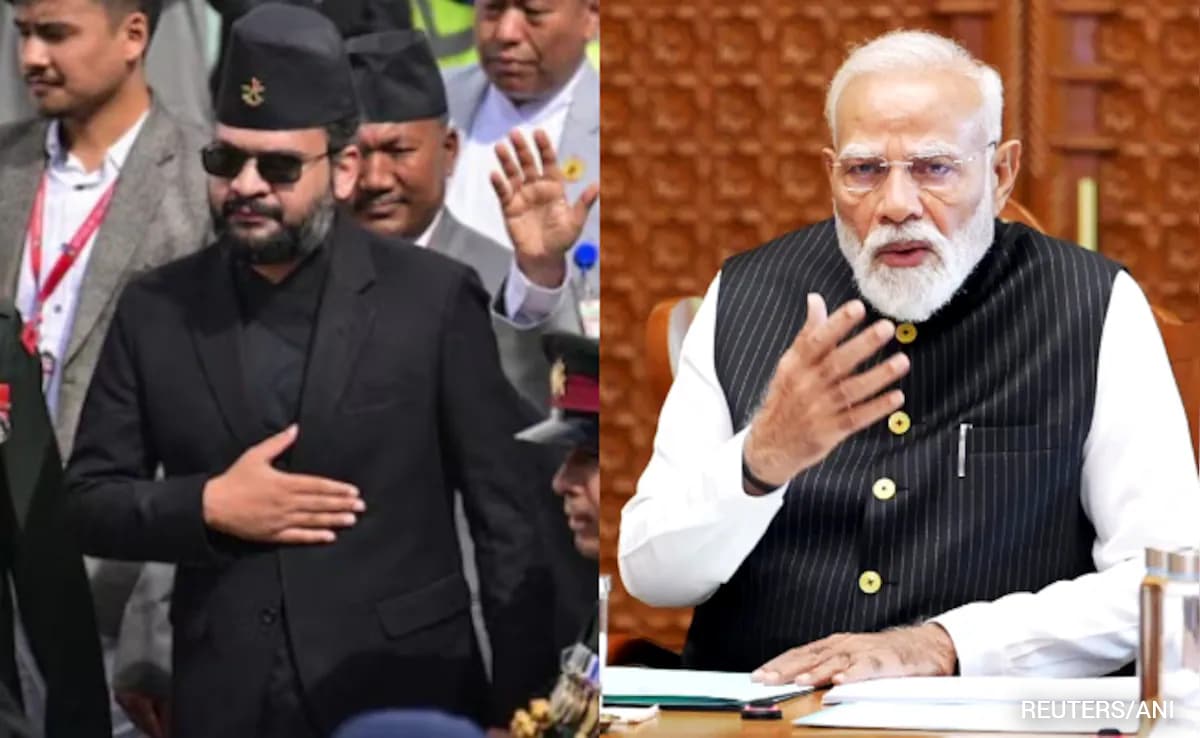
The headlines currently circulating regarding a "Prime Minister Balen Shah" thanking Indian Prime Minister Narendra Modi are not just premature. They are a fundamental misreading of the current Nepali political structure. Balen Shah is the Mayor of Kathmandu, not the Prime Minister of Nepal. However, the international confusion surrounding his title points to a much deeper, more volatile reality in Himalayan politics. Shah’s rising influence has become so outsized that foreign observers—and perhaps a few nervous power brokers in New Delhi—are already treating him as the de facto face of a new Nepal.
This confusion stems from a specific diplomatic exchange where Modi extended greetings to the people of Nepal and its leadership. Balen Shah, ever the master of digital optics, responded with a public statement expressing an eagerness to work closely on shared interests. To the uninitiated, it looked like a head-of-state interaction. In reality, it was a calculated maneuver by a municipal leader who is currently more popular than the actual Prime Minister, Pushpa Kamal Dahal, also known as Prachanda.
The Sovereign Mayor and the Diplomatic Friction
Balen Shah’s rise is a nightmare for traditional diplomacy. Unlike the old-school politicians of the Nepali Congress or the CPN-UML, who have decades of transactional relationships with Indian and Chinese intelligence and diplomatic corps, Shah operates on a mandate of unapologetic sovereignty. This makes his "thank you" to Modi more than just a polite gesture. It is a signal of his intent to bypass the central government of Nepal and deal directly with international stakeholders.
Historically, the relationship between India and Nepal has been a delicate balancing act of geopolitical influence and cultural proximity. When Balen Shah thanks Narendra Modi for his greetings, he isn't just speaking for a city of 1.4 million people. He is speaking for a generation of Nepalis who feel the central government has failed them. This is the source of the "Prime Minister" confusion. To his supporters, he is the only leader who acts with the authority of a national executive.
The tension between Kathmandu and New Delhi often centers on two issues: the border and water. Balen Shah’s public persona is built on a nationalist foundation that does not easily bend to external pressure. His willingness to "work closely" with India is likely conditional on a respect for Nepali autonomy that the previous generation of leaders was often accused of compromising for the sake of political survival in Kathmandu.
Why the World Thinks Balen is Already in Charge
The current Prime Minister of Nepal, Prachanda, leads a fragile coalition that seems to change its internal configuration every few months. This instability has created a vacuum. While the central government spends its energy on survival, Balen Shah is clearing the streets, digitizing the municipal bureaucracy, and taking a hard line on local development.
The perception of Shah as a national leader is bolstered by his massive social media following and his background as a structural engineer and rapper. He represents a technocratic populism that is rare in South Asia. When a world leader like Modi acknowledges Nepal, Shah’s response often carries more weight with the youth and the diaspora than the official communiques from the Ministry of Foreign Affairs.
However, the path from Mayor to Prime Minister is not as straightforward as his followers might hope. Nepal's parliamentary system requires a party infrastructure that Shah currently lacks. He ran as an independent, and while his movement is growing, he does not yet have the legislative numbers to challenge for the Prime Minister’s office. The confusion in the media about his title is a reflection of his gravitas, not his current constitutional position.
The Indian Perspective on the New Guard
For New Delhi, the rise of an unpredictable, nationalist leader like Balen Shah is a complication. India has long preferred to deal with the "Big Three" parties in Nepal because their patterns are predictable. Balen Shah is a wild card. His recent exchange with Modi indicates a pragmatism that many didn't expect from him.
India is acutely aware that Nepal is a critical buffer zone between itself and China. Any shift in leadership—even at the municipal level in the capital—has implications for regional security. The "work closely" phrase in Shah’s response is a classic piece of diplomatic language that hides as much as it reveals. It suggests a willingness to cooperate on infrastructure projects, but it stops short of the subservience that nationalist critics in Nepal often fear.
The real story here isn't just a mislabeled headline. It’s the fact that the geopolitical center of gravity in Nepal is shifting away from the old guard. If foreign media outlets are already calling Balen Shah the "PM," it means the narrative has already shifted. The people of Nepal are increasingly looking to Kathmandu’s City Hall for the kind of leadership they used to expect from the Prime Minister’s residence at Baluwatar.
Managing the Misinformation Loop
The speed at which the "PM Balen Shah" story spread highlights a significant flaw in the modern information cycle regarding South Asian politics. Because Shah is the most visible Nepali leader on the global stage, search algorithms and poorly researched news briefs often default to the highest possible rank for him. This is more than a clerical error; it is a symptom of how global audiences consume political news from smaller nations.
To understand the actual state of play, one must look at the Constitutional Constraints that Shah currently faces. To become the actual Prime Minister, he would need to:
- Form or lead a political party.
- Win a seat in the House of Representatives.
- Command a majority or lead a coalition in that House.
None of this has happened yet. Yet, the fact that he is engaging with Modi on this level shows that he is already preparing for that eventual transition. He is building his international profile before he even has the domestic office to match it.
The Economic Implications of a Shah Leadership
If we look at the business and trade relationship between India and Nepal, a leader like Shah brings both risk and opportunity. India is Nepal’s largest trading partner. The transit of goods through the Raxaul-Birgunj border is the lifeblood of the Nepali economy.
A "Prime Minister Shah" would likely demand a renegotiation of trade terms. He has already shown a penchant for enforcing local laws with a rigor that has upset established business interests in Kathmandu. Extending that to the national level would mean a focus on domestic production over imports, a move that would directly affect Indian exporters.
The "thanks for the greetings" exchange is a soft opening to what could be a very hard-nosed negotiation period in the coming years. Shah understands that he cannot lead Nepal into prosperity by being an isolationist. He needs India for energy exports and trade routes. But he also knows that his domestic popularity depends on his ability to stand up to "the big brother" to the south.
Regional Stability and the China Factor
While the current conversation is focused on the Modi-Shah interaction, China is watching closely. Beijing has significantly increased its footprint in Nepal through the Belt and Road Initiative (BRI). The traditional parties have been adept at playing India and China against each other to extract concessions.
Balen Shah’s approach to China is still being defined, but his nationalist rhetoric suggests he might be less willing to play the "Great Game" in the traditional sense. He appears more focused on internal strength than external patronage. This makes him a unique figure in Himalayan politics: a leader who may actually mean what he says when he talks about sovereignty.
The international community, including India, is trying to figure out if Shah is a flash in the pan or a permanent fixture. By responding to Modi, Shah has effectively forced his way into the national conversation on foreign policy, an area usually reserved for the Prime Minister and the Foreign Minister.
The Ground Reality in Kathmandu
In the narrow alleys of Ason and the wide boulevards of New Baneshwor, the "PM" title isn't seen as a mistake—it's seen as a prophecy. Shah’s success in Kathmandu has been built on tangible results. He has focused on waste management, cultural preservation, and the removal of illegal structures. These are local issues, but in a country where the central government often fails to provide basic services, they take on a national significance.
The danger for Shah is that the hype might outpace his ability to deliver. The "Prime Minister" confusion sets an incredibly high bar for a man who is still technically just an urban administrator. If he cannot translate his municipal success into a national movement, the very titles being thrust upon him today will be used as a critique of his "failed ambition" tomorrow.
The Future of the Modi-Shah Relationship
The relationship between Narendra Modi and the leadership in Kathmandu has always been a mix of religious kinship and political friction. Modi’s "neighborhood first" policy has seen significant investment in Nepal, but it has also seen moments of deep tension, such as the 2015 blockade.
Balen Shah represents a generation that remembers that blockade vividly. His "eager to work closely" message is a diplomatic olive branch, but it is one held by a man who has made a career out of not backing down. This isn't just about greetings; it's about the renegotiation of the Himalayan power dynamic.
The world should stop looking at the title and start looking at the influence. Whether he is called Mayor or Prime Minister, Balen Shah is currently the most significant political actor in Nepal. His interactions with India will define the next decade of South Asian diplomacy. The confusion over his title is simply the world catching up to the fact that the old rules of Nepali politics no longer apply.
Watch the upcoming local election cycles and the formation of new political alliances in Kathmandu. That is where the real "Prime Minister" campaign is actually happening.