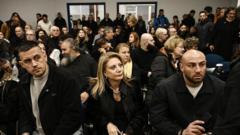
The cameras are positioned. The weeping families are seated in rows. The lawyers are sharpening their pencils for a marathon of procedural gymnastics. Most news outlets are framing the trial of the 2023 Tempi train crash as a quest for "justice." They are wrong.
This isn't justice. It is a sacrificial ritual designed to protect a system that is fundamentally broken. By focusing on the negligence of a handful of station masters and technicians, the Greek state and the broader European rail community are performing a massive sleight of hand. They want you to look at the "human error" so you don’t look at the structural rot that made that error inevitable. Recently making waves recently: The Kinetic Deficit Dynamics of Pakistan Afghanistan Cross Border Conflict.
If you think putting fifty people in prison will prevent another head-on collision, you haven't been paying attention to how modern infrastructure actually functions.
The Myth of the "Human Error"
The media loves a villain. A station master who went to a party. A technician who left a switch in the wrong position. It’s a clean narrative. It allows the public to believe that if we simply hire "better people," the trains will run safely. Additional insights into this topic are covered by The New York Times.
This is a lie.
In any high-consequence industry—aviation, nuclear power, rail—"human error" is never the cause. It is the symptom. I have spent years looking at system failures, and the pattern is always the same. You build a system that relies on a single person being perfect 100% of the time, and then you act shocked when they fail.
The Tempi crash wasn't a tragedy of individual incompetence. It was a mathematical certainty. When you operate a high-speed rail line without functional automated signaling, remote monitoring, or an operational European Rail Traffic Management System (ERTMS), you are effectively playing Russian Roulette with a hundred-ton revolver.
The Cost of Cheap Signaling
Let’s talk about the math of safety.
- Scenario A: A human operator monitors a screen for 12 hours. Probability of a lapse in judgment over a career: 100%.
- Scenario B: A digital interlock prevents two trains from occupying the same block of track. Probability of failure: Negligible, provided the hardware is maintained.
Greece spent billions on rail upgrades. Where did the money go? It went into the pockets of contractors and the coffers of political campaigns while the actual safety systems—the ones that would have automatically stopped those trains regardless of what the station master did—remained "under construction" for a decade.
The trial is a distraction from the fact that the Hellenic Railways Organization (OSE) and ERGOSE presided over a graveyard of unfinished contracts. Every day that trial continues, the people who signed off on those incomplete safety systems are breathing a sigh of relief. The spotlight is on the guy in the signal box, not the guy in the ministerial office.
Stop Asking for "Closure" and Start Demanding Redundancy
The families want closure. They want someone to pay. That is a human response, but it’s a bad policy.
In the aftermath of the crash, the "People Also Ask" sections of the internet were flooded with questions like, "Was the station master trained?" or "How could they miss a train on the tracks?" These are the wrong questions. The right question is: "Why was it possible for a train to be on the wrong track without an alarm sounding in three different locations?"
If your safety protocol involves one person looking at a screen and hoping they don't get a headache, you don't have a protocol. You have a prayer.
The Institutional Inertia of European Rail
This isn't just a Greek problem. It is a European tragedy wrapped in a layer of Greek bureaucracy. The European Union has poured money into the Mediterranean corridors for years. Yet, we see a recurring theme: national operators prioritize the "look" of modern rail—fast trains and shiny stations—over the "guts" of the system.
The ERTMS was supposed to be the Great Equalizer. It’s a system designed to make human error irrelevant. If a train exceeds a speed limit or passes a red signal, the system takes over. It’s been in development and rollout for decades. In Greece, it was a ghost.
I’ve seen this before in dozens of infrastructure projects. The "invisible" safety tech is always the first thing to be delayed when budgets get tight or when a project manager needs to hit a milestone. You can’t cut a ribbon on a signaling cabinet. You can’t take a PR photo with a software update. So, the politicians focus on the trains, and the software—the part that keeps people alive—is treated as an optional luxury.
The Courtroom as a Shield
The trial is currently being treated as a path to truth. It’s actually a way to bury it.
When you prosecute 54 individuals simultaneously, you create a legal fog. The defense for the lower-level employees will be—rightly—that they were working in a broken environment. The defense for the higher-ups will be that they weren't informed of the specific technical failures on that specific night.
By the time the appeals are over and the sentences are handed down, the public's rage will have cooled. A few mid-level managers might serve time. The political class will have moved on to the next election. And the system? The system stays the same because "justice" was served.
What Real Accountability Looks Like
If we wanted to actually fix the rail system, the trial wouldn't be about one night in Tempi. It would be a forensic audit of every euro spent on rail safety since 2014.
- Claw back the funds: Every contractor who failed to deliver functional signaling systems should be barred from public tenders and forced to refund the state.
- Mandatory Automation: No train should be allowed to exceed 60 km/h on a line that doesn't have active, automated collision avoidance. If the tech isn't ready, the train doesn't run fast. Period.
- Criminalize Negligent Oversight: We shouldn't just be looking at the station master. We should be looking at the auditors who signed off on "completed" safety stages that didn't exist.
The Hard Truth About Rail Travel
People want to believe that rail is the "safe" alternative to driving. Statistically, it is. But that safety is an illusion when the underlying technology is bypassed.
The most "contrarian" take I can give you is this: The Tempi crash was not an accident. An accident is an unforeseen event. This was a predictable outcome of a deliberate choice to prioritize speed and politics over failsafe engineering.
We are currently watching a legal theater designed to convince us that the "bad apples" have been removed. But the orchard is still poisoned. As long as we accept a system where safety is a line item that can be deferred to the next fiscal year, we are all just passengers on a train with no brakes.
The Illusion of Progress
The trial will last months. It will produce thousands of pages of testimony. It will dominate the headlines in Athens and Brussels. And yet, if you go to a train station in Europe today and ask if the ERTMS is fully operational on every high-speed line, the answer will still be a messy "mostly" or "soon."
"Mostly" is how people die.
The status quo is a world where we blame the person at the end of the chain because it's easier than admitting the chain was never built. We find it easier to prosecute a man for being tired or distracted than to prosecute a government for failing to install a computer that never gets tired and never gets distracted.
The trial is a performance. The real crime is that the trains are still running on the same logic that failed that night. They’ve added some more staff, sure. They’ve lowered some speeds. But they haven't replaced the fundamental flaw: the reliance on human perfection.
If you’re looking for justice in that courtroom, you’re looking in the wrong place. Justice isn't a verdict. Justice is a signal that turns red when it's supposed to.
Everything else is just noise.